
1D0-541 Online Practice Questions and Answers
Consider the Recreation relation shown in the exhibit. You need to apply a SQL statement to the
Recreation relation that will return the following data:
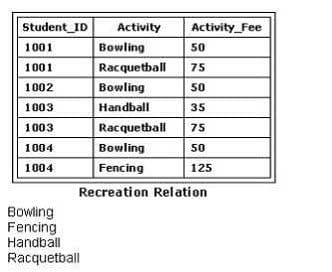
Which SQL statement applied to the Recreation relation will return this data?
A. SELECT Activity FROM Recreation;
B. SELECT DISTINCT Activity FROM Recreation;
C. SELECT Activity FROM Recreation WHERE NOT LIKE Activity;
D. SELECT Activity FROM Recreation WHERE DISTINCT Activity;
Which area of database security involves maintaining access to enterprise data?
A. Integrity
B. Privacy
C. Availability
D. Confidentiality
A. A set of normalized relations
B. A reviewed entity-relationship (ER) model
C. An entity-relationship (ER) model with no redundant data
D. A set of denormalized relations
Consider the Orders relation shown in the exhibit. Which of the following SQL statements would return all complete tuples for order dates in 2002, arranged by amount from lowest to highest?
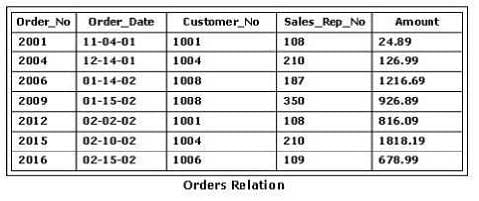
A. SELECT * FROM Orders WHERE Order_Date LIKE _02 ORDER BY Amount;
B. SELECT (Order_Date, Amount) FROM Orders WHERE Order_Date LIKE %02 ORDER BY Amount;
C. SELECT * FROM Orders WHERE Order_Date LIKE _02 ORDER BY Order_No;
D. SELECT * FROM Orders WHERE Order_Date LIKE %02 ORDER BY Amount;
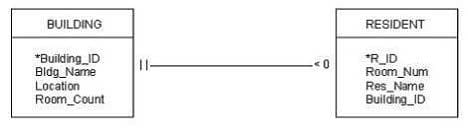
Consider the Information Engineering diagram shown in the exhibit. Building_ID, R_ID, Room_Count and Room_Num are integer numbers, whereas Bldg_Name, Location and Res_Name are all represented by variable-length strings with a maximum of 20 characters.
Which SQL statement best implements the RESIDENT relation shown in this diagram?
A. CREATE TABLE RESIDENT ( R_ID INTEGER NULL PRIMARY KEY, Room_Num FLOAT, Res_Name VARCHAR, Building_ID INTEGER NULL, FOREIGN KEY Building_ID REFERENCES BUILDING (Building_ID));
B. CREATE TABLE RESIDENT ( R_ID INTEGER NOT NULL PRIMARY KEY, Room_Num BINARY, Res_Name VARCHAR (20), Building_ID INTEGER NOT NULL, FOREIGN KEY Building_ID REFERENCES BUILDING (Building_ID));
C. CREATE TABLE RESIDENT ( R_ID INTEGER NOT NULL PRIMARY KEY, Room_Num INTEGER, Res_Name VARCHAR (20), Building_ID INTEGER NOT NULL);
D. CREATE TABLE RESIDENT ( R_ID INTEGER NOT NULL PRIMARY KEY, Room_Num INTEGER, Res_Name VARCHAR (20), Building_ID INTEGER NOT NULL, FOREIGN KEY Building_ID REFERENCES BUILDING (Building_ID));
Consider the entity-relation (ER) diagram shown in the exhibit. When the logical database design phase is completed, which of the following is a valid DBDL description of the base relations for the ER diagram?
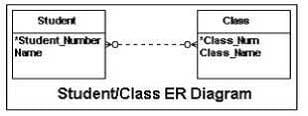
A. STUDENT( Student_Number: integer NOT NULL Name: variable length character string length 20 NOT NULL) Primary Key Student_Number CLASS( Class_Num: integer NOT NULL Class_Name: integer NOT NULL) Primary Key Class_Num
B. STUDENT( Student_Number: integer NOT NULL Name: variable length character string length 20 NOT NULL) Primary Key Student_Number CLASS( Class_Num: integer NOT NULL Class_Name: integer NOT NULL) Primary Key Class_Num Foreign Key Class_Num References STUDENT
C. STUDENT( Student_Number: integer NOT NULL Name: variable length character string length 20 NOT NULL) Primary Key Student_Number STU_CLASS( Student_Number: integer NOT NULL Class_Num: integer NOT NULL) Primary Key Student_Number CLASS( Class_Num: integer NOT NULL Class_Name: integer NOT NULL) Primary Key Class_Num
D. STUDENT( Student_Number: integer NOT NULL Name: variable length character string length 20 NOT NULL) Primary Key Student_Number STU_CLASS( Student_Number: integer NOT NULL Class_Num: integer NOT NULL) Primary Key Student_Number CLASS( Class_Num: integer NOT NULL Class_Name: integer NOT NULL) Primary Key Class_Num
Consider the following relations shown in the exhibit. Which of the following SQL statements would return the Customers2 relation from the Customers relation?

A. SELECT * FROM Customers WHERE Satisfaction_Rate <= 80 OR Satisfaction_Rate >= 90;
B. SELECT * FROM Customers WHERE Satisfaction_Rate IN (80 AND 90);
C. SELECT * FROM Customers WHERE Satisfaction_Rate >= 80 AND Satisfaction_Rate <= 89;
D. SELECT * FROM Customers WHERE Satisfaction_Rate BETWEEN (80, 90);
What is the most important service provided by a database management system?
A. Provides support for a data manipulation language
B. Allows users to store data in a distributed data repository
C. Provides support for data formatting language commands
D. Translates procedural commands into non-procedural commands
Consider the table for an employee database shown in the exhibit. What is the degree of the table?
A. 25
B. 5
C. 4
D. 20
A large enterprise uses a two-tier database architecture and runs complex database processing on the client. Which term best describes the client in this system?
A. Fat client
B. Thin client
C. Terminal client
D. Enterprise client