
1Y0-402 Online Practice Questions and Answers
Scenario: A Citrix Architect needs to design a new XenApp and XenDesktop environment for a financial services company. During the project kickoff meeting, the organization states the following business priorities:
"Overall, we want a robust solution which ensures that users can access their resources at any time, even if our primary datacenter experiences an outage. Our employees will need to access their resources from both inside and outside our corporate network, but we need to ensure that we enable this in a secure manner and protect our sensitive data."
Which four design decisions align with the organization's stated business drivers? (Choose four.)
A. Redundancy should be implemented for all infrastructure components.
B. Server OS Virtual Delivery Agent (VDA) machines should be used to increase user density per machine.
C. Optimal Gateway Routing should be configured on StoreFront.
D. NetScaler will be required in the environment.
E. A multi-Site architecture and disaster recovery plan will be required.
F. Single image management should be included in the design.
G. SmartAccess or SmartControl features should be considered for this environment.
Scenario: While assessing the User Layer, a Citrix Architect finds that most of the internal users connect using corporate-owned laptops, desktop devices, and thin clients. Many of these laptops and desktop devices are running Windows 10, while the remainder of the machines are running Windows 7 and are in the process of being migrated to Windows 10. Some users also connect using personal devices which have Receiver Desktop Lock installed.
Currently, Citrix Receiver is manually installed on any endpoint device added to the company. All these devices use Citrix Receiver version 4.8 and above. The IT team is planning to automate a process to update all the devices with the latest version of Citrix Receiver and to automate another process for automatic installation of Citrix Receiver without incurring extra costs and maintenance.
During the initial testing of the Citrix Receiver Auto-Update feature, the architect observed that the Citrix Receiver Auto-Update feature does NOT work on some of the machines.
Which two reasons could be causing this issue? (Choose two.)
A. Citrix Receiver was locally installed with administrator-level privileges.
B. The Group Policy Object for Receiver Auto-Update feature is incorrectly configured in Active Directory.
C. Citrix Receiver Auto-Update is disabled on machines where Receiver Desktop Lock is installed.
D. The Citrix Receiver Auto-Update feature needs to be configured before Receiver Desktop Lock is configured.
Scenario: A Citrix Architect needs to design a new XenApp and XenDesktop environment.
Click the Exhibit button to view information collected by the architect during the Resource Layer discussions.
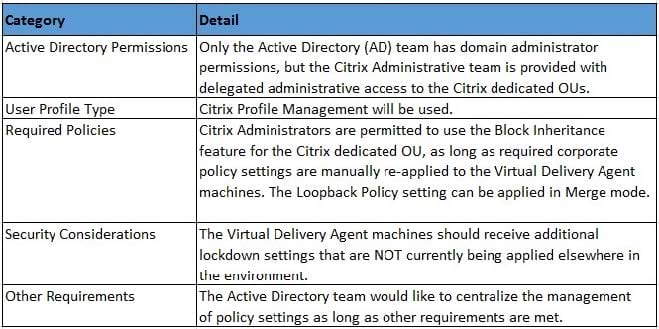
Based on the requirements, the Citrix Administrative team should use _______to manage Citrix policies and __________ to manage Microsoft settings. (Choose the correct option to complete the sentence.)
A. Citrix Studio; Workspace Environment Manager
B. Active Directory Group Policy Objects; Active Directory Group Policy Objects
C. Citrix Studio; Local Policies
D. Active Directory Group Policy Objects; Workspace Environment Manager
E. Citrix Studio; Active Directory Group Policy Objects
Scenario: A Citrix Architect needs to design a new XenApp and XenDesktop environment. The customer previously installed all applications locally on managed laptops and desktops but is willing to evaluate other application delivery methods as part of the new deployment. The environment will be standardized on Windows 10 and Windows Server 2016 for the Virtual Delivery Agent (VDA) machines.
As part of an application analysis performed earlier in the project, the information in the Exhibit was collected regarding one of the required applications.
Click the Exhibit button to view the information.
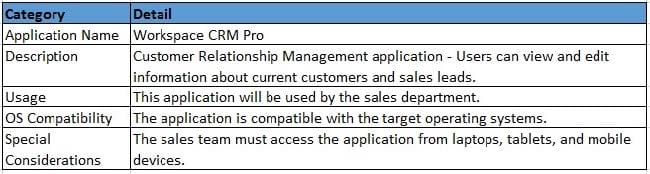
Additionally, the customer has the following objectives:
Minimize the amount of additional infrastructure components. Minimize the server hardware required.
How should the architect install the application?
A. On an Application Layer using Citrix App Layering, be included in a layered image, and accessed through a virtual desktop session
B. Stream it to a VDA machine using Microsoft App-V and accessed through a virtual desktop session
C. Directly on a Server OS VDA machine and accessed from the endpoint as a published application
D. Directly on a VDA machine image and accessed through a virtual desktop session
E. Directly on endpoint devices and included in a virtual desktop session using the Local App Access feature
Scenario: A Citrix Architect needs to design a multi-datacenter XenApp and XenDesktop environment that will use Provisioning Services (PVS) to manage Virtual Delivery Agent (VDA) machine images. Each datacenter will have a separate Provisioning Services farm. During the design discussions, the architect creates a diagram to depict the way vDisk files will be replicated between PVS farms, based on the available storage for the vDisk Stores.
Click the Exhibit button to view the diagram.
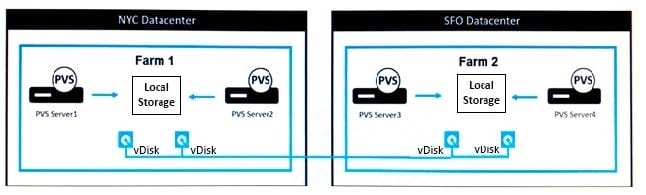
Overall, the customer has identified the following objectives for the image replication process:
Minimize the administrative time required to replicate images between farms Must be usable by storage administrators without PVS farm administrative permissions Can handle network interruptions without administrator intervention
Which method should the architect use to replicate the vDisk files between datacenters?
A. Scheduled robocopy commands
B. vDisk Replicator Tool
C. Microsoft DFS-R
D. Manual copy
E. SAN replication
Scenario: A Citrix Architect needs to support a XenApp and XenDesktop environment with two datacenters. App Layering is being used to create Layered Images that are used by the Virtual Delivery Agent (VDA) machines in both datacenter locations. To comply with disaster recovery requirements, administrators must be able to modify and deploy Layered Images from either datacenter if needed.
Which statement correctly describes the process that the architect must follow to meet the requirements?
A. All required layers should be exported from the first Enterprise Layer Manager to an SMB file share, and then imported into the second Enterprise layer manager.
B. All required layers should be copied from the first Enterprise Layer Manager to the second Enterprise Layer Manager using robocopy commands.
C. All required layers should be copied from the first Enterprise Layer Manager to the second Enterprise Layer Manager using Microsoft DFS-R.
D. All required layers should be exported from the first Layer Manager using the hypervisor hosting the machine, then imported to the hypervisor resource pool in the secondary datacenter.
Scenario: A Citrix Architect is using Radius and LDAP as dual-factor authentication. The architect is migrating to Citrix Cloud and wants to retain the same authentication procedure for XenApp and XenDesktop service in Citrix Cloud.
Which deployment strategy should the architect use for Citrix ADC and StoreFront to ensure that the solution complies with the existing security policies of the company without incurring additional costs?
A. Use Citrix Cloud Gateway service and on-premises StoreFront.
B. Set up a new Citrix ADC VPX instance and StoreFront on-premises.
C. Use Citrix Cloud Gateway service and Citrix Cloud Workspace.
D. Set up Citrix ADC with bring-your-own license (BYOL) and StoreFront in a public cloud.
Scenario: A Citrix Architect needs to design a new XenApp and XenDesktop environment.
The architect has identified the User Layer requirements, as shown in the Exhibit.
Click the Exhibit button to view the requirements.
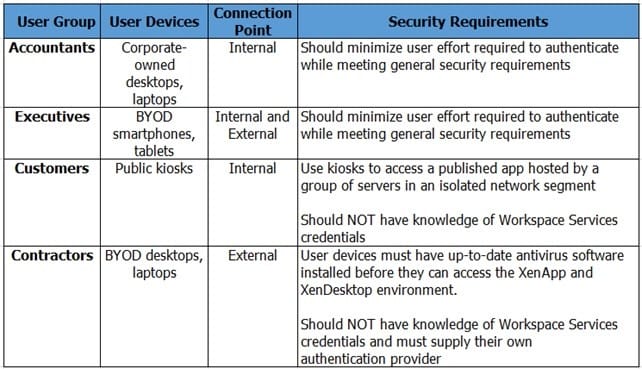
Additionally, management at the organization has identified the following general Access Layer
requirements:
A multi-factor authentication method is required for any connections to the XenApp and XenDesktop
environment originating from outside the corporate network.
External connections must be authenticated by a NetScaler Gateway virtual server located in a DMZ
network.
Internal connection traffic should NOT leave the internal corporate network.
Which authentication method should the architect use for the Accountants group?
A. Username and password
B. Federated Authentication Service
C. LDAP and RADIUS
D. Smart Card
E. Domain pass-through
A Citrix Architect is designing a new XenApp and XenDesktop environment. The IT team would like to deploy Windows 10 persistent VDI and Windows Server 2016 non-persistent hosted shared desktops.
The IT team has used physical servers in the past to host the IT infrastructure but would like to move to a hypervisor solution for the new environment. At the same time, the hardware and storage costs for the new deployment should be minimized where possible.
The IT team has requested there are no company-wide outages during hardware updates and maintenance.
The architect should recommend that failover clusters and live migration be used for _____________ and that these resource clusters should use ___________storage. (Choose the correct option to complete the sentence.)
A. Citrix infrastructure only; SAN
B. Citrix infrastructure only; local
C. all XenApp and XenDesktop components; SAN
D. all XenApp and XenDesktop components; local
E. Citrix infrastructure and dedicated desktops only; local
Scenario: A Citrix Architect is reviewing a XenApp and XenDesktop design for an environment with
multiple Active Directory forests.
Click the Exhibit button to view the design details.
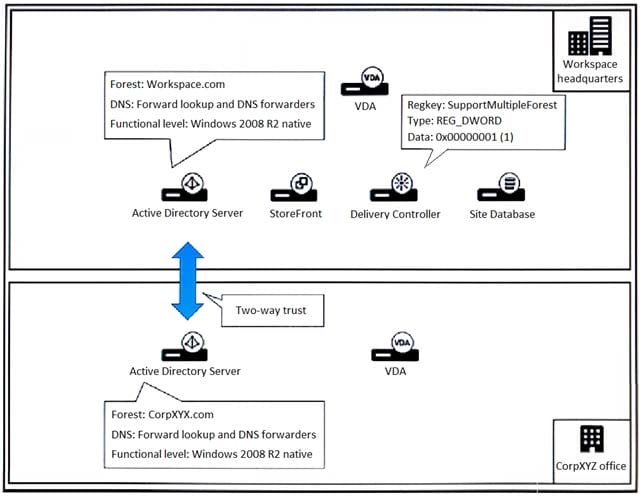
Which risk should the architect highlight to the customer, based on the details listed in the Exhibit?
A. The SupportMultipleForest registry key is configured incorrectly.
B. The Active Directory trust method is configured incorrectly.
C. The Active Directory functional level is configured incorrectly.
D. The DNS lookup strategy is configured incorrectly.