
1Z0-052 Online Practice Questions and Answers
Your DB_RECOVERY_FILE_DEST_SIZE is 8G.
Currently, 5G of the space is used of which 4G consists of obsolete backups.
You execute this command:
SQL> ALTER SYSTEM SET db_recovery_fle_dest_size=2G;
What is the outcome?
A. It changes DB_RECOVERY_FILE_DEST_SIZE to 2G and deletes the obsolete backups.
B. It changes DB_RECOVERY_FILE_DEST_SIZE to 5G.
C. It fails because DB_RECOVERY_FILE_DEST_SIZE is a static parameter.
D. It fails because the new size is less than 5G.
E. It changes DB_RECOVERY_FILE_DEST_SIZE to 2G without deleting valid backups.
Which three are true about the Automatic Workload Repository (AWR)? (Choose three.)
A. It is maintained by executing the PL/SQL procedures in the DBMS_STATS package.
B. It includes statistics that contain the number of distinct values per table column.
C. It includes statistics that contain the number of rows per table.
D. AWR data is stored in the SYSAUX tablespace.
E. Automatic AWR snapshots are created by the Manageability Monitor (MMON) background process.
F. By default, AWR data is retained for eight days.
Which action is automatically performed as part of the Incident Packaging Service in Enterprise Manager Support Workbench?
A. invoking the Data Recovery Advisor and SQL Repair Advisor
B. gathering metadata from the Automatic Diagnostic Repository (ADR)
C. Creating a service request with My Oracle Support
D. invoking the SQL Test Case Builder
When would you use memory advisors?
A. to get a recommendation whether Automatic Memory Management (AMM) or Automatic Shared Memory Management (ASMM) should be implemented.
B. to determine the impact of adding or reducing memory on DB Time
C. to generate memory-related alerts when memory demand exceeds a specified percentage
D. to determine the impact of adding memory on hard parse count
E. to determine the impact of adding memory on logical and physical reads
After performing a clean shut down of the database instance for maintenance, you mount the database
and then execute a command to open the database:
SQL> ALTER DATABASE OPEN;
Which two statements are true? (Choose two.)
A. The online redo log files and online data files are opened
B. All the online data files headers are checked for consistency
C. Instance recovery is performed before opening the database
D. The path and existence of all the log file members are checked
Your database instance is running with full workload after database creation. You have decided to use a fixedsize undo tablespace. You want to use the undo Advisor to estimate the capacity of the undo tablespace.
Which two factors must you consider before using the Undo Advisor to estimate the capacity of the undo tablespace? (Choose two.)
A. The retention period to support flashback
B. The expected length of the longest-running query
C. The number of undo tablespaces in the database
D. The size of the Flash Recovery Area for the database instance
In which situation would you use static database registration for a listener?
A. When multiple databases are to be registered with the listener
B. When DBAs need to connect remotely to start up the database instance
C. When users need to connect the database instance using the host naming method
D. When the database instance that is to be registered with the listener is configured in shared server mode
You are using flat files as the data source for one of your data warehousing applications. To optimize the application performance, you plan to move the data from the flat files to clustered tables in an Oracle database. While migrating the data, you want to have minimal impact on the database performance and optimize the data load operation. Which method would you use to load data into the Oracle database?
A. Use the external table population.
B. Use the Oracle Data Pump export and import utility.
C. Use the conventional path data load of the SQL*Loader utility.
D. Use the INSERT INTO...SELECT command to load the data.
Your database is functional with a peak load for the last one hour. You want to preserve the performance statistics collected during this period to be used for comparison when you analyze the performance of the database in the future.
What action would you take to achieve this task?
A. Insert finding directives for ADDM tasks in the future.
B. Create a baseline on a pair of snapshots spanning the peak-load period.
C. Decrease the snapshot interval in the AWR to collect more snapshots during the peakload period.
D. Set the snapshot retention period in the Automatic Workload Repository (AWR) to zero to avoid automatic purging of snapshots.
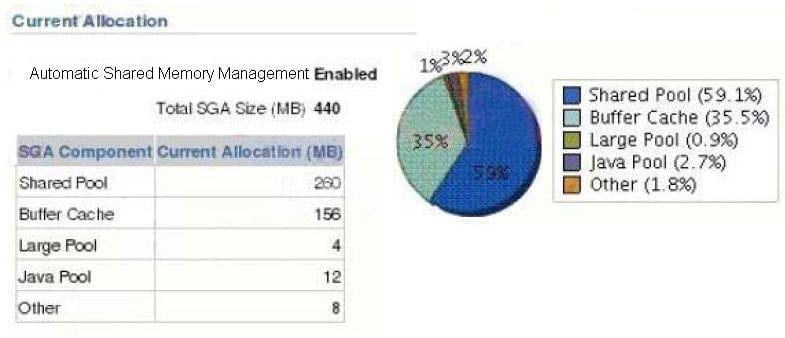
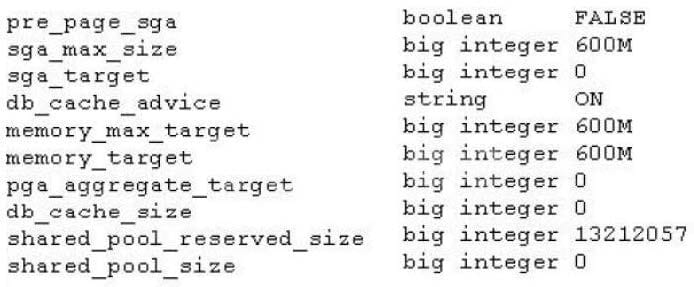
View Exhibit1 and Exhibit2 to examine the current memory allocation and parameter settings, respectively. Why are advisors not available for the shared pool and the buffer cache?
09 (exhibit):
10 (exhibit):
A. because the DB_CACHE_ADVICE parameter is set to OFF
B. because Automatic Memory Management (AMM) is disabled for the database instance
C. because Automatic Shared Memory Management (ASMM) is enabled for the database instance
D. because the values for the DB_CACHE_SIZE and SHARED_POOL_SIZE parameters were not set initially