
Exam2pass
0 items Sign In or Register
  • Home
  • IT Exams
  • Guarantee
  • FAQs
  • Reviews
  • Contact Us
  • Demo
Exam2pass > Oracle > Oracle Certifications > 1Z0-060 > 1Z0-060 Online Practice Questions and Answers

1Z0-060 Online Practice Questions and Answers

Questions 4

You must track all transactions that modify certain tables in the SALES schema for at least three years.

Automatic undo management is enabled for the database with a retention of one day.

Which two must you do to track the transactions? (Choose two.)

A. Enable supplemental logging for the database.

B. Specify undo retention guarantee for the database.

C. Create a Flashback Data Archive in the tablespace where the tables are stored.

D. Create a Flashback Data Archive in any suitable tablespace.

E. Enable Flashback Data Archiving for the tables that require tracking.

Buy Now

Correct Answer: DE

E: By default, flashback archiving is disabled for any table. You can enable flashback archiving for a table if you have the FLASHBACK ARCHIVE object privilege on the Flashback Data Archive that you want to use for that table.

D: Creating a Flashback Data Archive / Create a Flashback Data Archive with the CREATE FLASHBACK ARCHIVE statement, specifying the following: Name of the Flashback Data Archive Name of the first tablespace of the Flashback Data Archive

(Optional) Maximum amount of space that the Flashback Data Archive can use in the first tablespace / Create a Flashback Data Archive named fla2 that uses tablespace tbs2, whose data will be retained for two years:

CREATE FLASHBACK ARCHIVE fla2 TABLESPACE tbs2 RETENTION 2 YEAR;

Questions 5

You want to capture column group usage and gather extended statistics for better cardinality estimates for the CUSTOMERS table in the SH schema.

Examine the following steps:

1.

Issue the SELECT DBMS_STATS.CREATE_EXTENDED_STATS (`SH', `CUSTOMERS') FROM dual statement.

2.

Execute the DBMS_STATS.SEED_COL_USAGE (null, `SH', 500) procedure.

3.

Execute the required queries on the CUSTOMERS table.

4.

Issue the SELECT DBMS_STATS.REPORT_COL_USAGE (`SH', `CUSTOMERS') FROM dual statement.

Identify the correct sequence of steps.

A. 3, 2, 1, 4

B. 2, 3, 4, 1

C. 4, 1, 3, 2

D. 3, 2, 4, 1

Buy Now

Correct Answer: B

Step 1 (2). Seed column usage Oracle must observe a representative workload, in order to determine the appropriate column groups. Using the new procedure DBMS_STATS.SEED_COL_USAGE, you tell Oracle how long it should observe the workload. Step 2: (3) You don't need to execute all of the queries in your work during this window. You can simply run explain plan for some of your longer running queries to ensure column group information is recorded for these queries. Step 3. (1) Create the column groups At this point you can get Oracle to automatically create the column groups for each of the tables based on the usage information captured during the monitoring window. You simply have to call the DBMS_STATS.CREATE_EXTENDED_STATS function for each table.This function requires just two arguments, the schema name and the table name. From then on, statistics will be maintained for each column group whenever statistics are gathered on the table.

Note:

*

DBMS_STATS.REPORT_COL_USAGE reports column usage information and records all the SQL operations the database has processed for a given object.

*

The Oracle SQL optimizer has always been ignorant of the implied relationships between data columns within the same table. While the optimizer has traditionally analyzed the distribution of values within a column, he does not collect value- based relationships between columns.

*

Creating extended statisticsHere are the steps to create extended statistics for related table columns withdbms_stats.created_extended_stats: 1 - The first step is to create column histograms for the related columns.2 ?Next, we run dbms_stats.create_extended_stats to relate the columns together. Unlike a traditional procedure that is invoked via an execute ("exec") statement, Oracle extended statistics are created via a select statement.

Questions 6

Which two statements are true about variable extent size support for large ASM files?

A. The metadata used to track extents in SGA is reduced.

B. Rebalance operations are completed faster than with a fixed extent size

C. An ASM Instance automatically allocates an appropriate extent size.

D. Resync operations are completed faster when a disk comes online after being taken offline.

E. Performance improves in a stretch cluster configuration by reading from a local copy of an extent.

Buy Now

Correct Answer: AC

A: Variable size extents enable support for larger ASM datafiles, reduce SGA memory requirements for very large databases (A), and improve performance for file create and open operations.

C: You don't have to worry about the sizes; the ASM instance automatically allocates the appropriate extent size.

Note:

*

The contents of ASM files are stored in a disk group as a set, or collection, of data extents that are stored

on individual disks within disk groups. Each extent resides on an individual disk. Extents consist of one or

more allocation units (AU).

To accommodate increasingly larger files, ASM uses variable size extents.

*

The size of the extent map that defines a file can be smaller by a factor of 8 and 64 depending on the file

size. The initial extent size is equal to the allocation unit size and it increases by a factor of 8 and 64 at

predefined thresholds. This feature is automatic for newly created and resized datafiles when the disk

group compatibility attributes are set to Oracle Release 11 or higher.

Questions 7

Which three statements are true concerning the multitenant architecture? (Choose three.)

A. Each pluggable database (PDB) has its own set of background processes.

B. A PDB can have a private TEMP tablespace.

C. PDBs can share the SYSAUX tablespace.

D. Log switches occur only at the multitenant container database (CDB) level.

E. Different PDBs can have different default block sizes.

F. PDBs share a common system tablespace.

G. Instance recovery is always performed at the CDB level.

Buy Now

Correct Answer: BDG

B:

*

A PDB would have its SYSTEM, SYSAUX, TEMP tablespaces. It can also contains other user created

tablespaces in it.

*

There is one default temporary tablespace for the entire CDB. However, you can create additional

temporary tablespaces in individual PDBs.

D:

*

There is a single redo log and a single control file for an entire CDB

*

A log switch is the point at which the database stops writing to one redo log file and begins writing to

another. Normally, a log switch occurs when the current redo log file is completely filled and writing must

continue to the next redo log file.

G: instance recovery

The automatic application of redo log records to uncommitted data blocks when an database instance is

restarted after a failure.

Incorrect Answers:

A:

*

There is one set of background processes shared by the root and all PDBs. ?

*

High consolidation density. The many pluggable databases in a single container database share its

memory and background processes, letting you operate many more pluggable databases on a particular

platform than you can single databases that use the old architecture.

C: There is a separate SYSAUX tablespace for the root and for each PDB.

F: There is a separate SYSTEM tablespace for the root and for each PDB.

Questions 8

Which two are prerequisites for performing a flashback transaction? (Choose two.)

A. Flashback Database must be enabled.

B. Undo retention guarantee for the database must be configured.

C. EXECUTE privilege on the DBMS_FLASHBACK package must be granted to the user flashing back transaction.

D. Supplemental logging must be enabled.

E. Recycle bin must be enabled for the database.

F. Block change tracking must be enabled for the database.

Buy Now

Correct Answer: CD

To configure your database for the Flashback Transaction feature, you or your database administrator must:

With the database mounted but not open, enable ARCHIVELOG:

ALTER DATABASE ARCHIVELOG;

Open at least one archive log:

ALTER SYSTEM ARCHIVE LOG CURRENT;

If not done, enable minimal and primary key supplemental logging:

ALTER DATABASE ADD SUPPLEMENTAL LOG DATA;

ALTER DATABASE ADD SUPPLEMENTAL LOG DATA (PRIMARY KEY) COLUMNS;

If you want to track foreign key dependencies, enable foreign key supplemental logging:

ALTER DATABASE ADD SUPPLEMENTAL LOG DATA (FOREIGN KEY) COLUMNS;

References: http://docs.oracle.com/cd/E11882_01/appdev.112/e41502/adfns_flashback.htm#ADFNS611

Questions 9

You find this query being used in your Oracle 12c database:
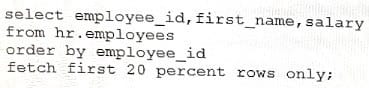
Which method a used by the optimizer to limit the rows being returned?

A. A TOP-N query is created during execution and a filter is added to the query dynamically using ROWNUM to limit the rows to 20 percent of the total rows.

B. A view is created during execution and a filter on the view limits the rows to 20 percent of the total rows.

C. All the rows are returned to the client or middle tier but only the first 20 percent are returned to the screen or the application.

D. A filter is added to the table query dynamically using ROWNUM to limit the rows to 20 percent of the total rows.

Buy Now

Correct Answer: B

Questions 10

You are administering a database stored in Automatic Storage Management (ASM). You use RMAN to back up the database and the MD_BACKUP command to back up the ASM metadata regularly. You lost an ASM disk group DG1 due to hardware failure.

In which three ways can you re-create the lost disk group and restore the data? (Choose three.)

A. Use the MD_RESTORE command to restore metadata for an existing disk group by passing the existing disk group name as input parameter and use RMAN to restore the data.

B. Use the MKDG command to restore the disk group with the same configuration as the backed-up disk group and data on the disk group.

C. Use the MD_RESTORE command to restore the disk group with the changed disk group specification, failure group specification, name, and other attributes and use RMAN to restore the data.

D. Use the MD_RESTORE command to restore both the metadata and data for the failed disk group.

E. Use the MKDG command to add a new disk group DG1 with the same or different specifications for failure group and other attributes and use RMAN to restore the data.

Buy Now

Correct Answer: BCE

Questions 11

Which three statements are true about adaptive SQL plan management?

A. It adds new; bettor plans automatically as fixed plans to the baseline.

B. The non-accepted plans are automatically accepted and become usable by the optimizer if they perform better than the existing accepted plans.

C. It automatically performs verification or evolves non-accepted plans, in COMPREHENSIVE mode when they perform better than existing accepted plans.

D. The non-accepted plans in a SQL plan baseline are automatically evolved, in COMPREHENSIVE mode, during the nightly maintenance window and a persistent verification report is generated.

Buy Now

Correct Answer: BCD

Questions 12

Your multitenant container database (CDB) contains two pluggable databases (PDBs).

Which three tools can be used to add a new PDB to the CDB? (Choose three.)

A. Enterprise Manager Cloud Control

B. SQL Developer

C. Database Upgrade Assistant (DBUA)

D. Database Configuration Assistant (DBCA)

E. Oracle Universal Installer (OUI)

Buy Now

Correct Answer: ABD

Questions 13

Your multitenant container database (CDB) contains several pluggable databases (PDBs).

A common user C##A_ADMIN, is created with connect privileges.

You execute this command from the root container:

SQL> GRANT create tablespace to C##A_ADMIN;

Which statement is true?

A. The command executes successfully, enabling the C##A_ADMIN user to create a tablespace only in the root container.

B. The command fails because the CONTAINER=ALL clause is not used.

C. The command executes successfully, enabling the C##A_ADMIN user to create tablespaces in the root container as well as in the PDBs.

D. The command fails because the CONTAINER=CURRENT clause is not used.

Buy Now

Correct Answer: C

Exam Code: 1Z0-060
Exam Name: Upgrade to Oracle Database 12c
Last Update: May 26, 2026
Questions: 217

PDF (Q&A)

$45.99
ADD TO CART

VCE

$49.99
ADD TO CART

PDF + VCE

$59.99
ADD TO CART

Exam2Pass----The Most Reliable Exam Preparation Assistance

There are tens of thousands of certification exam dumps provided on the internet. And how to choose the most reliable one among them is the first problem one certification candidate should face. Exam2Pass provide a shot cut to pass the exam and get the certification. If you need help on any questions or any Exam2Pass exam PDF and VCE simulators, customer support team is ready to help at any time when required.

Home | Guarantee & Policy |  Privacy & Policy |  Terms & Conditions |  How to buy |  FAQs |  About Us |  Contact Us |  Demo |  Reviews

2026 Copyright @ exam2pass.com All trademarks are the property of their respective vendors. We are not associated with any of them.