
Exam2pass
0 items Sign In or Register
  • Home
  • IT Exams
  • Guarantee
  • FAQs
  • Reviews
  • Contact Us
  • Demo
Exam2pass > Oracle > Oracle Certifications > 1Z0-070 > 1Z0-070 Online Practice Questions and Answers

1Z0-070 Online Practice Questions and Answers

Questions 4

Batch and DSS workloads on your Exadata X6 Database Machine are causing performance problems for OLTP workloads at certain times of the day.

There are five RAC databases performing OLTP I/O. Two of them also perform batch I/O. There is another RAC database that performs only DSS I/O.

You are asked to resolve this problem so that the OLTP workload will not suffer when competing with the batch or DSS workloads.

You decide to use the I/O resource manager.

Which is the best way to solve this problem?

A. Create a category plan with EXADCLI calling EXACLI to give the OLTP category the highest priority on all the cells, and use the Database Resource Manager to create the OLTP category and map all OLTP-oriented consumer groups in all databases to it.

B. Use the Database Resource Manager to give the OLTP category the highest priority and use EXADCLI calling EXACLI to create the OLTP category on all the cells.

C. Create a category plan with EXADCLI calling EXACLI to give the OLTP category the highest priority on all the cells, and use the Database Resource Manager to give the OLTP consumer group the highest priority on all databases.

D. Create a database plan using EXADCLI calling EXACLI to give OLTP I/O the highest priority from all six databases.

Buy Now

Correct Answer: C

Explanation:

You can manage I/O resources based on categories by creating a category plan.

You can add any number of categories, or modify the predefined categories. You should map consumer

groups to the appropriate category for all databases that use the same cell storage. Any consumer group

without an explicitly specified category defaults to the OTHER category.

References: http://docs.oracle.com/cd/E80920_01/SAGUG/exadata-storage-server-iorm.htm

Questions 5

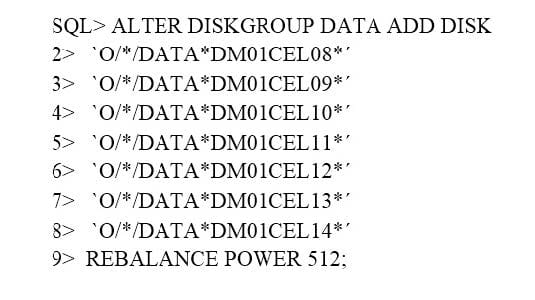
You are in the process of upgrading your X5 Database Machine half rack to a full rack.

The new storage servers are called DM01CEL08 through DM01CEL14.

After creating 96 new griddisks, you issued this SQL statement: How many failgroups if any, will be added to the DATA diskgroup by executing this SQL statement?
A. 0, because the new griddisks will be added to the existing failgroups

B. 12, consisting of seven griddisks each

C. 96, consisting of seven griddisk each

D. 7, consisting of 12 griddisks each

E. 1, consisting of all 96 griddisks

Buy Now

Correct Answer: D

Explanation:

The number of failure groups equals the number of Exadata Cells. Each failure group is composed of a

subset of grid disks in the Oracle ASM disk group that belong to a single storage cell.

References: http://docs.oracle.com/cd/E80920_01/SAGUG/exadata-administering-asm.htm

Questions 6

You plan to migrate an Oracle database that supports an online transaction processing (OLTP) workload to your X6 Database Machine. The Database Machine database version is 11.2.

You plan to perform a physical database migration using Transportable Database.

Which two are requirements for this method?

A. The source database must be deployed on a Little Endian platform,

B. The source database must be at least 11.1.

C. The source database must be at least 11.2.

D. The source database must use only bigfile tablespaces.

E. The source database must be deployed on a Big Endian platform.

F. The source database must not use bigfile tablespaces.

Buy Now

Correct Answer: AC

Explanation:

Transportable database approach (TDB). If the source system is running Oracle 11.2 or above with Little

Endian format, this method can be used to migrate the database to Exadata.

References: https://www.toadworld.com/platforms/oracle/w/wiki/11551.managing-troubleshooting-exadatapart-3-migrating-databases-to-exadata-database-machine-best-practices

Questions 7

You are designing the monitoring architecture and procedures for an X5 Database Machine fabric consisting of two full racks, to provide for the monitoring for all components on the critical path of the admin network.

Which two components need to be monitored?

A. the Infiniband leaf switches

B. the power distribution units

C. the Cisco 48 port Catalyst Ethernet Switch

D. the InfiniBand spine switches
Buy Now

Correct Answer: CD

Explanation:

The Cisco Catalyst 4948 Ethernet switch is supplied with the Oracle Exadata Rack.

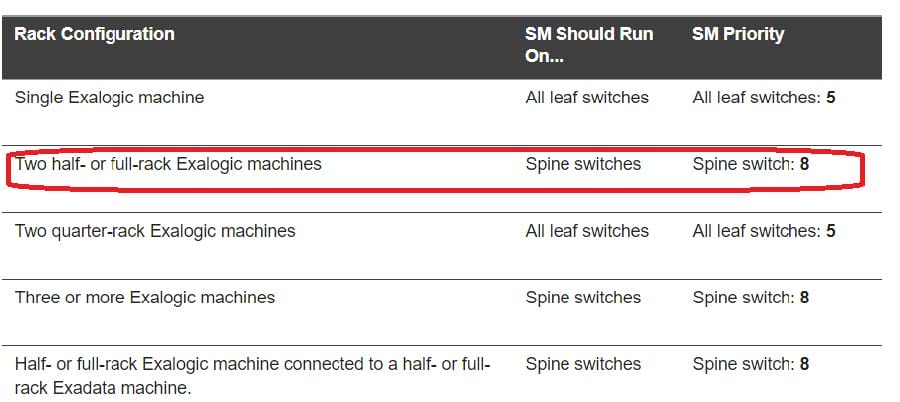
D: Figure: Running the Subnet Manager in Different Rack Configurations

References:

https://docs.oracle.com/cd/E18476_01/doc.220/e18478/GUID-9FF8B5B0-3481-4B73-89D3108CBD7EB989.htm#ELMOG76346 http://docs.oracle.com/cd/E80920_01/DBMIN/configuring-exadata.htm#DBMIN21274

Questions 8

Because of a motherboard failure on an X6 high-capacity Exadata storage server, you must replace the server chassis with a replacement unit.

Which are three of the components must you move from the original Exadata storage server to the new Exadata storage server?

A. Redundant power supplies

B. The host bus channel adaptor

C. The USB flash drive

D. The four Sun Flash Accelerator PCIe cards

E. The 12 physical disks

Buy Now

Correct Answer: ADE

Explanation:

Remove the following reusable components:

1.

Fan modules

2.

SAS storage drive cables

3.

PCIe cards

4.

Power supplies

References: https://docs.oracle.com/cd/E62172_01/html/E63689/goiqw.html#scrolltoc

Questions 9

Which three are true concerning Hybrid Columnar Compression (HCC) deployed on Exadata storage?

A. HCC can be used only when the Exadata Smart Flash Cache is configured in Write-Through mode.

B. HCC data is never cached in the Exadata Smart Flash Cache.

C. By default, decompression is performed by Exadata Storage Servers.

D. Rows residing in HCC compressed segments, are always self- contained in a single database block.

E. Rows residing in HCC compressed segments, are always self- contained in a single compression unit.

F. Row-level locks are supported on HCC compressed data.

Buy Now

Correct Answer: CEF

Explanation:

C: The decompression process typically takes place on the Oracle Exadata Storage Server in order to maximize performance and offload processing from the database server.

E: A logical construct called the compression unit is used to store a set of hybrid columnar compressed rows. When data is loaded, column values for a set of rows are grouped together and compressed. After the column data for a set of rows has been compressed, it is stored in a compression unit.

F: What happens when I update a row on compressed tables? What about locks? BASIC and OLTP: the updated row stays in the compressed block ‘usual’ Oracle's row-level locks

Hybrid columnar: Updated row is moved, as in a delete + insert How to see that? With dbms_rowid package New row is OLTP compressed if possible Lock affects the entire CU that contains the row

Note: Oracle's Hybrid Columnar Compression technology is a new method for organizing data within a database block. As the name implies, this technology utilizes a combination of both row and columnar methods for storing data. This hybrid approach achieves the compression benefits of columnar storage, while avoiding the performance shortfalls of a pure columnar format.

Incorrect Answers:

B: Data remains compressed not only on disk, but also remains compressed in the Exadata Smart Flash Cache, on Infiniband, in the database server buffer cache, as well as when doing back-ups or log shipping to Data Guard.

References: http://www.oracle.com/technetwork/database/exadata/ehcc-twp-131254.pdf

Questions 10

You plan to partition the database and storage grids in an X5-2 full rack, creating two clusters and two storage grids without using virtualization.

One cluster will be used for production and should consist of six database servers and nine storage servers.

The other cluster will be used for test and development, and should consist of two database servers and five storage servers.

The storage must be partitioned so that the storage servers are visible only to the appropriate database servers that are meant to access them.

What must be done to achieve this?

A. Configure Exadata realms using Oracle ASM-scoped security mode.

B. Configure Exadata realms using Database–scoped security mode.

C. Edit the CELLIP.ORA file on each database server to contain IP addresses of storage servers in the storage grid associated with the cluster to which that database server belongs.

D. Edit the CELLINIT.ORA file on each database server to contain IP addresses of storage servers in the

storage grid associated with the cluster to which that database server belongs.

E. Edit the CELLIP.ORA file on each database server to contain IP addresses of database servers which are allowed access to specific storage servers in the same storage grid.

F. Edit the CELLIP.ORA file on each storage server to contain IP addresses of database servers in the database server grid that are associated with the storage grid to which that storage server belongs.

Buy Now

Correct Answer: C

Explanation:

The cellinit.ora file is host-specific, and contains all database IP addresses that connect to the storage

network used by Oracle Exadata Storage Servers. This file must exist for each database that connect to

Oracle Exadata Storage Servers.

The cellinit.ora file contains the database IP addresses.

The cellip.ora file contains the storage cell IP addresses.

Both files are located on the database server host.

References: http://docs.oracle.com/cd/E80920_01/SAGUG/exadata-storage-serverconfiguring.htm#SAGUG20369

Questions 11

Which two statements are true about the Integrated Lights Out Manager (ILOM) on an Exadata X5 or X6 Database Machine?

A. ILOM on database servers can use IPMI to send sensor alerts to an Enterprise Manager Agent.

B. ILOM on a storage server uses SNMP to send sensor alerts to the cellsrv process on the same storage server.

C. ILOM on a storage server uses IPMI to send sensor alerts to the MS process on the same storage server.

D. ILOM on a storage server uses SNMP to send sensor alerts to the MS process on the same storage server.

E. ILOM on database servers can use SNMP to send sensor alerts to an Enterprise Manager Agent.

Buy Now

Correct Answer: CE

Explanation:

C: ILOM supports the Intelligent Platform Management Interface (IPMI), which enables you to monitor and

control your server platform, as well as to retrieve information about your server platform.

ILOM supports alerts in the form of IPMI Platform Event Trap (PET) alerts. Alerts provide advance warning

of possible system failures.

E: Oracle ILOM supports the Simple Network Management Protocol (SNMP), which is used to exchange

data about network activity.

SNMP functionality requires the following two components:

1.

Network management station – A network management station hosts management applications, which monitor and control managed nodes.

2.

Managed node – A managed node is a device such as a server, router, or hub that hosts SNMP management agents that are responsible for carrying out requests from management stations, such as a service processor (SP) running Oracle ILOM. Managed nodes can also provide unsolicited status information to a management station in the form of a trap.

References: https://docs.oracle.com/cd/E19860-01/E21452/E21452.pdf

Questions 12

Which four are true about Exadata features?

A. Storage Indexes persist across Exadata storage server reboots.

B. Data Warehouse workloads will benefit from Smart Flash Cache configured in Write-Through mode.

C. Hybrid Columnar Compressed tables can be compressed and decompressed on Exadata storage servers.

D. Hybrid Columnar Compressed tables can be compressed and decompressed on the database servers.

E. OLTP workloads will benefit from Smart Flash Cache configured in Write-Back mode.

F. Storage Indexes persist across database server reboots.

Buy Now

Correct Answer: CDEF

Explanation:

CD: That data remains compressed not only on disk, but also remains compressed in the Exadata Smart

Flash Cache, on Infiniband, in the database server buffer cache, as well as when doing back-ups or log

shipping to Data Guard.

E (not B): Use the Write-Back Flash Cache feature to leverage the Exadata Flash hardware and make

Exadata Database Machine a faster system for Oracle Database Deployments. Write-through cache mode

is slower than write-back cache mode. However, write-back cache mode has a risk of data loss if the

Exadata Storage Server loses power or fails.

F: Storage indexes are not stored on disk; they are resident in the memory of the storage cell servers.

Incorrect Answers:

A: Storage indexes are not stored on disk; they are resident in the memory of the storage cell servers. They are created automatically after the storage cells receive repeated queries—with predicates-for columns. No user intervention is needed to create or maintain storage indexes. And because they are memory-resident structures, they disappear when the storage cells are rebooted.

References:

Questions 13

You want to use Enterprise Manager to monitor the power distribution units (PDUs) in your Database Machine.

On which three factors do the appropriate alarm thresholds for the plug-in depend?

A. voltage and phase type of the PDUs

B. disk types within the storage servers

C. Database Machine server models for both the storage servers and database servers in the rack

D. Database Machine rack size and variants

E. disk types within the expansion racks

F. distance between racks for multirack configurations

Buy Now

Correct Answer: BCE

Exam Code: 1Z0-070
Exam Name: Oracle Exadata X5 Administration
Last Update: May 23, 2026
Questions: 103

PDF (Q&A)

$45.99
ADD TO CART

VCE

$49.99
ADD TO CART

PDF + VCE

$59.99
ADD TO CART

Exam2Pass----The Most Reliable Exam Preparation Assistance

There are tens of thousands of certification exam dumps provided on the internet. And how to choose the most reliable one among them is the first problem one certification candidate should face. Exam2Pass provide a shot cut to pass the exam and get the certification. If you need help on any questions or any Exam2Pass exam PDF and VCE simulators, customer support team is ready to help at any time when required.

Home | Guarantee & Policy |  Privacy & Policy |  Terms & Conditions |  How to buy |  FAQs |  About Us |  Contact Us |  Demo |  Reviews

2026 Copyright @ exam2pass.com All trademarks are the property of their respective vendors. We are not associated with any of them.