
1Z0-072 Online Practice Questions and Answers
Which two are true about incomplete recovery? (Choose two.)
A. Incremental backups cannot be used to roll forward the database while performing it.
B. Uncommitted transactions will be rolled back after it completes.
C. It is possible only when the database is in MOUNT state.
D. The database must have FLASHBACK enabled in order to perform it.
E. Only RMAN backupsets can be used to restore a database as part of it.
The ORCL database has DEFERRED_SEGMENT_CREATION set to TRUE.
UNDOTBS2 is the active undo tablespace.
Examine these commands:
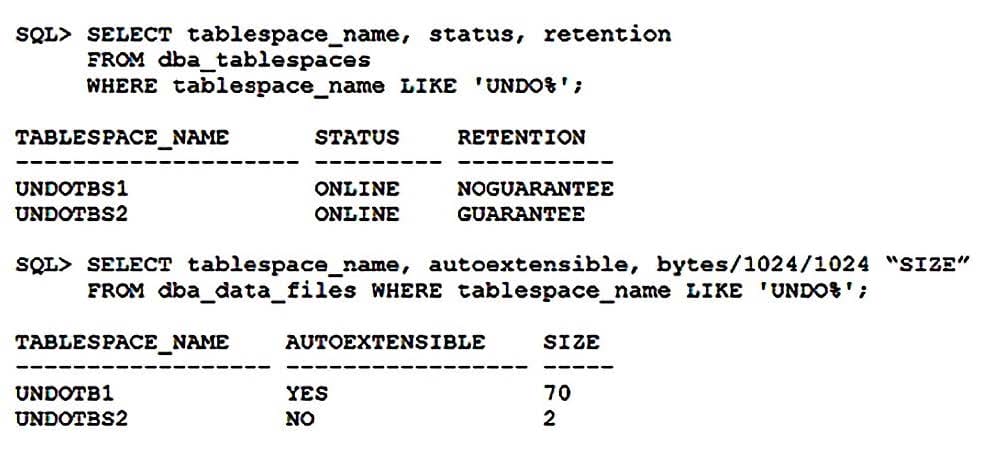
USER1 executes DML, which generates more than 2 MB of UNDO.
What is the result and why?
A. It suspends the transaction, which can be resumed by increasing the size of UNDOTBS2.
B. It returns an error because UNDOTBS2 is fixed size and has RETENTION GUARANTEE.
C. It suspends the transaction, which can be resumed by increasing USER1's quota on UNDOTBS2.
D. It returns an error because UNDOTBS2 has RETENTION GUARANTEE.
E. It suspends the transaction, which can be resumed by setting UNDOTBS1 as the active undo tablespace.
F. It returns an error because UNDOTBS2 is fixed size.
The SCOTT/TIGER user exists in two databases, BOSTON_DB and DALLAS_DB, in two different
locations.
Each database has a tnsnames.ora file defining DALLAS_DB as a service name.
Examine this command:

How do you execute the command so that only SCOTT in BOSTON_DB can access the SCOTT schema in DALLAS_DB?
A. as SCOTT in BOSTON_DB
B. as SYS in both the databases
C. as SCOTT in BOSTON_DB and SYS in DALLAS_DB
D. as SCOTT in both the databases
E. as SCOTT in DALLAS_DB
Which two are true about the roles? (Choose two.)
A. All privileges and roles granted to a user are enabled by default when the user logs in.
B. The SET ROLE statement can be used once per session.
C. The SET ROLE statement enables as well as disables roles in a session.
D. A role must be disabled before it can be revoked from a user.
E. The ALTER USER statement must be used to set specific default roles for a user.
Which two are segment types? (Choose two.)
A. table partition
B. materialized views on a prebuilt container
C. stored procedure
D. sequence
E. table
F. view
Which three failures do not require intervention for recovery? (Choose three.)
A. user process failure
B. media failure
C. statement failure
D. network interface card (NIC) failure
E. transaction failure
Your database instance is started by using an spfile. You want to modify the value of a static initialization parameter.
Examine these steps:
1.
Shut down the database instance.
2.
Modify the parameter in the spfile with scope = SPFILE.
3.
Modify the parameter in a pfile.
4.
Use the spfile to create a pfile.
5.
Use the pfile to create a spfile.
6.
Modify the parameter in the spfile with scope = BOTH.
7.
Start up the database instance.
Which are the minimum required steps in the correct order?
A. 2, 1, 7
B. 1, 7, 2
C. 1, 2, 7
D. 6, 1, 7
E. 1, 4, 3, 5, 7
Examine this extract from the show parameters command: How are SGA and PGA memory managed by an instance using these parameter settings?

A. SGA memory is manually managed and PGA memory is managed by using Automated SQL Execution Memory Management.
B. SGA memory is managed by using Automatic Shared Memory Management (ASMM) and PGA memory is managed by using Automated SQL Execution Memory Management.
C. SGA and PGA memory are managed by using Automatic Memory Management (AMM).
D. SGA memory is managed by using Automatic Shared Memory Management (ASMM) and PGA memory is manually managed.
E. SGA and PGA memory are manually managed.
Which two are true about instance recovery? (Choose two.)
A. It is guaranteed to complete within fast_start_mttr_target number of seconds.
B. Archived REDO log files are required to perform instance recovery.
C. The database opens after the roll forward phase of instance recovery.
D. It is performed when mounting a database.
E. Archived REDO log files are never required to perform instance recovery.
F. It occurs after a SHUTDOWN IMMEDIATE.
Which two are true about roles? (Choose two.)
A. The ALTER USER statement must be used to set specific default roles for a user.
B. A role must be disabled before it can be revoked from a user.
C. The SET ROLE statement can be used once per session.
D. The SET ROLE statement enables as well as disables roles in a session.
E. All privileges and roles granted to a user are enabled by default when the user logs in.