
1Z0-083 Online Practice Questions and Answers
Which two are true about Oracle Flashback features? (Choose two.)
A. FLASHBACK QUERY can retrieve REDO records from ONLINE and ARCHIVED REDO LOG files.
B. FLASHBACK VERSION QUERY can retrieve REDO records from ONLINE and ARCHIVED REDO LOG files.
C. FLASHBACK TABLE can undrop a column.
D. FLASHBACK DROP can undrop an index when undropping a table.
E. After a database is restored from flashback logs using the FLASHBACK DATABASE command, it is sometimes rolled forward using redo logs.
Your CDB has two regular PDBs as well as one application container with two application PDBs and an application seed.
No changes have been made to the standard PDB$SEED.
How many default temporary tablespaces can be assigned in the CDB?
A. three
B. eight
C. seven
D. six
E. five
On the 10th of August, you implement an incremental database backup strategy and configure a recovery window of five days.
Level 0 backups are taken on the 10th, 17th, and 24th of August. Differential level 1 incremental backups are taken daily between the level 0 backups.
Today is the 26th of August.
Which backups will be obsolete?
A. all backups prior to 10th of August
B. all backups prior to 22nd of August
C. all backups prior to 24th of August
D. all backups prior to 20th of August
E. all backups prior to 17th of August
Which three are true in Oracle 19c and later releases? (Choose three).
A. If the password file location changes, then the new location is used automatically by the Oracle Server.
B. Schema Only accounts can be granted administrator privileges.
C. All the Oracle-supplied accounts are Schema Only accounts.
D. Privilege Analysis is included in Oracle Enterprise Edition and no longer requires Database Vault.
E. Unified Auditing can be configured to audit only events that are issued indirectly by an audited user.
F. Unified Auditing can be configured to audit only events that are issued directly by an audited user.
RMAN is connected to a target database instance and an auxilary instance. You execute 3625the command:
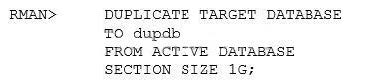
RMAN> DUPLICATE TARGET DATABASE TO dupdb FROM ACTIVE DATABASE SECTION SIZE 1G; What is the outcome?
A. RMAN uses the pull method to restore files using image copies
B. RMAN uses the push method to transfer image copies
C. RMAN uses the push method to transfer backup sets
D. RMAN uses the pull method to restore files using backup sets
You create a table with the PERIOD FOR clause to enable the use of the Temporal Validity feature of Oracle Database 12c.
Examine the table definition:
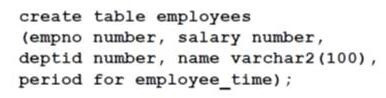
Which three statements are true concerning the use of the Valid Time Temporal feature for the EMPLOYEES table?
A. The valid time columns employee_time_start and employee_time_end are automatically created.
B. The same statement may filter on both transaction time and valid temp or altime by using the AS OF TIMESTAMP and PERIOD FOR clauses.
C. The valid time columns are not populated by the Oracle Server automatically.
D. The valid time columns are visible by default when the table is described.
E. Setting the session valid time using DBMS_FLASHBACK_ARCHIVE.ENABLE_AT_VALID_TIME sets the visibility for data manipulation language (DML), data definition language (DDL), and queries performed by the session.
Which two restrictions apply when the RMAN BACKUP AS COPY command is used to create a backup? (Choose two).
A. Backups can be taken only if a fast recovery area is configured.
B. Backups can be written only to disk.
C. Backups can be taken only for data files.
D. Binary compression cannot be applied to the backup.
E. Backups can be written only if checksums are stored for each block.
F. Backups can be written only to media.
Which three are true about RMAN archival backups with the RESTORE POINT clause? (Choose three.)
A. All archive logs are retained after an archival backup is taken, until the next archival backup is taken of the same database.
B. The SPFILE is included in the archival backup.
C. They are never considered obsolete by RMAN.
D. Archive logs are retained if they are necessary to allow the database to be recovered to a consistent state when an archival backup is restored.
E. The ARCHIVAL attribute for a backup overrides the RMAN retention policy.
F. They can optionally be written to a fast recovery area (FRA).
G. Use of a recovery catalog is always required to support the creation and use of archival backups.
Which two are prerequisites for using FLASHBACK TABLE? (Choose two.)
A. A table's constraints must be disabled before issuing the flashback.
B. The FLASHBACK ANY TABLE system privilege or the FLASHBACK object privilege must be granted to the user performing the flashback.
C. A table's indexes must be set to unusable before issuing the flashback.
D. Row Movement must be enabled on the table being flashed back.
E. The FLASHBACK ANY TABLE system privilege or the FLASHBACK object privilege must be granted to the table owner.
Which two are true about the Program Global Area (PGA) and its management in an Oracle database instance? (Choose two.)
A. The private SQL area (UGA) is located in the System Global Area (SGA) when using dedicated servers.
B. PGA_AGGREGATE_LIMIT is a hard limit on the PGA size for any one session.
C. The entire PGA is located in the System Global Area (SGA) when using shared servers.
D. Sorts and Hash Joins use PGA memory.
E. The private SQL area (UGA) is located in the System Global Area (SGA) when using shared servers.