
Exam2pass
0 items Sign In or Register
  • Home
  • IT Exams
  • Guarantee
  • FAQs
  • Reviews
  • Contact Us
  • Demo
Exam2pass > Oracle > Oracle Certifications > 1Z0-1054-22 > 1Z0-1054-22 Online Practice Questions and Answers

1Z0-1054-22 Online Practice Questions and Answers

Questions 4

You entered a journal and the client is asking for the following information:

1.

The current account balance

2.

What the future account balance will be if the journal is approved and posted

How will you get this information?

A. Query the account balance online

B. Use Oracle Transactional Business Intelligence (OTBI) to query General Ledger balances

C. View the Projected Balances region in the Create Journals page

D. Run a Trial Balance before and after posting

Buy Now

Correct Answer: C

you can view the projected balances region in the create journals page to see the current account balance and what the future account balance will be if the journal is approved and posted. Therefore, option C is correct. Option A is incorrect because querying the account balance online will not show you the future account balance. Option B is incorrect because using Oracle Transactional Business Intelligence (OTBI) to query General Ledger balances will not show you the future account balance. Option D is incorrect because running a trial balance before and after posting will not show you the current account balance.

Questions 5

Which tool can you use to create a Financial Income Statement?

A. One View Reporting

B. PS/nVision

C. Account Inspector

D. Rapid Implementation Enterprise Structures setup

Buy Now

Correct Answer: C

Account Inspector is a tool that allows you to create a Financial Income Statement using data from General Ledger Cloud. You can select an income statement account or an account group and view the account balance and its components, such as subledger details, journal lines, and supporting references. You can also drill down to the underlying transactions and subledger applications. You can customize the layout and appearance of the income statement and export it to Excel or PDF. One View Reporting is a tool that allows you to create reports using data from Oracle E-Business Suite applications, not Oracle Financials Cloud. PS/nVision is a tool that allows you to create reports using data from PeopleSoft applications, not Oracle Financials Cloud. Rapid Implementation Enterprise Structures setup is a tool that allows you to set up enterprise structures for Oracle Financials Cloud, not create financial statements. Reference: Oracle Financials Cloud: General Ledger 2022 Implementation Professional Objectives-Create Financial Reports 12

Questions 6

A company implementing Oracle General Ledger has a business requirement to report under two accounting conventions and is considering setting up a Primary and Secondary ledger. The two accounting standards are very close.

Which data conversion level should you recommend to ensure only manual journals will be entered in the secondary ledger?

A. Adjustment Only Level

B. Subledger Level

C. FBDI Level

D. Balance level

E. Journal Level

Buy Now

Correct Answer: AE

According to Oracle documentation, when you have a subsidiary company in a highly regulated country where there is a legal requirement to produce fiscal reports under local GAAP, you should configure the ledgers using these two ledger types: a primary ledger with the local accounting convention, and a secondary ledger with the IFRS accounting convention. A primary ledger represents your main accounting books that comply with local GAAP. A secondary ledger represents an alternative accounting representation that complies with IFRS. Therefore, options A and E are correct. Option B is incorrect because a reporting currency with the IFRS accounting convention does not represent an alternative accounting representation. Option C is incorrect because a primary ledger with the IFRS accounting convention does not comply with local GAAP. Option D is incorrect because a reporting currency with the local accounting convention does not represent an alternative accounting representation.

Questions 7

You are using budgetary control. You have an open purchase order for $500 USD, and an invoice for $300 is matched to the purchase order. What will be the funds status of the purchase order and the invoice?

A. Both are Partially Reserved

B. The purchase order is Liquidated and the invoice is Partially Reserved

C. The purchase order is Partially Liquidated and the invoice is Partially Reserved

D. The purchase order is Partially Liquidated and the invoice will be Reserved

E. Both are reserved

F. The purchase order is Open and the invoice is Validated

Buy Now

Correct Answer: C

When using budgetary control, an open purchase order for $500 USD will have a funds status of Reserved, meaning that funds are reserved for future spending. When an invoice for $300 USD is matched to the purchase order, the purchase order funds status will change to Partially Liquidated, meaning that some of the reserved funds have been liquidated by an invoice. The invoice funds status will be Reserved, meaning that funds are reserved for future payment. Reference: Oracle Financials Cloud: General Ledger 2022 Implementation Professional Objectives-Process Budget Journals 12

Questions 8

The Delete Translated Balances process provides the ability to completely reset translations in the event that significant changes are made to the accounting configuration.

Once the deletion process completes, what additional process must you run?

A. Submit the Update General Ledger Balances Cube process to ensure that the balances cube maintains translated balances that are consistent with future translations.

B. Submit the Create General Ledger Balances Cube process to ensure that the balances cube maintains translated balances that are consistent with future translations.

C. Submit the Create Currency Dimension Members process to ensure that the balances cube maintains translated balances that are consistent with future translations.

D. Submit the Create Scenario Dimension Members process to ensure that the balances cube maintains translated balances that are consistent with future translations.

Buy Now

Correct Answer: B

The Delete Translated Balances process deletes all previously translated balances for a given ledger, currency, and period range. After running this process, you must submit the Update General Ledger Balances Cube process to rebuild the balances cube and ensure that the translated balances are consistent with future translations. This process also updates the account hierarchies and dimension members in the balances cube. Reference: Oracle Financials Cloud: General Ledger 2022 Implementation Professional Objectives-Translate Balances 12

Questions 9

You want your sales representatives to be able to find points of interest, such as customers, while out on business. What should you enable to achieve this?

A. HZ_GEO_IDENTIFIER_SUBTYPE Lookup

B. Geocoding

C. Validation

D. Address Cleansing

Buy Now

Correct Answer: B

According to Oracle documentation1, you should enable geocoding to achieve the requirement of finding points of interest, such as customers, while out on business. Geocoding is the process of assigning geographic coordinates to a physical address. Geocoding enables you to use maps and location-based services to find and visualize points of interest. Therefore, option B is correct. Option A is incorrect because HZ_GEO_IDENTIFIER_SUBTYPE Lookup is not a feature that enables finding points of interest. Option C is incorrect because validation is not a feature that enables finding points of interest. Option D is incorrect because address cleansing is not a feature that enables finding points of interest.

Questions 10

Which two statements are true regarding the Intercompany Reconciliation Report? (Choose two.)

A. You can only drill down to the general ledger journal and then from there to the subledger journal entry.

B. The report includes Ledger balancing lines generated when the primary balancing segment value (BSV) is in balance, but either the second or third BSVs are not.

C. The report can be run using an additional currency and conversion rate that converts all amounts into a common currency for comparison.

D. The report displays the intercompany receivables and intercompany payables balances in summary for a period.

E. The report displays all clearing company balancing lines for a period.

Buy Now

Correct Answer: BC

According to the Oracle documentation12, the Intercompany Reconciliation Report can be run using an additional currency and conversion rate that converts all amounts into a common currency for comparison (option C). The report also includes ledger balancing lines generated when the primary balancing segment value is in balance, but either the second or third balancing segment values are not (option B). Option A is incorrect because you can drill down to the general ledger journal, subledger accounting entry, and source receivables or payables transaction2. Option D is incorrect because the report displays the intercompany receivables and intercompany payables balances in summary for a period, and any differences between them1. Option E is incorrect because the report does not display clearing company balancing lines2.

Questions 11

When will Intercompany processing balance a journal using the accounts identified here for the UK Ledger?
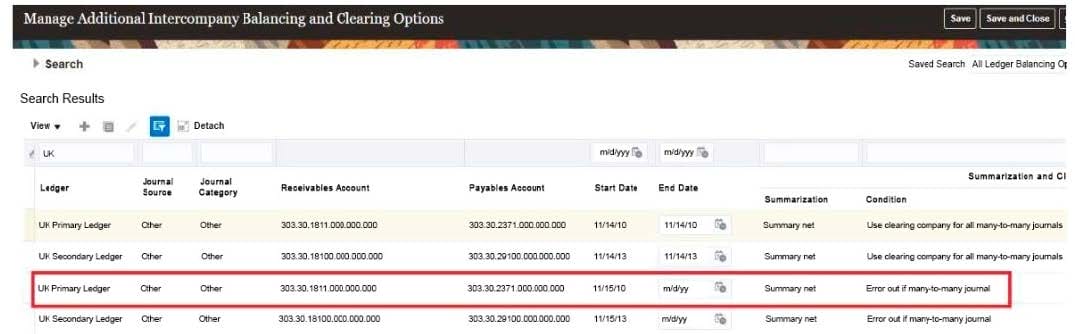
A. when there is a many-to-many journal and you want to use a clearing company

B. when the journal is not balanced by the primary balancing segment value (BSV)

C. when the journal is balanced by the primary BSV but not by second or third BSV

D. when the journal is balanced by second balancing segment value

Buy Now

Correct Answer: C

Intercompany processing will balance a journal using the accounts identified here for the UK Ledger when the journal is balanced by the primary balancing segment value (BSV) but not by second or third BSV. A BSV is a segment in the chart of accounts that identifies a legal entity or business unit for which financial statements are prepared and balanced. A primary BSV is required for every ledger and is used to balance journal entries within a ledger. A secondary or tertiary BSV is optional and is used to balance journal entries across different dimensions other than the primary BSV, such as fund or region. Intercompany processing is a feature that enables intercompany transactions between different legal entities or business units within the same enterprise. Intercompany processing uses intercompany balancing rules to generate intercompany receivables and payables accounts for cross-ledger or cross-BSV journals. Intercompany processing will balance a journal using the accounts identified here for the UK Ledger when the journal is balanced by the primary BSV but not by second or third BSV, as this indicates that there is an intercompany transaction between different legal entities or business units within the UK Ledger that requires intercompany balancing. Intercompany processing will not balance a journal using the accounts identified here for the UK Ledger when there is a many-to-many journal and you want to use a clearing company, as this is a scenario that involves multiple legal entities or business units across different ledgers that requires a separate clearing company ledger to perform intercompany balancing. Intercompany processing will not balance a journal using the accounts identified here for the UK Ledger when the journal is not balanced by the primary BSV, as this is an invalid scenario that violates the accounting rules and prevents posting of the journal. Intercompany processing will not balance a journal using the accounts identified here for the UK Ledger when the journal is balanced by second balancing segment value, as this is an incomplete scenario that does not specify whether the journal is also balanced by primary and third BSV.

Reference: Oracle Financials Cloud: General Ledger 2022 Implementation Professional Objectives-Configure and Process Intercompany 12

Questions 12

Your customer uses Financials Cloud, Projects, Inventory and Procurement.

Which two statements are true regarding intercompany accounting for these products? (Choose two.)

A. Each product has its own Intercompany Accounting feature that needs to be set up separately

B. Within Financials Cloud, Intercompany Balancing Rules are used to balance both cross-ledger intercompany transactions and single-ledger Intercompany journals

C. Intercompany Balancing Rules are defined centrally and applied across Financials and Project Portfolio Management D. They need to license a separate stand-alone Intercompany product that acts as the Intercompany Accounting Hub

Buy Now

Correct Answer: BC

Intercompany Balancing Rules are used to automatically create balancing entries for intercompany transactions that span different ledgers or legal entities within a ledger. They are defined centrally in the Manage Intercompany Balancing Rules task and can be applied across Financials and Project Portfolio Management products. Intercompany Balancing Rules can also be used to balance single-ledger intercompany journals that have different balancing segment values for the debit and credit lines.

Reference: Oracle Financials Cloud: General Ledger 2022 Implementation Professional Objectives-Configure and Process Intercompany 12

Questions 13

What are the two benefits of having the Essbase cube embedded in General Ledger Cloud? (Choose two.)

A. Posting performance is much faster

B. Integrating with third-party systems is easier because the Essbase cube provides chart of accounts mapping rules

C. General ledger balances are multidimensional, allowing you to perform robust reporting and analysis

D. You can access real-time results for reporting and analysis because every time a transaction is posted in General Ledger, multidimensional balances are also updated simultaneously

E. You no longer need to create and maintain hierarchies because the Essbase cubes are created when you create your chart of accounts

Buy Now

Correct Answer: CD

The benefits of having the Essbase cube embedded in General Ledger Cloud are that general ledger balances are multidimensional, allowing you to perform robust reporting and analysis using different dimensions and hierarchies, and that you can access real-time results for reporting and analysis because every time a transaction is posted in General Ledger, multidimensional balances are also updated simultaneously. Posting performance is not faster because of the Essbase cube, as posting still involves updating the relational tables. Integrating with third-party systems is not easier because of the Essbase cube, as this involves using web services or file-based data import. You still need to create and maintain hierarchies because the Essbase cubes are not created when you create your chart of accounts, but when you complete the accounting configuration. Reference: Oracle Financials Cloud: General Ledger 2022 Implementation Professional Objectives-Use Oracle Transactional Business Intelligence (OTBI) 12

Exam Code: 1Z0-1054-22
Exam Name: Oracle Financials Cloud: General Ledger 2022 Implementation Professional
Last Update: May 23, 2026
Questions: 131

PDF (Q&A)

$45.99
ADD TO CART

VCE

$49.99
ADD TO CART

PDF + VCE

$59.99
ADD TO CART

Exam2Pass----The Most Reliable Exam Preparation Assistance

There are tens of thousands of certification exam dumps provided on the internet. And how to choose the most reliable one among them is the first problem one certification candidate should face. Exam2Pass provide a shot cut to pass the exam and get the certification. If you need help on any questions or any Exam2Pass exam PDF and VCE simulators, customer support team is ready to help at any time when required.

Home | Guarantee & Policy |  Privacy & Policy |  Terms & Conditions |  How to buy |  FAQs |  About Us |  Contact Us |  Demo |  Reviews

2026 Copyright @ exam2pass.com All trademarks are the property of their respective vendors. We are not associated with any of them.