1Z0-1055-21 Online Practice Questions and Answers
Certain suppliers that your customer regularly deals with are exempt from tax. How would you configure tax for this?
A. Enable the relevant suppliers for Offset Tax and create an Offset Tax to remove the calculated tax line from these suppliers.
B. Define a Tax Status and Rate for Exempt, define a Party Fiscal Classification of Exempt, assign it to the relevant suppliers, and write a rule to incorporate the exempt Party Fiscal Classification.
C. Create a new Tax Regime for the Exempt tax and subscribe the exempt suppliers to the tax regime on the Configuration Options tab.
D. Define a Tax Status and Rate for Exempt, define a Supplier Fiscal Classification of Exempt, assign it to the relevant suppliers, and write a rule to incorporate the exempt Supplier Fiscal Classification.
When creating a check payment, from where is the payment document defaulted?
A. Legal Entity
B. Bank
C. Business Unit
D. Bank Account
E. Supplier
You want to route invoices to three different approvers at the same time and only one approver needs to approve the invoice. Which approval ruleset should you use?
A. InvoiceApproversFYIParticipantInParallelMode
B. InvoiceApproversSingleParticipantInParallelMode
C. InvoiceApproversParallelParticipantInParallelMode
D. Invoice Approvers
The Accounts Payable Manager voided a foreign currency payment due to insufficient funds. Which three statements are correct? (Choose three.)
A. All related interest invoices are reversed if previously created.
B. Any previous accounting and payment records for an invoice are reversed.
C. All related withholding tax invoices are automatically voided.
D. Any realized gain or loss previously calculated is reversed.
E. Voiding the payment automatically places an invoice on hold.
Which reports can show you differences between your subledger balances and general ledger balances to help you reconcile quickly?
A. Payables to Ledger Reconciliation report
B. Payables Aging reports with the General Ledger Trial Balance report
C. General Ledger Financial Statements and the Accounts Payable and Invoice Registers
D. Payables Trial Balance and General Ledger Trial Balance reports
Your customer matches their invoices to a purchase order and have noticed that the payment terms are
defaulting from the order. For some suppliers, they would like to use the payment terms from the supplier
site.
How can the customer achieve this?
A. Enter the payment terms in the Manage Payment Options page so they default onto the invoice.
B. Enter the payment terms at the Supplier level so they default onto the invoice.
C. Enter the payment terms at the supplier site level so they default onto the invoice.
D. Manually override the payment terms that have defaulted from the purchase order for those suppliers.
E. Enter the payment terms in the Manage Invoice Options page so they default onto the invoice.
You need to create a recurring expense for one of your regular expenses. Which three are frequencies that you can choose for these types of expenses? (Choose three.)
A. Weekly
B. Monthly
C. Bimonthly
D. Biweekly
E. Annually
You have two business units, Vision Operations and Vision Services. How can you enable expense auditors to audit expense reports for specific business units?
A. Use segment valuesecurity rules to secure access to business units.
B. Assign the Expense Auditor Vision Operations and Expense Auditor Vision Services data roles to each Expense Auditor.
C. Assign the Expense Auditor as the owner of each business unit.
D. Assign the Expense Auditor job roles to each auditor.
You have 10 ledgers and 30 business units and want to leverage Preference Data Sets. What is the function of Reference Data Sets?
A. allow you to secure data by business unit
B. allow you to assign multiple business units to users in a shared service center
C. allow you to maintain sets of related data in a Data Dictionary
D. allow you to share reference data, such as payment terms, across multiple business units to avoid redundant setup
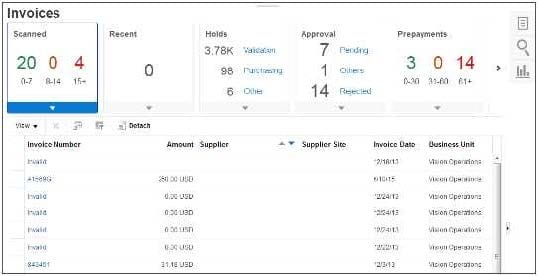
Which three attributes are captured during the scanning of invoice images?
A. Invoice Date
B. Invoice Number
C. Terms Date
D. PO Number
E. Payment Method