
1Z0-1067-22 Online Practice Questions and Answers
You have received an email from your manager to provision new resources on Oracle Cloud Infrastructure (OCI). When researching OCI, you determined that you should use OCI Resource Manager. Since this is a task that will be done multiple times for development, test, and production. You will need to create a command that can be re-used.
Which CLI command can be used in this situation? (Choose the best answer.)
A. oci resource-manager stack create ––tenancy–id
B. oci resource-manager stack update ––compartment–id
C. oci resource-manager stack create ––compartment–id
D. oci resource-manager stack update ––tenancy–id
You are asked to deploy a new application that has been designed to scale horizontally. The business stakeholders have asked that the application be deployed in us-phoenix-1.
Normal usage requires 2 OCPUs. You expect to have few spikes during the week, that will require up to 4 OCPUs, and a major usage uptick at the end of each month that will require 8 OCPUs.
What is the most cost-effective approach to implement a highly available and scalable solution? (Choose the best answer.)
A. Create an instance pool with a VM.Standard2.2 shape instance configuration. Setup the autoscaling configuration to use 2 availability domains and have a minimum of 2 instances, to handle the weekly spikes, and a maximum of 4 instances.
B. Create an instance with 1 OCPU shape. Use the Resize Instance action to scale up to a larger shape when more resources are needed.
C. Create an instance with 1 OCPU shape. Use a CLI script to clone it when more resources are needed.
D. Create an instance pool with a VM.Standard2.1 shape instance configuration. Setup the autoscaling configuration to use 2 availability domains and have a minimum of 2 instances and a maximum of 8 instances.
You have the following compartment structure within your company's Oracle Cloud Infrastructure (OCI) tenancy:
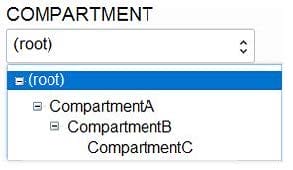
You want to create a policy in the root compartment to allow SystemAdmins to manage VCNs only in CompartmentC.
Which policy is correct? (Choose the best answer.)
A. Allow group SystemAdmins to manage virtual-network-family in compartment CompartmentB:CompartmentC
B. Allow group SystemAdmins to manage virtual-network-family in compartment Root
C. Allow group SystemAdmins to manage virtual-network-family in compartment CompartmentA:CompartmentB:CompartmentC
D. Allow group SystemAdmins to manage virtual-network-family in compartment CompartmentC
You run a large global application with 90% of customers based in the US and Canada. You want to be able to test a new feature and allow a small percentage of users to access the new version of your application.
What Oracle Cloud Infrastructure Traffic Management steering policy should you utilize? (Choose the best answer.)
A. Load Balancer
B. IP Prefix steering
C. ASN steering
D. Geolocation steering
Which two statements are TRUE about Object Storage data security and encryption in Oracle Cloud Infrastructure (OCI)? (Choose two.)
A. Client-side encryption is managed by the customer.
B. Data needs to be decrypted on the client side before retrieving it.
C. OCI Vault Management is used by default to provide data security.
D. All traffic to and from Object Storage service is encrypted using TLS.
E. A VPN connection to OCI is required to ensure secure data transfer to an object storage bucket.
Your company has restructured its HR departments. As part of this change, you also need to re-organize compartments within Oracle Cloud Infrastructure (OCI) to align them to the company's new organizational structure. The following change is required:
Compartment Team_x needs to be moved under a new parent compartment, Project_B
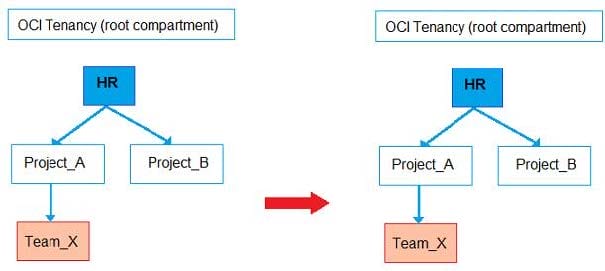
The tenancy has the following policies defined for compartments Project_A and Project_B: Policy1: Allow group G1 to manage instance-family in compartment HR:Project_A Policy2: Allow group G2 to manage instance-family in compartment HR:Project_B
Which two statements describe the impacts after the compartment Team_x is moved? (Choose two.)
A. Group G2 can now manage instance-families in compartment Project_B and compartment Team_X
B. Group G1 can now manage instance-families in compartment Project_A, compartment Project_B and compartment Team_X
C. Group G1 can now manage instance-families in compartment Project_A but not in compartment Team_x
D. Group G2 can now manage instance-families in compartment Project_A but not in compartment Team_x
E. Group G2 can now manage instance-families in compartment Project_B, compartment Project_A and compartment Team_X
You have ordered two FastConnect connections that provide a high availability connection architecture between your on-premises data center and Oracle Cloud Infrastructure (OCI). You want to run these connections in an ACTIVE/PASSIVE architecture.
How can you accomplish this? (Choose the best answer.)
A. Decrease the prefix length of AS for the FastConnect you want to use as PASSIVE connection.
B. Enable BGP on the FastConnect that you want as the ACTIVE connection.
C. Use AS PATH prepending with your routes.
D. Adjust one of the connections to have a higher ASN.
The boot volume on your Oracle Linux instance has run out of space. Your application has crashed due to a lack of swap space, forcing you to increase the size of the boot volume.
Which step should NOT be included in the process used to solve the issue? (Choose the best answer.)
A. Reattach the boot volume and restart the instance.
B. Attach the resized boot volume to a second instance as a data volume; extend the partition and grow the file system in the resized boot volume.
C. Stop the instance and detach the boot volume.
D. Resize the boot volume by specifying a larger value than the boot volume's current size.
E. Create a RAID 0 configuration to extend the boot volume file system onto another block volume.
You have been asked to update the lifecycle policy for object storage using the Oracle Cloud Infrastructure (OCI) Command Line Interface (CLI).
Which command can successfully update the policy? (Choose the best answer.)
A. oci os object-lifecycle-policy delete –ns
B. oci os object-lifecycle-policy put –ns
C. oci os object-lifecycle-policy put –ns
D. oci os object-lifecycle-policy get –ns
Your deployment platform within Oracle Cloud Infrastructure (OCI) leverages a compute instance with multiple block volumes attached. There are multiple teams that use the same compute instance and have access to these block volumes. You want to ensure that no one accidentally deletes any of these block volumes. You have started to construct the following IAM policy but need to determine which permissions should be used.
allow group DeploymentUsers to manage volume-family where ANY { request.permission != , request.permission != , request.permission != }
Which permissions can you use in place of in this policy? (Choose the best answer.)
A. VOLUME_DELETE, VOLUME_ATTACHMENT_DELETE, VOLUME_BACKUP_DELETE
B. VOLUME_ERASE, VOLUME_ATTACHMENT_ERASE, VOLUME_BACKUP_ERASE
C. ERASE_VOLUME, ERASE_VOLUME_ATTACHMENT, ERASE_VOLUME_BACKUP
D. DELETE_VOLUME, DELETE_VOLUME_ATTACHMENT, DELETE_VOLUME_BACKUP