
1Z0-148 Online Practice Questions and Answers
You executed the following command:
SQL> ALTER SESSION SET PLSCOPE_SETTINGS = 'IDENTIFIERS:ALL';
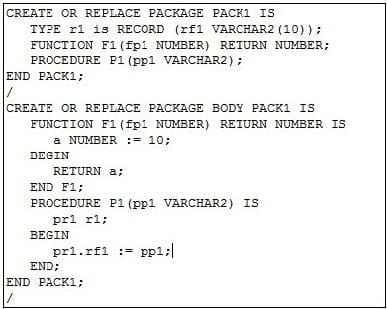
You create a new package called PACK1. View Exhibit1 to examine the PL/SQL code for the PACK1
package specification and body.
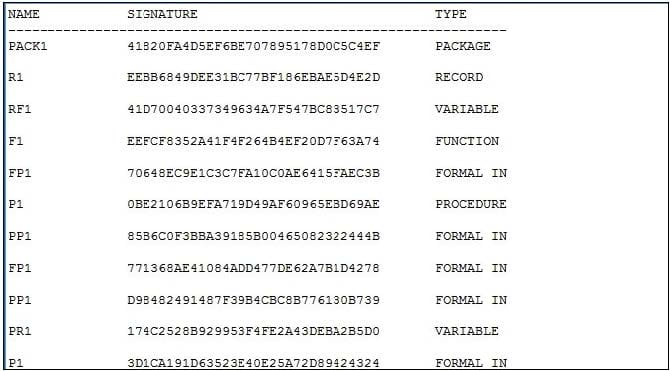
You issue the following query to see all unique identifiers with a name, such as %1:
SQL> SELECT NAME, SIGNATURE, TYPE
FROM USER_IDENTIFIERS
WHERE NAME LIKE '%1' AND USAGE='DECLARATION'
ORDER BY OBJECT_TYPE, USAGE_ID;
View Exhibit2 to examine the output of the query. Which two statements are true about the output of the
query? (Choose two.)
A. The SIGNATURE column has a unique value for an identifier except for identifiers with the same name.
B. The TYPE column has the value of packages, function or procedures, object types, PL/SQL types, triggers, or exceptions.
C. The query shows the output for only those identifiers for PL/SQL objects, which are created by the user and are compiled after the ALTER SESSION command.
D. The ALTER SESSION command automatically collects identifier data and the query shows the output for all the identifiers for PL/SQL objects, which are created by the user.
Which two statements correctly describe the features of SecureFiles? (Choose two.)
A. Compression does not entail table or index compression and vice-versa.
B. Encryption stores the encryption keys for the LOB columns inside the database.
C. Encryption stores the encryption keys for the LOB columns outside the database.
D. Compression stores identical data occurring two or more times in the same LOB column as a single copy for the table.
In a user session, tracing is enabled as follows:
SQL> EXECUTE
DBMS_TRACE.SET_PLSQL_TRACE(DBMS_TRACE.TRACE_ENABLED_LINES);
PL/SQL procedure successfully completed.
You executed the procedure as follows:
SQL> EXECUTE PROC10
PL/SQL procedure successfully completed.
When you examine the PLSQL_TRACE_EVENTS table, you find that no trace information was written into
it.
View the Exhibit.
What is the reason for this?

A. The PROC10 procedure is created with the invoker's right.
B. The PROC10 procedure is not compiled with the DEBUG option.
C. Tracing is not enabled with the TRACE_ENABLED_CALLS option.
D. The TRACE_ENABLED parameter is set to FALSE for the session.
Examine the structure of the TEST_DETAILS table: Name Null? Type
TEST_ID NUMBER
DESCRIPTION CLOB
DESCRIPTION data was entered earlier and saved for TEST_ID 12.
You execute this PL/SQL block to add data to the end of the existing data in the DESCRIPTION column for
TEST_ID 12:
DECLARE
clob_loc CLOB;
buf CHAR(12);
BEGIN
SELECT description INTO clob_loc FROM test_details WHERE test_id = 12 ;
buf := '0123456789';
DBMS_LOB.WRITEAPPEND(clob_loc,DBMS_LOB.GETLENGTH(buf), buf);
COMMIT;
END;
/
It generates an error on execution.
What correction should you do to achieve the required result?
A. WRITEAPPEND must be replaced with APPEND.
B. The BUF variable data type must be changed to CLOB.
C. FOR UPDATE must be added to the SELECT statement.
D. The GETLENGTH routine must be replaced with the LENGTH built-in function in WRITEAPPEND.
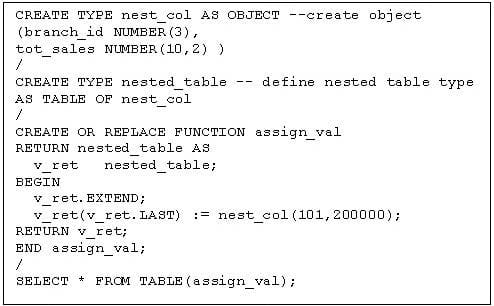
View the Exhibit and examine the PL/SQL code.
Which statement is true about the execution of the PL/SQL code?
A. It executes successfully and displays 101 and 200000 values.
B. The ASSIGN_VAL function generates an error during compilation because nested tables cannot be returned by functions.
C. The SELECT statement generates an error because the nested table has not been initialized in the ASSIGN_VAL function.
D. The ASSIGN_VAL function generates an error during compilation because the EXTEND method cannot be used with nested tables.
Examine this function call:
cur_num := DBMS_SQL.TO_CURSOR_NUMBER (cur_val);
Which two statements are true?
A. CUR_VAL must be opened after this line is executed in the PL/SQL block.
B. CUR_VAL must be a weakly typed cursor variable.
C. CUR_VAL can be either a strongly or weakly typed cursor variable.
D. CUR_VAL must be opened before this line is executed in the PL/SQL block.
E. The PL/SQL block can continue to use the cursor variable after this line is executed.
Which two statements describe actions developers can take to make their application less vulnerable to security attacks?
A. Include the AUTHID DEFINER clause in stored program units.
B. Do not concatenate unchecked user input into dynamically constructed SQL statements.
C. Switch from using DBMS_SQL to EXECUTE IMMEDIATE.
D. Include the AUTHID CURRENT_USER clause in stored program units.
E. Increase the amount of code that is accessible to users by default.
Examine this code executed as SYS:
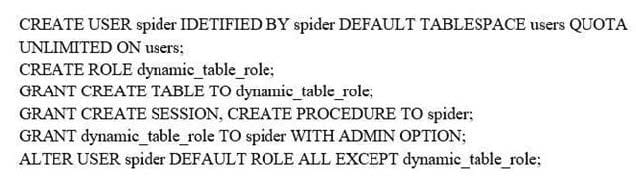
Examine this code executed as SPIDER and the error message received upon execution:
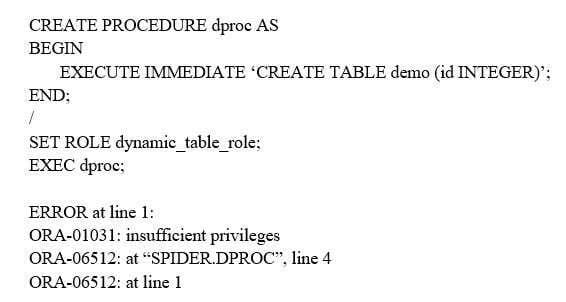
What is the reason for this error?
A. The procedure needs to be granted the DYNAMIC_TABLE_ROLE role.
B. The EXECUTE IMMEDIATE clause is not supported with roles.
C. Privileges granted through roles are never in effect when running definer's rights procedures.
D. The user SPIDER needs to be granted the CREATE TABLE privilege and the procedure needs to be granted the DYNAMIC_TABLE_ROLE.
Which statement is true about the DBMS_PARALLEL_EXECUTE package?
A. DBMS_PARALLEL_EXECUTE is a SYS-owned package and can be accessed only by a user with DBA privileges.
B. To execute chunks in parallel, users must have CREATE JOB system privilege.
C. No specific system privileges are required to create or run parallel execution tasks.
D. Only DBAs can create or run parallel execution tasks.
E. Users with CREATE TASK privilege can create or run parallel execution tasks.
You create this package and procedure:
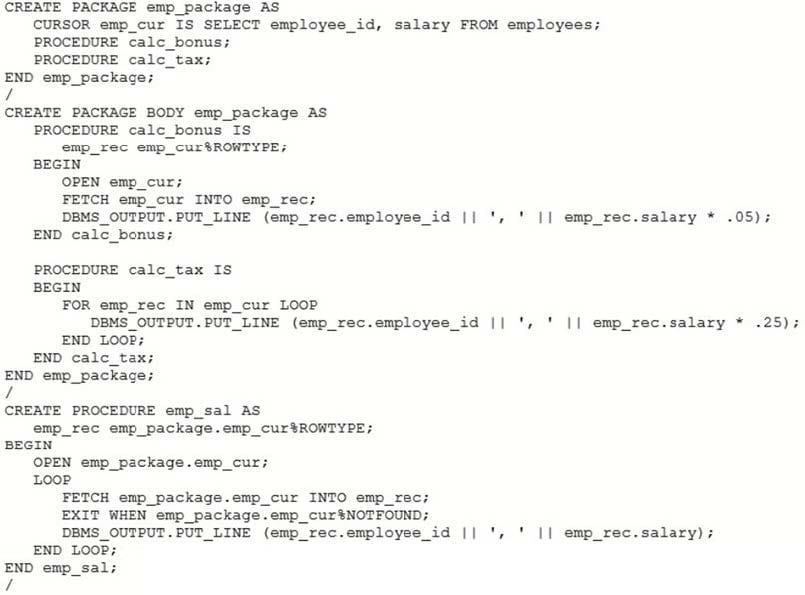
Which two blocks will execute without errors? (Choose two.)
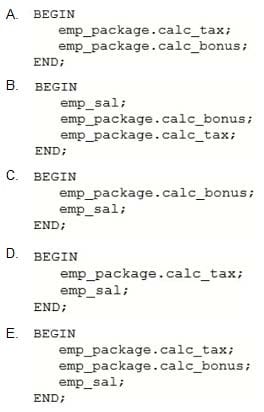
A. Option A
B. Option B
C. Option C
D. Option D
E. Option E