
1Z0-149 Online Practice Questions and Answers
Which block of code displays the error message "Incorrect price value"?


A. Option A
B. Option B
C. Option C
D. Option D
Which three are true about the procedure overloading feature? (Choose three.)
A. Each procedure can be a nested subprogram.
B. Each procedure's formal parameters can differ in data type or name.
C. Each procedure must use named notation to specify the corresponding actual parameters.
D. Each procedure's formal parameters must differ in name.
E. Each procedure can be a packaged subprogram.
F. Each procedure must use positional notation to specify the corresponding actual parameters.
G. Each procedure can be a standalone subprogram.
SERVEROUTPUT is enabled.
Which is the correct method to use a PACKAGED CONSTANT in SELECT statements?
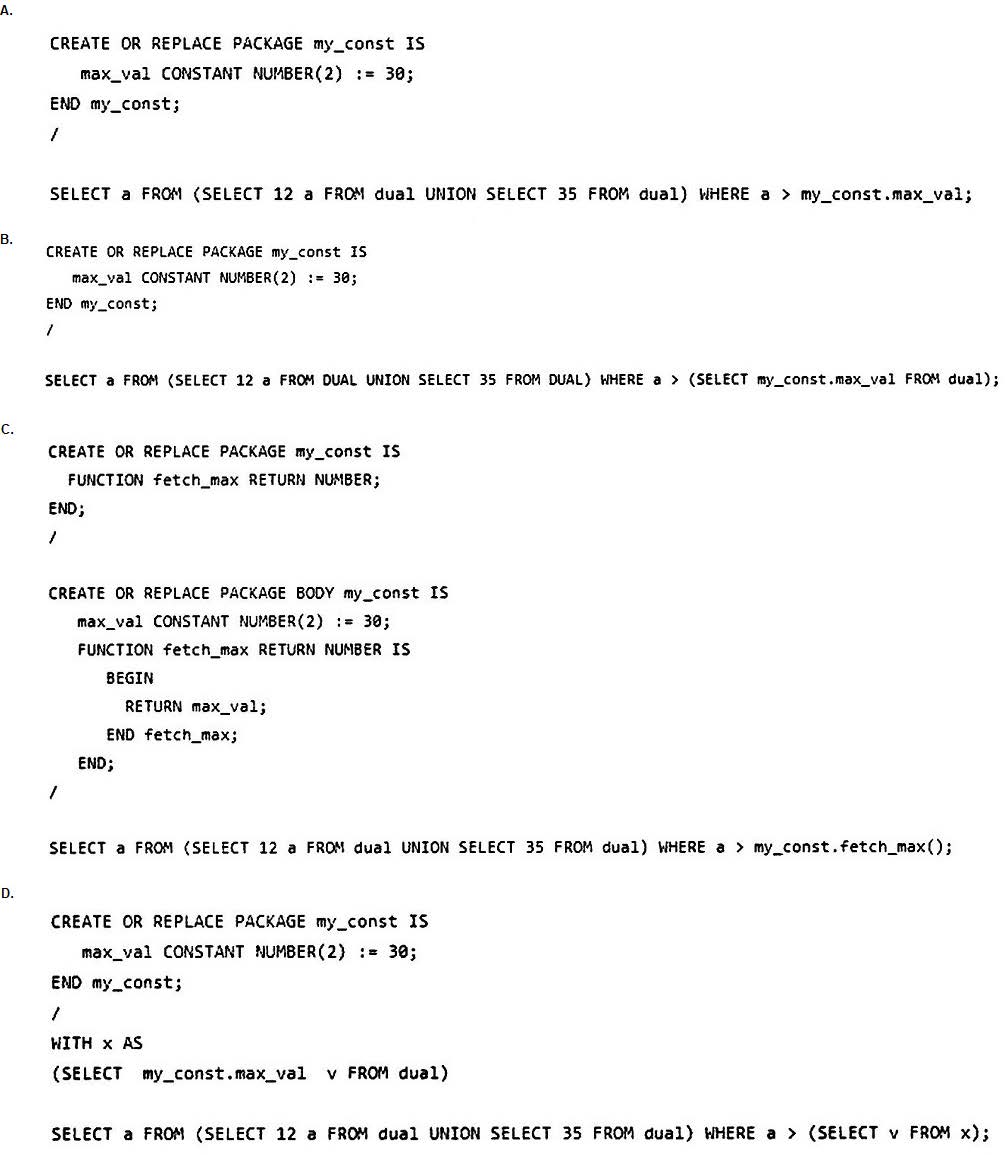
A. Option A
B. Option B
C. Option C
D. Option D
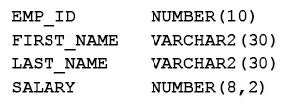
Examine the EMPLOYEES table structure:
Now, examine this code:
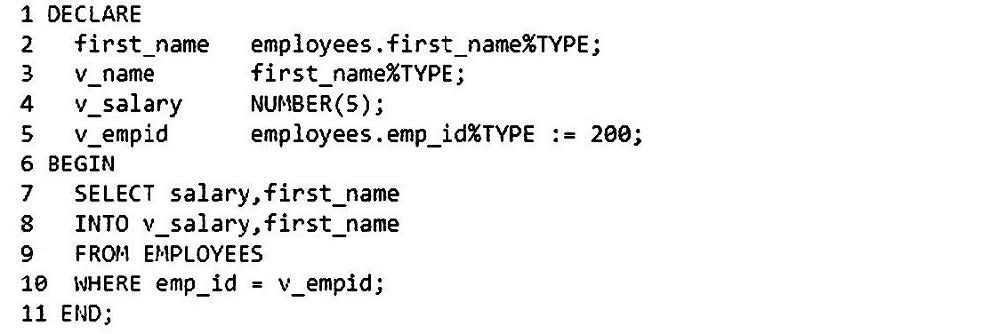
Which statement is true about the result of executing this block?
A. It will execute successfully provided the salary of EMP_ID 200 does not exceed the value 99999.
B. It will return an error at line 2.
C. It will return an error at line 3.
D. It will return an error at line 8.
E. It will execute successfully by rounding up the salary of EMP_ID 200 to the appropriate value.
Examine this anonymous block of code:
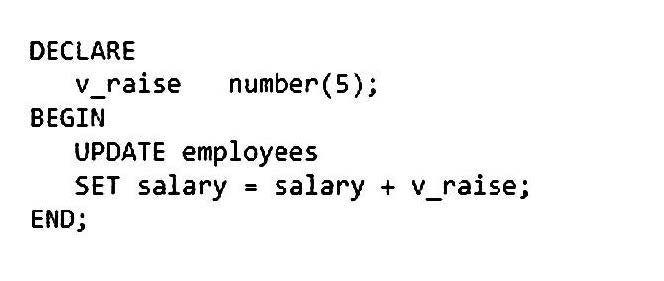
Which two statements are true about the results of executing it? (Choose two.)
A. It will set all salaries to 0 if it executes successfully.
B. It will always return a compile time error because it lacks an EXCEPTION section.
C. It might return a run time error depending on who invokes it.
D. It will always automatically initialize v_raise.
E. It will set all salaries to NULL if it executes successfully.
F. It will always return a run time error because v_raise is not initialized.
Which is true about the PLSCOPE_SETTINGS parameter?
A. It is deprecated in Oracle 12c.
B. It can be used to obtain information about all identifiers when compiling a procedure.
C. It can be used to control execution of specific portions of the PL/SQL code conditionally.
D. It can be used to control a user's privileges on PL/SQL objects at run time.
Which two are true about collections and RECORD types? (Choose two.)
A. A variable of RECORD type can contain fields of another RECORD type or any collection type.
B. Only associative arrays and nested tables can have elements of RECORD type.
C. All collections and RECORD types can be defined in PL/SQL blocks, packages, or at the schema level.
D. Collections and RECORD types are always dense.
E. All collections and RECORD types can be stored in table columns.
F. VARRAYS, nested tables and each field in %ROWTYPE type variables have a default value of null.
Examine the structure of the ora1.depts table:
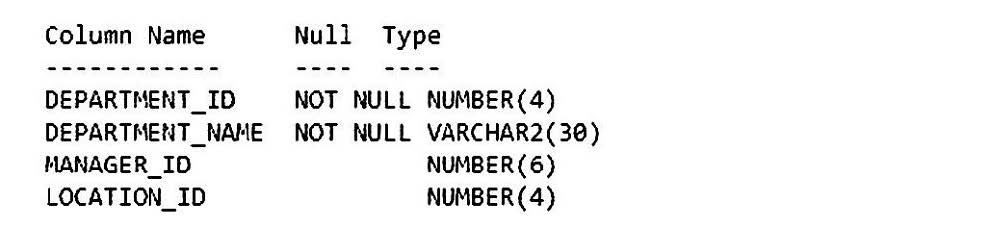
Now, examine these statements issued by user ora1 which execute successfully:
Create or replace view dep_vu as select * from depts;
Alter table depts add dep_email varchar2(20);
Finally, examine this block of code executed by user ora1:
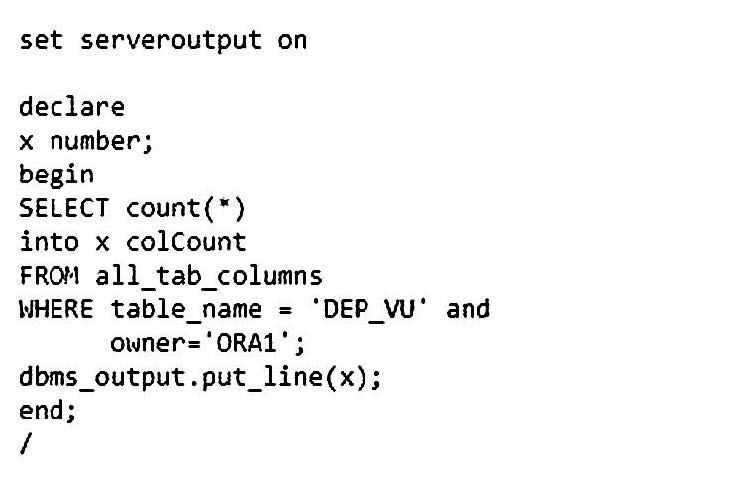
Which is true?
A. DEP_VU must be manually recompiled to successfully run this code.
B. It will run successfully producing a result of 4.
C. It will result in an error because table depts has been altered.
D. It will run successfully producing a result of 5.
Which three PL/SQL-only data types can be used in queries and native dynamic SQL issued from PL/SQL in the server? (Choose three.)
A. a record declared in an anonymous block
B. a record declared in a procedure
C. an associative array indexed by PLS_INTEGER
D. a record declared in a package specification
E. a predefined PL/SQL-only data type like BOOLEAN
F. an associative array indexed by VARCHAR2
Examine this DECLARE section:
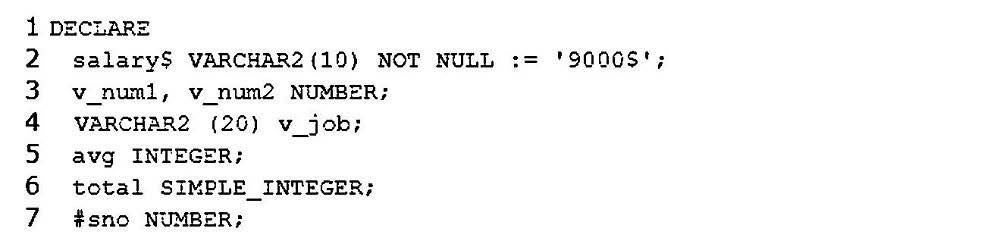
Which two lines are valid? (Choose two.)
A. line 5
B. line 6
C. line 7
D. line 4 E. line 3
F. line 2