
Exam2pass
0 items Sign In or Register
  • Home
  • IT Exams
  • Guarantee
  • FAQs
  • Reviews
  • Contact Us
  • Demo
Exam2pass > Oracle > Oracle Certifications > 1Z0-591 > 1Z0-591 Online Practice Questions and Answers

1Z0-591 Online Practice Questions and Answers

Questions 4

Which two components are required for all OBIEE installations?

A. Admin Server

B. RCU Schema

C. Managed Server

D. Node Manager

E. Oracle 11g

Buy Now

Correct Answer: BE

Explanation: B: Before you can run Oracle Business Intelligence 11g Installer, you must first create

required Oracle Business Intelligence schemas in an unhardened database. You use a tool called the Repository Creation Utility (RCU) to create these schemas with the appropriate permissions and data.

E: The database 11gR2 is required if you want to run the Oracle Business Intelligence Enterprise Edition Plus Samples One Oracle Database Preinstalled and not hardened to host the schemas.

Questions 5

The WebLogic Repository Schema generated via RCU can be deployed to which three DBMS?

A. Oracle RDBMS

B. Microsoft SQL Server

C. IBM DB2

D. Teradata

Buy Now

Correct Answer: ABC

Explanation: BIEE 11g Install High level Steps : Software Required

1.

Database (Oracle, IBM DB2 or MS-SQL)

2.

Repository Creation Utility (RCU)

3.

OBIEE 11g (11.1.1.3 is latest OBIEE as of 30 April 2011)

4.

WebLogic 10.3.3 (Optional ?Only required for 64 bit machine or IBM AIX)

5.

JDK 1.6 64 bit (Optional ?Only required for 64 bit machine)

Questions 6

There is a logical fact table that contains Item number, store, time, and revenue. How would you add Number of items sold?

A. By creating a derived measure on the logical column Item number and using the count Function

B. By creating a derived measure on the logical column item number and using the count distinct function

C. By creating a derived measure based on the physical column item number and changing the aggregation method to count

D. By creating a derived metric by using the Expression Builder
Buy Now

Correct Answer: C

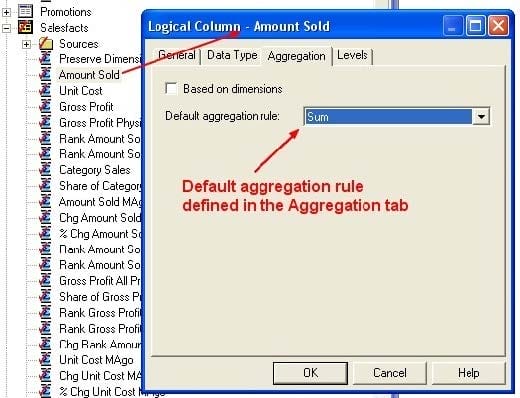
Explanation: A measure column is a column unlike the baseline column that has a default aggregation rule defined in the Aggregation tab of the Logical Column dialog in the repository. Measure columns always calculate the aggregation with which they are defined. Measures need to be defined in a logical fact. Any column with an aggregation rule is a measure.

Questions 7

One benefit of adding a second table source that is joined to the first table source in the Physical Layer by a foreign key relationship is that______.

A. Multiple SQL queries are performed

B. Two SQL queries are performed to get data from both tables

C. A single SQL query is performed to get data from both tables

D. No SQL queries are performed against the source tables

Buy Now

Correct Answer: C

Explanation: A single query can be performed accessing data from both tables through a join on the columns in the foreign key relation.

Questions 8

How will you model a Type II Slowly-Changing Dimension?

A. Add an additional column to the dimension table to capture a version of change

B. Overwrite an existing dimension table record with the changed record

C. Add a new row to the dimension table with a new key for the changed record

D. Do Nothing

Buy Now

Correct Answer: C

Explanation: Dimensional Modeling - Slowly Changing Dimensions

*

Type 1 - Overwrite Original Value

A change does not require tracking

*

Type 2 - Add a new record

With Type II SCD, a new version of the dimension record (row) is created, and the existing version is marked as history.

Each row does not correspond to a different instance of an entity but a different "state", a "snapshot" of the instance at a point in time.

Note: Tracking changes in dimension is referred in datawarehousing as slowly changing dimensions.

In the source system a lot of changes are daily made :

new customers are added,

addresses are modified,

new regional hierarchies are implemented,

or simply the product descriptions and packaging change.

These sorts of changes need to be reflected in the dimension tables and in several cases, the history of the changes also needs to be tracked.

By remembering history, we are then able to look at historical data and compare it to their current situation.

Questions 9

Identify the two Object level security functions that are done on the repository by using the BI Admin tool.

A. Assign users to a web catalog group

B. Create a new repository group

C. Create a new user in the repository

D. Create a web catalog group

E. Define permissions for Dashboard

Buy Now

Correct Answer: BC

Explanation: The Oracle Business Intelligence (BI) Administration Tool can be used to build, modify, enhance, and manage an Oracle BI repository.

C: To add a new user to a repository

1 Open a repository in the Administration Tool.

2 Display the security manager by selecting Manage > Security. 3 Select Action > New > User to open the User dialog box.

4 Type a name and password for the user.

5 If you want to log queries for this user in the query log, change the query logging level to 1 or 2.

6 Click OK.

This creates a new user with default rights granted to it.

Note: What is Oracle BI Admin Tool/Oracle Business Intelligence Administration Tool?

Oracle Business Intelligence Administration Tool is Used to manage OBIEE server Available only for Windows operating systems.

A Windows application that allows the BI Server administrator to create and edit repositories. Can edit repositories in either online or offline mode. Having a session manager and a cache manager in online mode.

Questions 10

There are two aggregate tables that are available for query. How would they be mapped into the logical data model so queries can use them?

A. By creating two new logical tables sources

B. By opening the two logical Table Source dialog boxes and mapping the appropriate levels in the Content tab

C. Both A and B

D. By creating one new Logical Table Source
Buy Now

Correct Answer: B

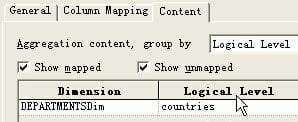
1. Configure the new source table to have the 'logical level' under the content set to 'Countries' (the summarized level)

Explanation: B: Example:

b

2. Do the similiar setting for dimension table Now when user query the data at 'Counties' level, the query will be redirected to these summary table instead of the more detail fact table Note: Aggregate tables are Physical tables that store Aggregates of measures across multiple levels of a Hierarchy.

Questions 11

The three metadata layers are an important concept of the BI Server. Which statement is incorrect?

A. The physical layer defines the objects and relationships that the Oracle BI Server needs to write native queries against each physical data source.

B. Separating the logical of the application from the physical model provides the ability to federate multiple physical sources to the same logical object.

C. The model and mapping layer define the business or logical model of the data. This layer determines the analytic behavior seen by users.

D. The presentation layer defines the relationship that is needed to create the DML.

Buy Now

Correct Answer: D

Explanation: The relationship is defined at the model and mapping layer.

Note:

At the highest level, an OBIEE Metadata Repository includes three layers of information:

1.

First, a Physical layer is defined. The metadata layer identifies the source data.

2.Second, a Business Model and Mapping layer is defined. This metadata layer organizes the physical layer into logical categories and records the appropriate metadata for access to the source data. 3.Finally, the Presentation layer is defined. This metadata layer exposes the business model entities for end-user access.

Questions 12

Which option does not describe Aggregate tables?

A. Aggregate tables increase query performance by pre-calculating frequently accessed measure aggregations.

B. Aggregate tables relieve bottlenecks and pre-calculate and store the data for better query response.

C. Aggregate tables typically have fewer rows than the non aggregate tables and, therefore, processing should be quicker.

D. Aggregate tables are created and stored on the BI Server.

Buy Now

Correct Answer: D

Questions 13

You run the Consistency Check and receive the warning: [39003] Missing functional dependency association for column: DIM_Offer_End_Date.CREATE_DT.

What would you check?

A. Whether the logical table source for this column has been disabled

B. Whether the columns creating CREATE_DT have been deleted

C. Whether there is a logical join between the DIM and FACT tables

D. Whether there is a physical join between the DIM and FACT tables

E. Whether there is a physical column mapped to the logical column

F. DIM_Offer_End_Date.CREATE_DT

Buy Now

Correct Answer: A

Explanation: This warning indicates that the given column is only mapped to logical table sources that are disabled. The warning brings this issue to the repository developer's attention in case the default behavior is not desired.

Reference: Oracle Fusion Middleware Metadata Repository Builder's Guide for Oracle Business Intelligence Enterprise Edition, Common Consistency Check Messages

Exam Code: 1Z0-591
Exam Name: Oracle Business Intelligence Foundation Suite 11g Essentials
Last Update: May 29, 2026
Questions: 120

PDF (Q&A)

$45.99
ADD TO CART

VCE

$49.99
ADD TO CART

PDF + VCE

$59.99
ADD TO CART

Exam2Pass----The Most Reliable Exam Preparation Assistance

There are tens of thousands of certification exam dumps provided on the internet. And how to choose the most reliable one among them is the first problem one certification candidate should face. Exam2Pass provide a shot cut to pass the exam and get the certification. If you need help on any questions or any Exam2Pass exam PDF and VCE simulators, customer support team is ready to help at any time when required.

Home | Guarantee & Policy |  Privacy & Policy |  Terms & Conditions |  How to buy |  FAQs |  About Us |  Contact Us |  Demo |  Reviews

2026 Copyright @ exam2pass.com All trademarks are the property of their respective vendors. We are not associated with any of them.