
1Z0-902 Online Practice Questions and Answers
Which four actions should you take before proceeding with applying updates to your Exadata Database Machine?
A. Consult My Oracle Support note 888828.1 to determine the current recommended Exadata software release.
B. Check the Exadata Critical Issues My Oracle Support note 1270094.1 for any issues not added to the latest version of exachk.
C. Run exachk and resolve only WARNINGS that you have not seen before.
D. Run the appropriate patchmgr preqequisite check step for each component being updated.
E. Run patchmgr --all_comp --autofix --autobackup --upgrade --rolling.
F. For database servers, perform a server backup using patchmgr --dbnodes db_list_file --backup --rolling.
You are updating your Exadata X9M-2 Elastic Database Machine with 6 database servers and 12 High Capacity Storage Servers. You will be using patchmgr to apply updates across the entire machine while still maintaining database availability.
Assuming you are driving patchmgr from an external server, which statement is true about the execution phase?
A. patchmgr must be invoked with the --rolling argument. Each component type must be upgraded independently of the other.
B. patchmgr cannot apply updates in a rolling manner, you must manually apply patches with the dbnodeudpate and cellupdate tools if high availability is required.
C. patchmgr will apply patches in component groups consisting of 1 database server and 2 storage servers to minimize disruption.
D. patchmgr must be invoked with the --rolling argument with all database and storage servers listed in a single input file.
What are two recommended configuration best practices for backup and recovery on Exadata?
A. Placing the backup network on dedicated switches installed in the top of the rack (ToR) has the benefits of isolating the backup network from other workloads and providing a greater level of control.
B. Even if the backup was limited to writing to four tape drives, eight channels could be specified to expedite the restore process.
C. The internal Recovery Appliance backup and restore processing is optimized when the RMAN FILESPERSET parameter is set to 1 for the level 1 incremental backup set.
D. When off-site long-term backup retention is needed, use Oracle Database Backup Cloud Service as a low-cost, offsite scalable storage for a disaster recovery solution.
You are adding a disk expansion kit to a running Exadata X8M Database Machine's Database Servers, and have a filesystem layout that includes:
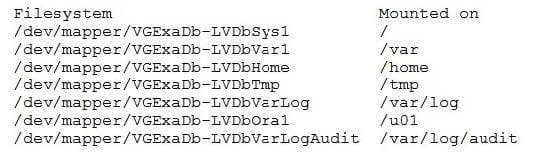
After running the following commands, which command needs to be run to add 20G of space to the filesystem mounted on /u01?

A. # lvextend -L +20G --verbose /dev/mapper/VGExaDb-LVDbOral
B. # xfs_growfs /uOl +20G
C. # resize2fs +20G /dev/VGExaDb/LVDbOral
D. # lvextend -L +20G --verbose /dev/VGExaDb/LVDbOral
Which are three customer options for hosting the Platinum Services Advanced Support Gateway?
A. Install on Oracle Database Appliance.
B. Provide individual x86 64-Bit gateway hardware.
C. Install in Oracle Virtual Machine with required hardware.
D. Purchase the recommended x86 64-Bit gateway hardware from Oracle.
E. Install on Exadata Engineered System.
Which are two correct statements for managing virtual deployment using Oracle Exadata Deployment Assistant (OEDA)?
A. OEDA allows customers to have both bare metal (BM) and virtual machine (VM) in an Exadata X9M Quarter Rack.
B. There is no limit on the number of VMs in an Exadata rack as long as the Exadata rack has adequate resources.
C. OEDA deployment steps include calibrate cells, create cell disks, and resecure machine.
D. OEDA sets up key-based authentication for the root user by using the setuprootssh.sh utility included with OEDA.
You have been tasked with replacing a memory module of an Exadata Storage Server and need to power off the affected storage server. Which two commands must you execute to safely power off the storage server in an Exadata X9M Database Machine?
A. CeLLCLI> alter cell shutdown SERVICES all on the affected storage server
B. CeLLCLI> list GRIDDISK where status != 'inactive' on the affected storage server
C. 'crsct1 stop cluster -all' on one of the database servers
D. CellCLI LIST GRIDDISK ATTRIBUTES name WHERE asmdeactivationoutcome != 'Yes' on the affected Storage server
E. CellCLI alter GRIDDISK all inactive on the affected storage server
F. shutdown -h now' on the affected storage server
Which two of the following network connection types can be deployed on the client network ports of an Exadata X9M-2 Database Server?
A. 2x 25Gb ports on eth1 and eth2 using SFP28 transceivers and OM4 fiber cable for backup network, and 2x 25Gb ports on eth5 and eth6 using SFP28 transceivers and OM4 fiber cable for client network
B. 2x 25Gb ports on eth1 and eth2 using SFP28 transceivers and OM4 fibre cable for client network, and 2x 10Gb ports on eth9 and eth10 using RJ45 cat6 cable for backup network
C. 2x 10Gb ports on eth1 and eth2 using FU45 cat6 cable for client network, and 2x 25Gb ports on eth11 and eth12 using SFP28 transceivers and OM4 fiber cable for backup network
D. 2x 25Gb ports on eth1 and eth2 using SFP28 transceivers and OM4 fiber cable for backup network, and 2x 10Gb ports on eth3 and eth4 using RJ45 cat6 cable for client network
Which two statements are true about Auto Service Request (ASR) with an Exadata Database Machine?
A. ASR Manager must be installed and configured on a dedicated server external to the Database Machine.
B. Configuring ASR is mandatory for all Database Machine assets.
C. ASR Manager must be installed and configured on one of the database servers.
D. ASR can upload configuration metadata to support problem resolution.
E. ASR Manager opens a service request (SR) automatically after sensors detect hardware faults.
F. ASR communicates with Oracle support services using HTTPS.
You are concerned about the operating temperature of the database servers in your Exadata Full Rack and want to be alerted if the server exceeds 30C. What command should use use to generate alerts for such an event?
A. dbmcli -e "set alert ds_temp> 30" on each database server
B. dbmcli -e "set threshold ds_temp comparison=' >', critical=30" on each database server
C. dbmcli -e "alert metriccurrent ds_temp where metricValue > 30" on each database server
D. dbmcli -e "create threshold ds_temp comparison='>', critical=30" on each database server