
Exam2pass
0 items Sign In or Register
  • Home
  • IT Exams
  • Guarantee
  • FAQs
  • Reviews
  • Contact Us
  • Demo
Exam2pass > Oracle > Oracle Certifications > 1Z0-997-21 > 1Z0-997-21 Online Practice Questions and Answers

1Z0-997-21 Online Practice Questions and Answers

Questions 4

You are currently working for a public health care company based in the United Stats. Their existing patient records runs in an on-premises data center and the customer is sending tape backups offsite as part of their recovery planning. You have developed an alternative archival solution using Oracle Cloud Infrastructure (OCI) that will save the company a significant amount of mom on a yearly basis. The solution involves storing data in an OCI Object Storage bucket After reviewing your solution with the customer global Compliance (GRC) team they have highlighted the following security requirements: All data less than 1 year old must be accessible within 2 hour. All data must be retained for at least 10 years and be accessible within 48 hours AH data must be encrypted at rest No data may be transmitted across the public Internet

Which two options meet the requirements outlined by the customer GRC team?

A. Provision a FastConnect link to the closest OCI region and configure a private peering virtual circuit.

B. Create an OCI Object Storage Standard tier bucket Configure a lifecycle policy to archive any object that Is older than 365 days

C. Create a VPN connection between your on premises data center and OCI. Create a Virtual Cloud Network (VCN) along with an OCI Service Gateway for OCI Object Storage.

D. Provision a FastConnect link to the closest OCI region and configure a public peering virtual circuit

E. Create an OCI Object Storage Standard tier bucket. Configure a lifecycle policy to delete any object that is older than 7 years

Buy Now

Correct Answer: BD

The Oracle Services Network is a conceptual network in Oracle Cloud Infrastructure that is reserved for

Oracle services. These services have public IP addresses that you typically reach over the internet.

However, you can access the Oracle Services Network without the traffic going over the internet.

There are different

ways, depending on which of your hosts need the access:

Hosts in your on-premises network:

-Private access through a VCN with FastConnect private peering or VPN Connect: The on-premises hosts use private IP addresses and reach the Oracle Services Network by way of the VCN and the VCN's service gateway.

-Public access with FastConnect public peering: The on-premises hosts use public IP addresses. regarding which Fastconnect Public peering: To access public services in Oracle Cloud Infrastructure without using the internet. For example, Object Storage, the Oracle Cloud Infrastructure Console and APIs, or public load balancers in your VCN. Communication across the connection is with IPv4 public IP addresses. Without FastConnect, the traffic destined for public IP addresses would be routed over the internet. With FastConnect, that traffic goes over your private physical connection. so Answer 4 will be the best answer that meets the customer requirement A service gateway lets your virtual cloud network (VCN) privately access specific Oracle services without exposing the data to the public internet. No internet gateway or NAT is required to reach those specific services. The resources in the VCN can be in a private subnet and use only private IP addresses. The traffic from the VCN to the Oracle service travels over the Oracle network fabric and never traverses the internet. Object Lifecycle Management lets you automatically manage the archiving and deletion of objects. By using Object Lifecycle Management to manage your Object Storage and Archive Storage data, you can reduce your storage costs and the amount of time you spend managing data.

Questions 5

You are building a highly available and fault tolerant web application deployment for your company. Similar application delayed by competitors experienced web site attack including DDoS which resulted in web server failing. You have decided to use Oracle Web Application Firewall (WAF) to implement an architecture which will provide protection against such attacks and ensure additional configuration will you need to implement to make sure WAF is protecting my web application 24?. Which additional configuration will you need to Implement to make sure WAF Is protecting my web application 24??

A. Configure auto scaling policy and it to WAF instance.

B. Configure Control Rules to send traffic to multiple web servers

C. Configure multiple origin servers

D. Configure new rules based on now vulnerabilities and mitigations

Buy Now

Correct Answer: C

Origin Management An origin is an endpoint (typically an IP address) of the application protected by the WAF. An origin can be an Oracle Cloud Infrastructure load balancer public IP address. A load balancer IP address can be used for high availability to an origin. Multiple origins can be defined, but only a single origin can be active for a WAF. You can set HTTP headers for outbound traffic from the WAF to the origin server. These name value pairs are then available to the application. Oracle Cloud Infrastructure Web Application Firewall (WAF) is a cloud-based, Payment Card Industry (PCI) compliant, global security service that protects applications from malicious and unwanted internet traffic. WAF can protect any internet facing endpoint, providing consistent rule enforcement across a customer's applications. WAF provides you with the ability to create and manage rules for internet threats including Cross-Site Scripting (XSS), SQL Injection and other OWASP-defined vulnerabilities. Unwanted bots can be mitigated while tactically allowed desirable bots to enter. Access rules can limit based on geography or the signature of the request. Distributed Denial of Service (DDoS) A DDoS attack is an often intentional attack that consumes an entity's resources, usually using a large number of distributed sources. DDoS can be categorized into either Layer 7 or Layer 3/4 (L3/4) A layer 7 DDoS attack is a DDoS attack that sends HTTP/S traffic to consume resources and hamper a website's ability to delivery content or to harm the owner of the site. The Web Application Firewall (WAF) service can protect layer 7 HTTP-based resources from layer 7 DDoS and other web application attack vectors.

Questions 6

After performing maintenance on an Oracle Linux compute instance the system is returned to a running state You attempt to connect using SSH but are unable to do so. You decide to create an instance console connection to troubleshoot the issue. Which three tasks would enable you to connect to the console connection and begin troubleshooting?

A. Use SSH to connect to the public: IP address of the compute Instance and provide the console connection OCID as the username.

B. edit the Linux boot menu to enable access to console.

C. Use SSH to connect to the service endpoint of the console connection service

D. Reboot the compute instance using the Oracle Cloud Infrastructure (OCI) Management Console

E. Upload an API signing key for console connection authentication.

F. Stop the compute Instance using the Oracle cloud Infrastructure (OCI) Command Line interface (CLI).

Buy Now

Correct Answer: BCD

The Oracle Cloud Infrastructure Compute service provides console connections that enable you to

remotely troubleshoot malfunctioning instances, such as:

An imported or customized image that does not complete a successful boot.

A previously working instance that stops responding.

the steps to connect to console and troubleshoot the OS Issue 1- Before you can connect to the serial

console you need to create the instance console connection. Open the navigation menu. Under Core

Infrastructure, go to Compute and click Instances.

Click the instance that you're interested in.

Under Resources, click Console Connections.

Click Create Console Connection.

Upload the public key (.pub) portion for the SSH key. You can browse to a public key file on your computer

or paste your public key into the text box.

Click Create Console Connection. When the console connection has been created and is available, the status changes to ACTIVE. 2- Connecting to the Serial Console you can connect to the serial console by using a Secure Shell (SSH) connection to the service endpoint of the console connection service Open the navigation menu. Under Core Infrastructure, go to Compute and click Instances. Click the instance that you're interested in. Under Resources, click Console Connections. Click the Actions icon (three dots), and then click Copy Serial Console Connection for Linux/Mac. Paste the connection string copied from the previous step to a terminal window on a Mac OS X or Linux system, and then press Enter to connect to the console. If you are not using the default SSH key or ssh-agent, you can modify the serial console connection string to include the identity file flag, -i , to specify the SSH key to use. You must specify this for both the SSH connection and the SSH ProxyCommand, as shown in the following line: ssh -i // -o ProxyCommand='ssh -i // -W %h:%p -p 443... Press Enter again to activate the console. 3- Troubleshooting Instances from Instance Console Connections To boot into maintenance mode Reboot the instance from the Console. When the reboot process starts, switch back to the terminal window, and you see Console messages start to appear in the window. As soon as you see the GRUB boot menu appear, use the up/down arrow key to stop the automatic boot process, enabling you to use the boot menu. In the boot menu, highlight the top item in the menu, and type e to edit the boot entry. In edit mode, use the down arrow key to scroll down through the entries until you reach the line that starts with either linuxefi for instances running Oracle Autonomous Linux 7.x or Oracle Linux 7.x, or kernel for instances running Oracle Linux 6.x. At the end of that line, add the following: init=/bin/bash Reboot the instance from the terminal window by entering the keyboard shortcut CTRL+X.

Questions 7

You have multiple IAM users who launch different types of compute Instances and block volumes every day. As a result, your Oracle cloud Infrastructure (OCF) tenancy quickly hit the service limit and you can no longer create any new instances. As you are cleaning up environment, you notice that the majority of the Instances and block volumes are untagged. Therefore, It is difficult to pinpoint the owner of these resources verify if they are safe to terminate. Because of this, your company has issued a new mandate, which requires adding compute instances. Which option is the simplest way to implement this new requirement?

A. Create a policy to automatically tag a resource with the user name.

B. Create a policy using IAM requiring users to tag specific resources. This will allow a user to launch compute instances on\y if certain tags were defined.

C. Create tag variables to automatically tag a resource with the user name.

D. Create a default tag for each compartment, which ensure that appropriate tags are applied at resource creation

E. Create tag variables for each compartment to automatically tag a resource with the user name.

Buy Now

Correct Answer: C

Tag Variables You can use a variable to set the value of a defined tag. When you add the tag to a resource, the variable resolves to the data it represents. You can use tag variables in defined tags and default tags. Supported Tag Variables The following tag variables are supported. ${iam.principal.name} The name of the principal that tagged the resource ${iam.principal.type} The type of principal that tagged the resource. ${oci.datetime} The date and time that the tag was created.

Consider the following example: Operations.CostCenter=" ${iam.principal.name} at ${oci.datetime} " Operations is the namespace, CostCenter is the tag key, and the tag value contains two tag variables ${iam.principal.name} and ${oci.datetime} . When you add this tag to a resource, the variable resolves to your user name (the name of the principal that applied the tag) and a time date stamp for when you added the tag. user_name at 2019-06-18T18:00:57.604Z The variable is replaced with data at the time you apply the tag. If you later edit the tag, the variable is gone and only the data remains. You can edit the tag value in all the ways you would edit any other tag value. To create a tag variable, you must use a specific format. ${} Type a dollar sign followed by open and close curly brackets. The tag variable goes between the curly brackets. You can use tag variables with other tag variables and with string values. Tag defaults let you specify tags to be applied automatically to all resources, at the time of creation, in a specific compartment. This feature allows you to ensure that appropriate tags are applied at resource creation without requiring the user who is creating the resource to have access to the tag namespaces. https://docs.cloud.oracle.com/en-us/iaas/Content/Tagging/Tasks/managingtagdefaults.htm

Questions 8

You are working as a solutions architect for an online retail store In Frankfurt which uses multiple compute instance VMs spread among three availability domains In the eu-frankfurt-1 region. You noticed the website Is having very high traffic, so you enabled autoscaling to sun tee me no f your application but, you observed that one of the availability domains is not receiving any traffic. What could be wrong In this situation?

A. Autoscaling only works with single availability domains.

B. You have to manually acid all three availability domains to your load balancer configuration.

C. Autoscaling can be enabled for multiple availability domains only in uk-london t region.

D. Autoscaling is using an Instance Pool configured to create instances in two availability Domains.

E. You forgot to attach a load balancer to your instance pool configuration.

Buy Now

Correct Answer: D

Autoscaling lets you automatically adjust the number of Compute instances in an instance pool based on performance metrics such as CPU utilization. This helps you provide consistent performance for your end users during periods of high demand, and helps you reduce your costs during periods of low demand. you can associate a load balancer with an instance pool. If you do this, when you add an instance to the instance pool, the instance is automatically added to the load balancer's backend set . After the instance reaches a healthy state (the instance is listening on the configured port number), incoming traffic is automatically routed to the new instance. Instance pools let you provision and create multiple Compute instances based off the same configuration, within the same region. By default, the instances in a pool are distributed across all fault Domains in a best-effort manner based on capacity. If capacity isn't available in one fault domain, the instances are placed in other fault domains to allow the instance pool to launch successfully. In a high availability scenario, you can require that the instances in a pool are evenly distributed across each of the fault domains that you specify. When sufficient capacity isn't available in one of the fault domains, the instance pool will not launch or scale successfully, and a work request for the instance pool will return an "out of capacity" error. To fix the capacity error, either wait for capacity to become available, or use the UpdateInstancePool operation to update the placement configuration (the availability domain and fault domain) for the instance pool. during create the instance pool you can select the location where you want to place the instances" In the Availability Domain list, select the availability domain to launch the instances in. If you want the instances in the pool to be placed evenly in one or more fault domains, select the Distribute instances evenly across selected fault domains check box. Then, select the fault domains to place the instances in.

Questions 9

You are the Solution Architect that designed this Oracle Cloud Infrastructure (OCI) compartment layout for your organization:
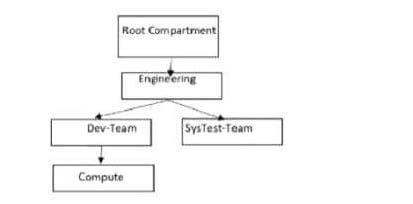
The development team has deployed quite a few instances under 'Compute' Compartment and the operations team needs to list the Instances under the same compartment for their testing. Both teams, development and operations are part of a group called 'Eng-group' You have been looking for an option to allow the operations team to list the instances without access any confidential information or metadata of resources. Which IAM policy should you write based on these requirements?

A. Allow group Eng-group to inspect instance-family in compartment Dev-Team:Compute and attach the policy to `Engineering' Compartment

B. Allow group Eng-group to inspect instance-family in compartment Dev-Team: Compute and attach the policy to 'SysTest Team' Compartment

C. Allow group Eng-group to read instance-family in compartment Compute and attach the policy to 'Engineering' Compartment.

D. Allow group Eng-group to read instance-family in compartment Dev-Team-.Compute and attach the policy to'Dev-Team'

Buy Now

Correct Answer: A

Policy Attachment When you create a policy you must attach it to a compartment (or the tenancy, which is the root compartment). Where you attach it controls who can then modify it or delete it. If you attach it to the tenancy (in other words, if the policy is in the root compartment), then anyone with access to manage policies in the tenancy can then change or delete it. Typically that's the Administrators group or any similar group you create and give broad access to. Anyone with access only to a child compartment cannot modify or delete that policy. When you attach a policy to a compartment, you must be in that compartment and you must indicate directly in the statement which compartment it applies to. If you are not in the compartment, you'll get an error if you try to attach the policy to a different compartment. Notice that attachment occurs during policy creation, which means a policy can be attached to only one compartment. Policies and Compartment Hierarchies a policy statement must specify the compartment for which access is being granted (or the tenancy). Where you create the policy determines who can update the policy. If you attach the policy to the compartment or its parent, you can simply specify the compartment name. If you attach the policy further up the hierarchy, you must specify the path. The format of the path is each compartment name (or OCID) in the path, separated by a colon: :: . . . to allow action to compartment Compute so you need to set the compartment PATH as per where you attach the policy as below examples if you attach it to Root compartment you need to specify the PATH as following Engineering:DevTeam:Compute if you attach it to Engineering compartment you need to specify the PATH as following Dev-Team:Compute if you attach it to Dev-Team or Compute compartment you need to specify the PATH as following Compute Note : in the Policy inspect verb that give the Ability to list resources, without access to any confidential information or user-specified metadata that may be part of that resource.

Questions 10

A new international hacktivist group, based in London, launched wide scale cyber attacks including SQL Injection and Cross-Site Scripting (XSS) across multiple websites which are hosted in Oracle Cloud Infrastructure (OCI). As an IT consultant, you must configure a Web Application Firewall (WAF) to protect these websites against the attacks. How should you configure your WAF to protect the website against those attacks? (Choose the best answer.)

A. Enable an Access Rule that contains XSS Filters Categories and SQL Filters Categories.

B. Enable a Protection Rule to block the attacks based on HTTP Headers that contain XSS and SQL strings.

C. Enable a Protection Rule that contains XSS Filters Categories and SQL Filters Categories.

D. Enable an Access Rule to block the IP Address range from London.

E. Enable a Protection Rule to block requests that came from London.

Buy Now

Correct Answer: C

https://www.ateam-oracle.com/using-oci-waf-web-application-firewall-with-oracle-e-businesssuite#:~:text=The%20protection%20rules%20can%20be,achieved%20by%20enabling%20correspond ing %20rules.

Questions 11

An OCI Architect is working on a solution consisting of analysis of data from clinical trials of a pharmaceutical company. The data is being stored in OCI Autonomous Data Warehouse (ADW) having 8 CPU Cores and 70 TB of storage. The architect is planning to setup autoscaling to respond to dynamic changes in the workload. Which of the following needs to be considered while configuring auto scaling? Choose two

A. Enabling auto scaling does not change the concurrency and parallelism settings

B. Auto scaling also scales IO throughput linearly along with CPU

C. The database memory SGA and PGA will not get affected by the changes in the number of CPUs during auto scaling

D. The maximum CPU cores that will be automatically allocated for this database is 16 CPUs

Buy Now

Correct Answer: AB

Auto scaling is enabled by default when you create an Autonomous Database instance or you can use Scale Up/Down on the Oracle Cloud Infrastructure console to enable or disable auto scaling. With auto scaling enabled the database can use up to three times more CPU and IO resources than specified by the number of OCPUs currently shown in the Scale Up/Down dialog. When auto scaling is enabled, if your workload requires additional CPU and IO resources the database automatically uses the resources without any manual intervention required. Enabling auto scaling does not change the concurrency and parallelism settings for the predefined services IO throughput depends on the number of CPUs you provision and scales linearly with the number of CPUs.

Questions 12

You are working with a customer who needs to attach an Oracle Cloud Infrastructure (OCI) block volume to a VM instance with read/write access type. The customer wants to know if the number of IOPS and throughput performance differs between the following two choices: Option A: attach a single 1 TB block volume to the VM instance Option B: attach two separate 500 GB block volumes In a RAID 0 array configuration to the VM instance

You can assume that the customer is using iSCSI attachment type to attach the volumes to the instance. In addition, you can assume 1 MB block size for throughput and 4 KB block size for IOPS consideration. How should you respond to the customer?

A. Option B provides higher level of throughput, but lower level of IOPS performance.

B. Both options provide the same number of IOPS and throughput performance.

C. Option A provides better IOPS, but lower throughput performance.

D. Option B provides better IOPS and throughput performance.

Buy Now

Correct Answer: B

Questions 13

You have created compartment called Dev for developers. There are two IAM groups for developers: group-devl and group-dev2. You need to write an Identity and Access Management (IAM) policy to give users in these groups access to manage all resources in the compartment Dev. Which of the following IAM policy will accomplish this?

A. Allow any-user to manage all resources in compartment Dev where request.group= /group-dev*/

B. Allow group group-devl group-dev2 to manage all resources in compartment Dev

C. Allow group /group-dev*/ to manage all resources in compartment Dev

D. Allow any-user to manage all resources in tenancy where target.comparment= Dev

Buy Now

Correct Answer: B

Exam Code: 1Z0-997-21
Exam Name: Oracle Cloud Infrastructure 2021 Architect Professional
Last Update: May 30, 2026
Questions: 137

PDF (Q&A)

$45.99
ADD TO CART

VCE

$49.99
ADD TO CART

PDF + VCE

$59.99
ADD TO CART

Exam2Pass----The Most Reliable Exam Preparation Assistance

There are tens of thousands of certification exam dumps provided on the internet. And how to choose the most reliable one among them is the first problem one certification candidate should face. Exam2Pass provide a shot cut to pass the exam and get the certification. If you need help on any questions or any Exam2Pass exam PDF and VCE simulators, customer support team is ready to help at any time when required.

Home | Guarantee & Policy |  Privacy & Policy |  Terms & Conditions |  How to buy |  FAQs |  About Us |  Contact Us |  Demo |  Reviews

2026 Copyright @ exam2pass.com All trademarks are the property of their respective vendors. We are not associated with any of them.