
1Z0-997-22 Online Practice Questions and Answers
A cloud engineer needs to enable routing between two Virtual Cloud Networks (VCN) from his tenancy. The VCNs are in the same region but in different compartments. After reviewing the IPv4 CIDR prefixes of the two VCNs, he notices that there are no overlapping CIDR blocks.
Which THREE are valid Oracle Cloud Infrastructure (OCI) options for connecting and routing between the two VCNs? (Choose three.)
A. Create two DRGs in the tenancy. Attach one VCN to one of the DRGs; attach the other VCN to the second DRG. In each one of the DRGs, create a Virtual Circuit Attachment. Select FastConnect Partner as the FastConnect type. Select any vendor from the list and complete the circuit at the partner site. Once the FastConnect IPv4 BGP field is in the UP state in each one of the Virtual Circuits, add a route rule in each one of the VCNs' route table to the other VCN using the DRG as the next hop.
B. Create two DRGs in the tenancy. Attach one VCN to one of the DRGs; attach the other VCN to the second DRG. In each one of the DRGs, create a Remote Peering Connection (RPC). Establish a connection from one RPC to the other. In each one of the VCNs' route table, add a route rule to the other VCN using the DRG as the next hop.
C. Create a DRG in the tenancy; add one of the VCN as a VCN attachment. In the other VCN, create a Local Peering Gateway (LPG). Peer the DRG to the LPG. In the VCN attached to the DRG, add a route rule in the route table that points to the DRG as the next hop. In the other VCN, add a route rule in the route table that points to the LPG as the next hop.
D. Add an LPG to each one of the VCNs. In one of the LPG, establish a Peering Connection to the other LPG. In each one of the VCN route table, add a route rule to the other VCN using the LPG as the next hop.
E. Create a DRG in the tenancy; add one of the VCNs as a VCN attachment. In the other VCN, create a Local Peering Gateway (LPG). Peer the DRG to the LPG. In the VCN attached to the DRG, enable BGP routing for the route to propagate to the VCN. In the other VCN add a route rule in the route table that points to the LPG as the next hop.
F. Create a Dynamic Routing Gateway (DRG) in the tenancy, add the two VCNs as VCN attachments and add routes in each one of the VCN route tables with the DRG as the next hop for the CIDR prefix of the other VCN.
You work for a large bank where your main application is a payment processing gateway API. You deployed the application on Oracle Container Engine for Kubernetes (OKE) and used API Gateway with several policies to control the access of the API endpoint.
However, your customers are complaining about the unavailability of the API endpoint. Upon checking, you noticed that the Gateway URL is throwing Service Unavailable error. You need to check the backend latency and backend responses when this error started last night.
What should you do to get this data? (Choose the best answer.)
A. Check with the application owner and search the log file for the container to get the metrics from the log file.
B. Go to Governance Menu and click on Audit to see the Audit log for the API Gateway. Filter it using Start and End date with a 503 response status.
C. Go to Developer Services and click on API Gateway. Go to the detail page of the gateway and select Metrics. Change the Start and End time to filter the metrics.
D. Go to Monitoring and click on Service Metrics. Choose the Metric Namespace as oci_apigateway. Change the Start and End time accordingly. Add a Dimension and select httpStatusCode: 503. Check the backend latency and backend responses metric.
Which three scenarios are suitable for the Oracle Infrastructure (OCI) Autonomous transaction Processing Server less (ATP-S) deployment?
A. well established, online auction marketplace is running an application where there is database usage 24? but also has peaks of activity that the hard to predict when the peaks happen, the total activities may reach 3 times the normal activity level
B. A small startup is deploying a new application fen eCommerce and it requires database to store customers' transactions the team b of what the load will look like since it is a new application.
C. A midsize company is considering migrating its legacy on premises MongoDB database to Oracle Cloud Infrastructure (OCI). The database has significantly higher workloads on weekends than weekdays
D. A developer working on an Internal project needs to use a database during work hours but doesn't need It during nights or weekends. the project budget requires her to keep costs low.
E. A manufacturing company is running Oracle E-Business Suite application on premises. They are looking to move this application to OCI and they want to use a managed database offering for their database tier.
A civil engineering company is running an online portal In which engineers can upload there constructions photos, videos, and other digital files.
There is a new requirement for you to implement: the online portal must offload the digital content to an Object Storage bucket for a period of 72 hours. After the provided time limit has elapsed, the portal will hold all the digital content locally and wait for the next offload period.
Which option fulfills this requirement?
A. Create a pre-authenticated URL for the entire Object Storage bucket to read and list the content with an expiration of 72 hours.
B. Create a pre authenticated URL lot each object that Is uploaded to the Object Storage bucket with an expiration of 72 hours.
C. Create a Dynamic Group with matching rule for the portal compute Instance and grant access to the Object Storage bucket for 72 hours.
D. Create a pre authenticated URL for the entire Object Storage bucket to write content with an expiration of 72 hours.
Your security team has informed you that there are a number of malicious requests for your web application coming from a set of IP addresses originating from a country in Europe.
Which of the following methods can be used to mitigate these type of unauthorized requests?
A. Web Application Firewall policy using access control rules
B. Deny rules in Virtual Cloud Network Security Group for the specific set of IP addresses.
C. Delete Internet Gateway from Virtual Cloud Network.
D. Deny rules in Virtual Cloud Network Security Lists for the specific set of IP addresses.
An OCI Architect is working on a solution consisting of analysis of data from clinical trials of a pharmaceutical company. The data is being stored in OCI Autonomous Data Warehouse (ADW) having 8 CPU Cores and 70 TB of storage. The architect is planning to setup autoscaling to respond to dynamic changes in the workload.
Which of the following needs to be considered while configuring auto scaling? Choose two
A. Enabling auto scaling does not change the concurrency and parallelism settings
B. Auto scaling also scales IO throughput linearly along with CPU
C. The database memory SGA and PGA will not get affected by the changes in the number of CPUs during auto scaling
D. The maximum CPU cores that will be automatically allocated for this database is 16 CPUs
Which three options are available to migrate an Oracle database 12.x from an on-premises environment to Oracle Cloud Infrastructure (OCI)?
A. Leverage OCI Storage Gateway asynchronous database migration option.
B. Use Oracle Data Pump Export/Import to migrate the database.
C. Configure RMAN cross-platform transportable tablespace backup sets.
D. Setup OCI schema and data transfer tool with Bare Metal DB Systems as the target.
E. Create a backup of your on-premises database In OCI DB Systems.
A global media organization is working on a project which lets users upload their videos on their site. After upload is complete, the video should be automatically processed by an Al algorithm. The algorithm will try to recognize actions in the videos so that it can be used to show related advertisements in future. The development team wants to focus on writing Al code and don't want to worry about underlying infrastructure for high-availability, scalability, security and monitoring.
Which OCI services should you recommend for this project?
A. Use OCI Events service for triggering automatic processing of video, Oracle Container Engine for Kubernetes (OKE) and OCI Digital Assistant
B. Use Oracle Container Engine for Kubernetes (OKE) for deployment of Al Code, OCI Notifications and Object Storage
C. Use OCI Resource Manager to manage the underlying infrastructure, OCI Functions and OCI Events service.
D. Use Object Storage for storing videos, OCI Events service and OCI Functions
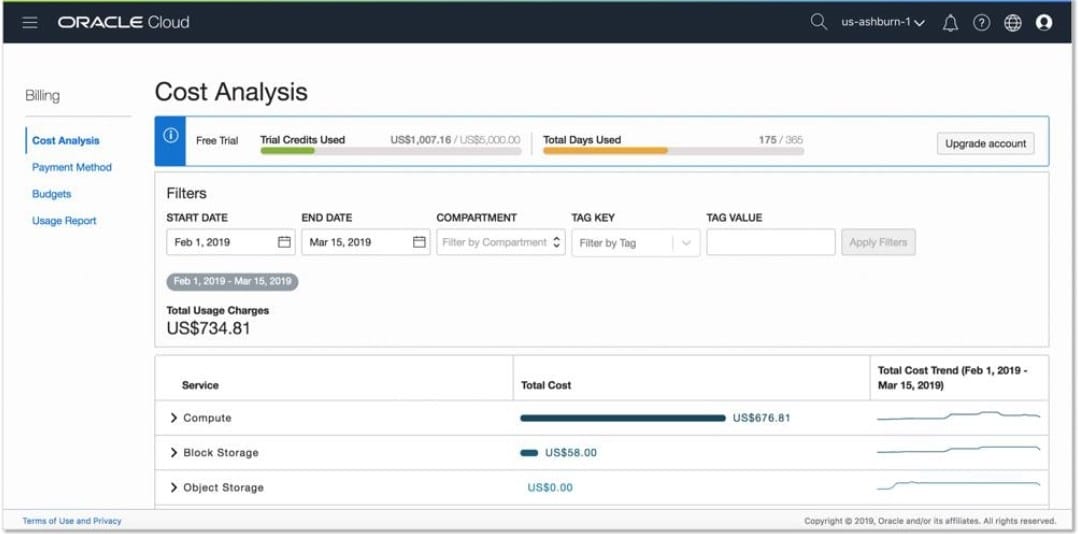
Multiple departments In your company use a shared Oracle Cloud Infrastructure (OCI) tenancy to Implement their projects. You are in charge of managing the cost of OCI resources in the tenancy and need to obtain better Insights Into department's usage.
Which three options can you implement together to accomplish this?
A. Create a budget that matches your commitment amount and an alert at 100 percent of the forecast
B. Set up a consolidated budget tracking lags to analyze costs in ,1 granular manner
C. Set up different compartments for each department then track and analyze cost per compartment
D. Use the billing cost tracking report to analyze costs
E. Set up a tag default that automatically applies tags to all specified resources created In a compartment then use these tags for cost analysis.
You have provisioned a new VM.DenseIO2.24 compute instance with local NVMe drives. The compute instance is running production application. This is a write heavy application, with a significant Impact to the business it the application goes down.
What should you do to help maintain write performance and protect against NVMe devices failure.
A. NVMe drive have built in capability to recover themself so no other actions are required
B. Configure RAID 6 for NVMe devices.
C. Configure RAID 1 for NVMe devices.
D. Configure RAID 10 for NVMe devices.