
301B Online Practice Questions and Answers
An LTM Specialist has set up a custom SNMP alert.
Which command line tool should the LTM Specialist use to test the alert?
A. logger
B. logtest
C. testlog
D. snmptest
There is a fault with an LTM device load balanced trading application that resides on directly connected VLAN vlan-301. The application virtual server is 10.0.0.1:80 with trading application backend servers on subnet 192.168.0.0/25. The LTM Specialist wants to save a packet capture with complete payload for external analysis.
Which command should the LTM Specialist execute on the LTM device command line interface?
A. tcpdump -vvv -w /var/tmp/trace.cap 'net 192.168.0.0/25'
B. tcpdump -vvv -s 0 -w /var/tmp/trace.cap 'net 192.168.0.0/25'
C. tcpdump -vvv -nni vlan-301 -w /var/tmp/trace.cap 'net 192.168.0.0/25'
D. tcpdump -vvv -s 0 -nni vlan-301 -w /var/tmp/trace.cap 'net 192.168.0.0/25'
Given this as the first packet displayed of an ssldump:
2 2 1296947622.6313 (0.0001) S>CV3.1(74) Handshake
ServerHello
Version 3.1
random[32]=
19 21 d7 55 c1 14 65 63 54 23 62 b7 c4 30 a2 f0
b8 c4 20 06 86 ed 9c 1f 9e 46 0f 42 79 45 8a 29
session_id[32]=
c4 44 ea 86 e2 ba f5 40 4b 44 b4 c2 3a d8 b4 ad
4c dc 13 0d 6c 48 f2 70 19 c3 05 f4 06 e5 ab a9
cipherSuite TLS_RSA_WITH_RC4_128_SHA
compressionMethod NULL
In reviewing the rest of the ssldump, the application data is NOT being decrypted.
Why is ssldump failing to decrypt the application data?
A. The application data is encrypted with SSLv3.
B. The application data is encrypted with TLSv1.
C. The data is contained within a resumed TLS session.
D. The BigDB Key Log.Tcpdump.Level needs to be adjusted.
A web developer has created a custom HTTP call to a backend application. The HTTP headers being sent by the HTTP call are:
GET / HTTP/1.1 User-Agent: MyCustomApp (v1.0) Accept: text/html Cache-Control: no-cache Connection: keep-alive CookiE. somecookie=1
The backend server is responding with the following:
HTTP/1.1 400 Bad Request DatE. Wed, 20 Jul 2012 17:22:41 GMT Connection: close
Why is the HTTP web server responding with a HTTP 400 Bad Request?
A. The client request does NOT include a Host header.
B. The User-Agent header contains an invalid character.
C. The web server is NOT expecting a keep-alive connection.
D. The web server is configured to accept HTTP 1.0 requests only.
A device group is made up of four members: LTM-A, LTM-B, LTM-C, and LTM-D. An LTM Specialist makes a configuration change on LTM-B. Later, a different LTM Specialist notices a "changes pending" message on all devices. When logged into LTM-D, the LTM Specialist attempts to config-sync to the device group. The sync operation fails.
Why is the LTM Specialist on LTM-D unable to synchronize the configuration to the group?
A. The changes made on LTM-B are invalid.
B. LTM-D has the lowest commit-id of the group.
C. NTP is NOT configured on the devices in the group.
D. LTM-B is the device eligible to initiate a config-sync.
-- Exhibit

-- Exhibit -Refer to the exhibit.
A company uses a complex piece of client software that connects to one or more virtual servers (VS) hosted on an LTM device. The client software is experiencing issues. An LTM Specialist is tasked with finding the cause of the problem.
The LTM Specialist has the tcpdump extract and knows the client software has at least one connection to a VS on port 1990. However, when a tcpdump runs on the internal VLAN, there is no record of port 1990 in the tcpdump.
Why is there no record of port 1990 in the tcpdump?
A. The LTM device drops the connection.
B. Port 1990 is a well-known port, so its use is restricted.
C. The LTM device performs a Port Address Translation (PAT).
D. The LTM device performs a Network Address Translation (NAT).
-- Exhibit
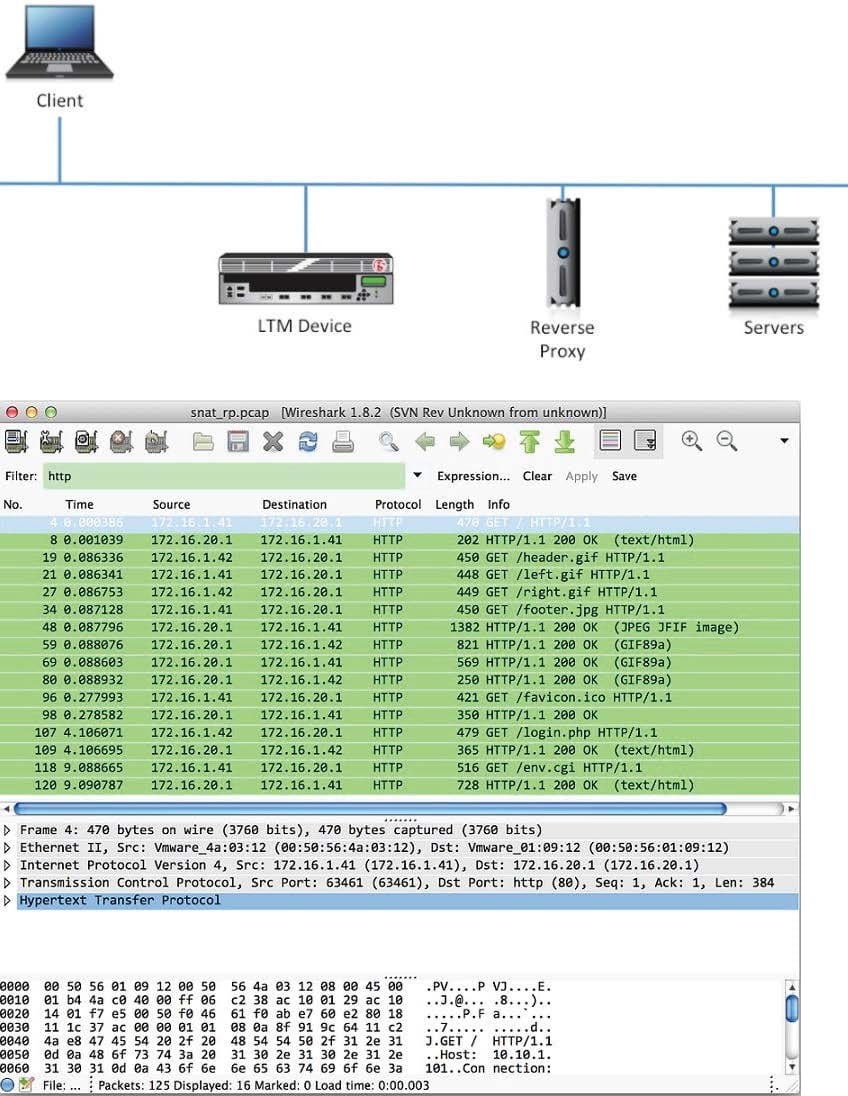
-- Exhibit -Refer to the exhibits. A virtual server has been configured for SSL offload on a single-arm network. On average, the virtual server will be handling 100,000 connections, with a peak of 130,000 connections. Between the virtual server and the web servers there is a
single reverse proxy to provide site caching. The proxy is configured to perform source IP persistence before contacting the web servers. The site is logging users out immediately after logging them in. What should the LTM Specialist do to resolve this issue?
A. Add a source address persistence profile to the virtual server.
B. Create an iRule to add client IP persistence to a SNAT pool member.
C. Change the virtual server server-side TCP profile to tcp-lan-optimized.
D. Configure the virtual server HTTP profile to insert an X-Forwarded-For header.
-- Exhibit
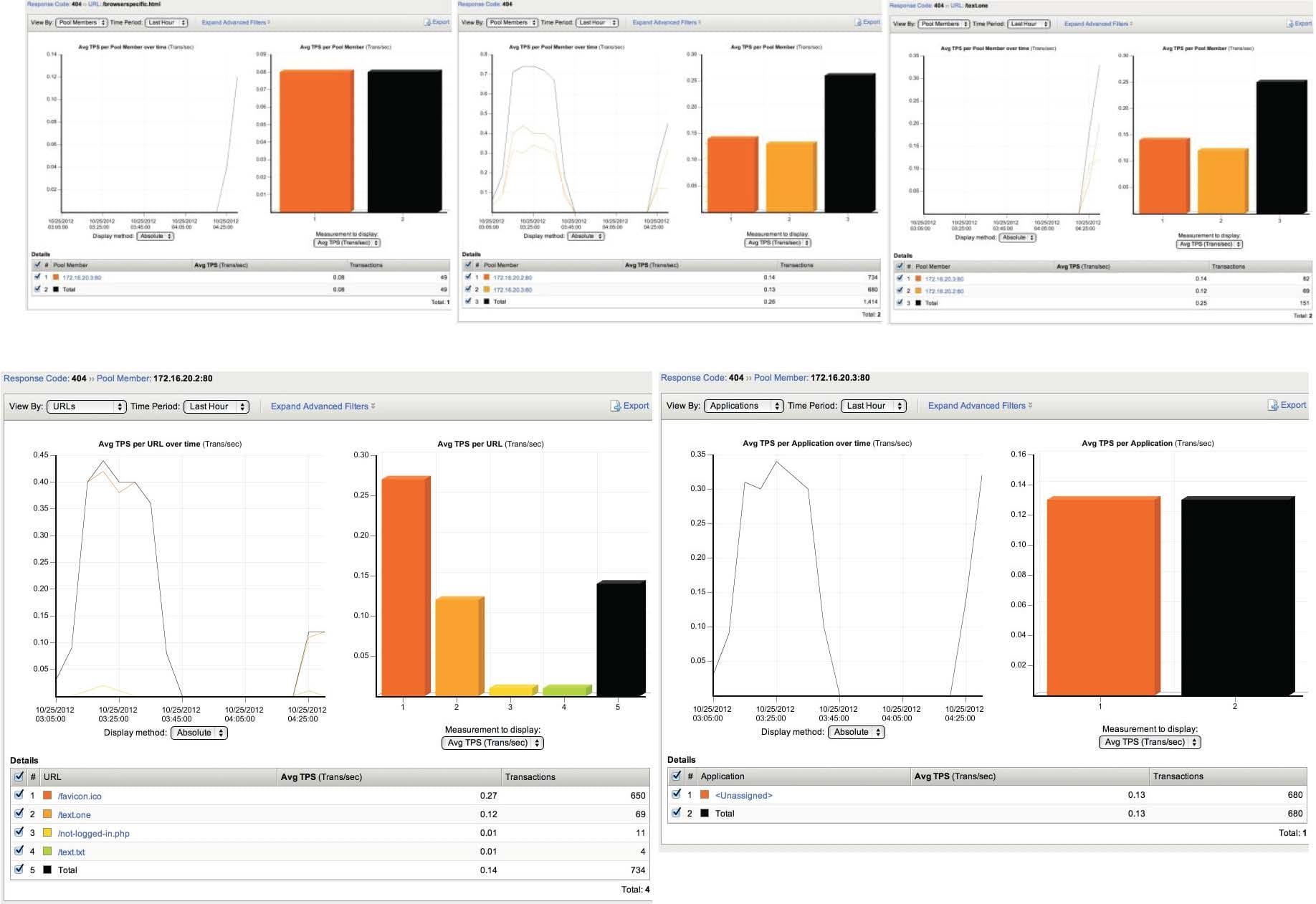
-- Exhibit -Refer to the exhibits.
Which two servers are missing two frequently used URLs? (Choose two.)
A. 172.16.20.1 /text.one /text.txt
B. 172.16.20.2 /text.one /text.txt
C. 172.16.20.1 /text.txt /browserspecific.html
D. 172.16.20.2 /text.one /browserspecific.html
E. 172.16.20.3 /text.one /browserspecific.html
-- Exhibit
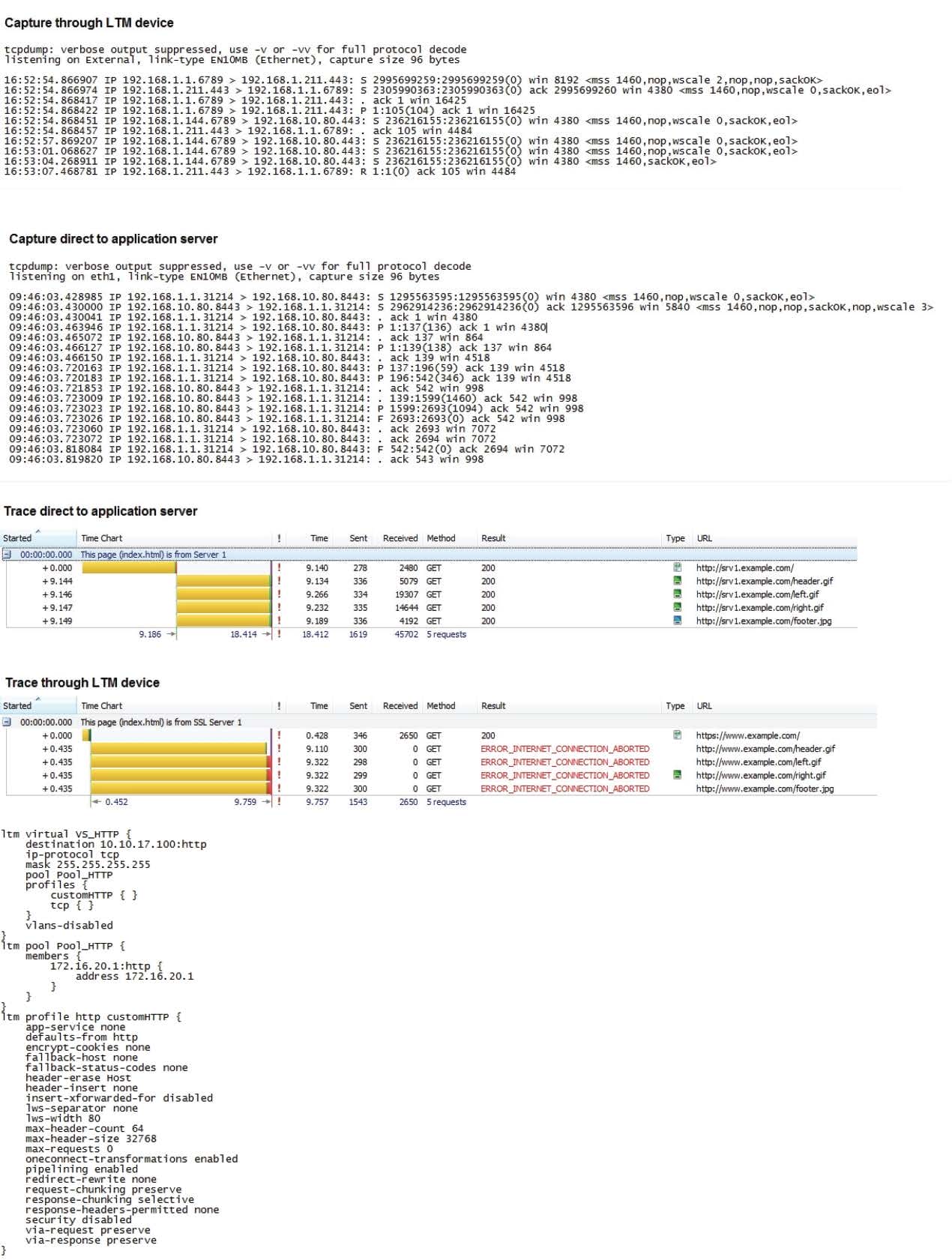
-- Exhibit -Refer to the exhibits.
An LTM Specialist is troubleshooting an application configured on an LTM device on a one- armed configuration. The application is NOT working through the LTM device but does work when accessed directly via the application servers. The
virtual server 192.168.1.211:443 is configured to SNAT using the address 192.168.1.144 and references a pool with the member 192.168.10.80:443. No Client or Server SSL profiles are associated. The LTM Specialist has collected two traffic
captures to help determine the issue.
What is the problem with the configuration on the LTM device?
A. Pool member is configured to use wrong port.
B. Pool member is configured for SSL off-loading.
C. Virtual server is configured to use wrong port.
D. Virtual server is configured without SSL Profiles.
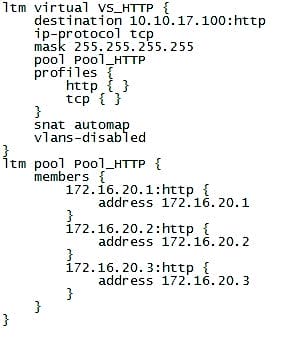
-- Exhibit -- Exhibit -Refer to the exhibit.
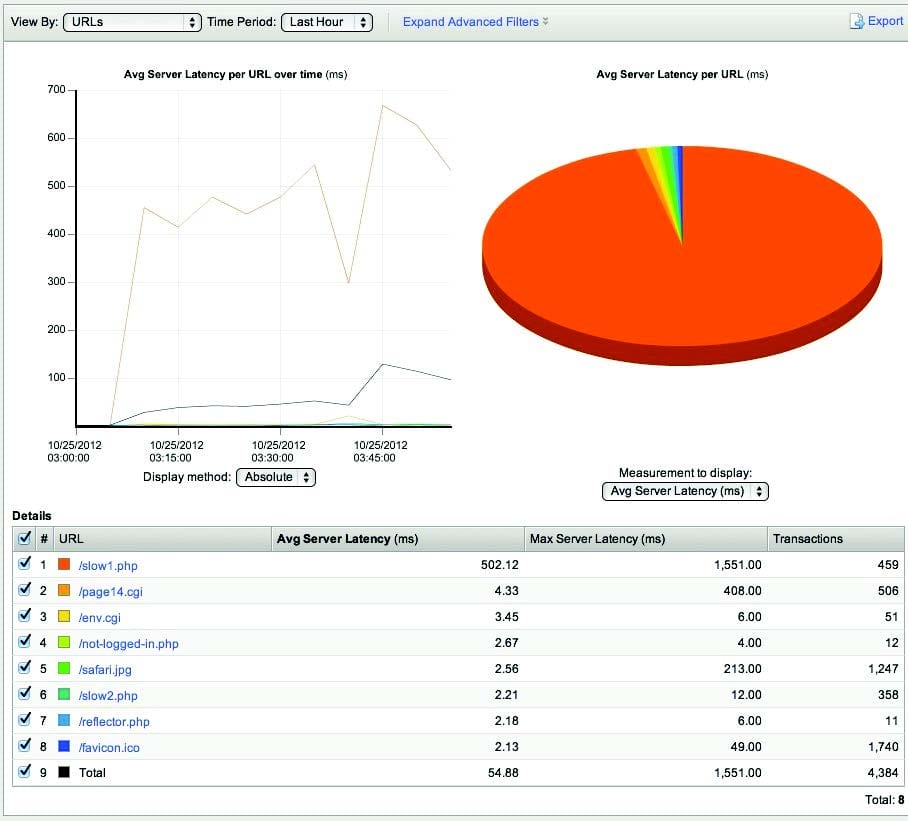
Which URL should be reported to the server/application team as getting user-visible errors?
A. /env.cgi
B. /page14.cgi
C. /reflector.php
D. /browserspecific.html