
4A0-107 Online Practice Questions and Answers
Which of the following can be used as classifiers of customer traffic? (Choose three)
A. DSCP value
B. 802.1p value
C. IP DF bit
D. TCP/UDP port numbers
E. HTML version number
Click the exhibit button below. Given the SAP-ingress policy, which of the following statements are FALSE? (Choose three)
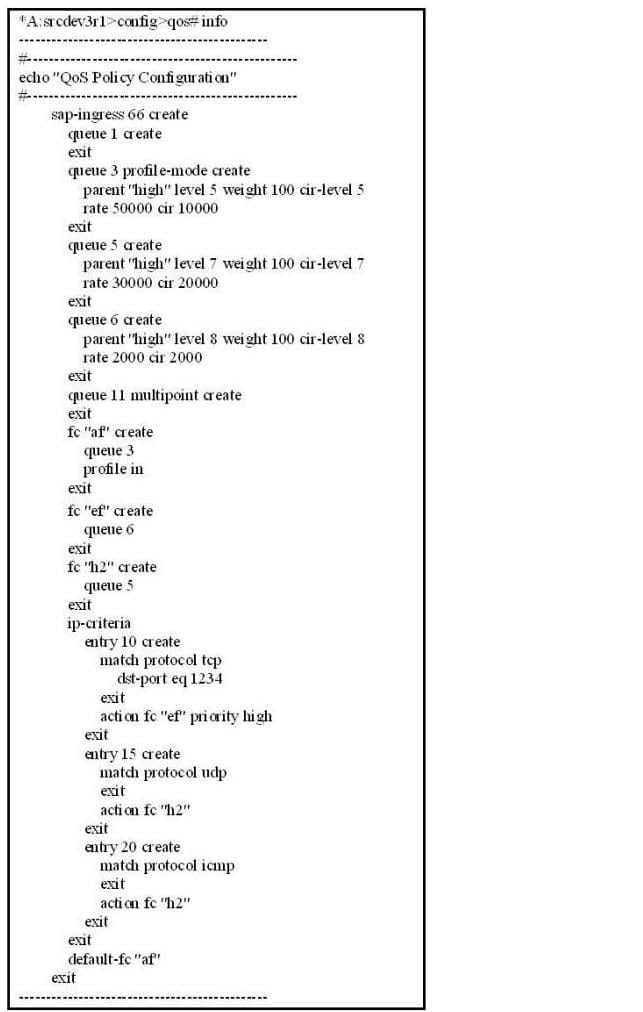
A. Queue 5 is using priority mode.
B. UDP traffic can be serviced at a maximum rate of 20 Mbps.
C. Ping traffic is place in queue 5.
D. Queues 5 and 6 will receive equal portions of any remaining available bandwidth to meet their above-CIR bandwidth requirements.
E. Queue 3 is scheduled before queue 5.
Which of the following statements BEST defines policing?
A. The process of delaying packets within a traffic stream to have them conform to a defined traffic profile.
B. The overall treatment of a defined subset of a customer's traffic within a DiffServ domain.
C. The process of discarding packets within a traffic stream in accordance with the state of a meter to enforce a defined traffic profile.
D. The action of setting the DiffServ codepoint of a packet prior to its entry into a downstream DiffServ domain.
E. A specified algorithm or operation that is implemented in a node in order to realize one or more per-hop behaviors.
If a packet is marked on a SAP-ingress, it will be remarked at the first network egress point (if remarking is enabled in the network egress policy).
A. TRUE
B. FALSE
Packets arrive at the VPRN SAP on PE1 with DSCP marking of af11 and Dot1p of 2. According to the QoS policies applied at routers PE1, P, and PE2, what is the dot1p value of packets egressing routerPE2? (All the SDPs are MPLS- encapsulated, and all interfaces are using their default trust states).
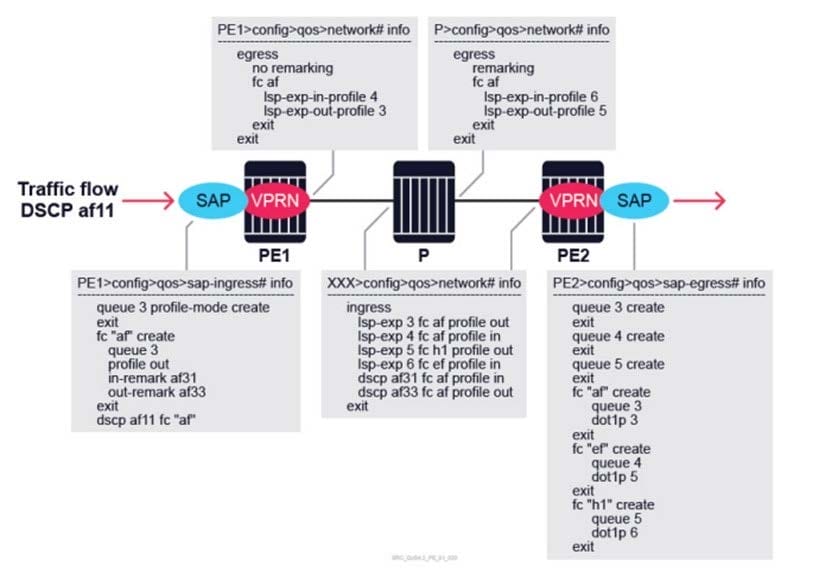
A. 2
B. 3
C. 5
D. 6
A SAP-ingress policy is configured so that ping traffic is classified as FC L1 and mapped to queue 3; however, all traffic is placed in queue 1. What is the most probable reason for this?
A. The default forwarding class for ICMP traffic is BE and cannot be changed.
B. The SAP has been shut down.
C. Queue 3 has no PIR or CIR configured, and thus cannot hold any packets.
D. The SAP-ingress policy has not been applied to the SAP.
A profile-mode queue is configured with the following attributes: MBS = 10 KB, CBS = 5 KB and HighPriority-Only = 30%. Assume there is no CBS overbooking, and the slope-policy is disabled. If the current queue depth is 8 KB, what will happen to an in-profile packet?
A. It will be discarded because the high-priority-only threshold is exceeded.
B. It will be stored in the queue's reserved buffer space and become out-of-profile.
C. It will be stored in the queue's reserved buffer space and remain in-profile.
D. It will contend for shared buffer space with packets from other queues.
Which of the following parameters is taken into account FIRST when a CFHP arbiter allocates bandwidth among its children policers?
A. PIR
B. CIR
C. Level
D. Weight
When we select the adaptation rule "min", how are the operational CIR/PIR rates of a queue calculated?
A. The administrative PIR values are ignored and both operational rates are set to the minimum residual rate allowed by the hardware.
B. The administrative PIR value is ignored and both operational rates are set to the administrative CIR value.
C. They are chosen as the largest multiple of the hardware rate step that is less than or equal to the corresponding CIR/PIR administrative value.
D. They are chosen as the smallest multiple of the hardware rate step that is greater than or equal to the corresponding CIR/PIR administrative value.
Which of the following about the process of queuing self-generated traffic in the Nokia 7750 SR is TRUE?
A. Ingress traffic is stored in IOM queues and egress traffic is stored in CPM queues.
B. Ingress traffic is stored in CPM queues and egress traffic is stored in IOM queues.
C. It is always stored in CPM queues.
D. It is always stored in IOM queues.