
4A0-110 Online Practice Questions and Answers
Two routers are physically connected to each other with ISIS configured. No ISIS adjacency can be found on both routers. Ping works fine on the local and the remote interface addresses on both routers. Review the confguration information shown below. Which of the following statements best describe the cause of the problem? Select one answer only.
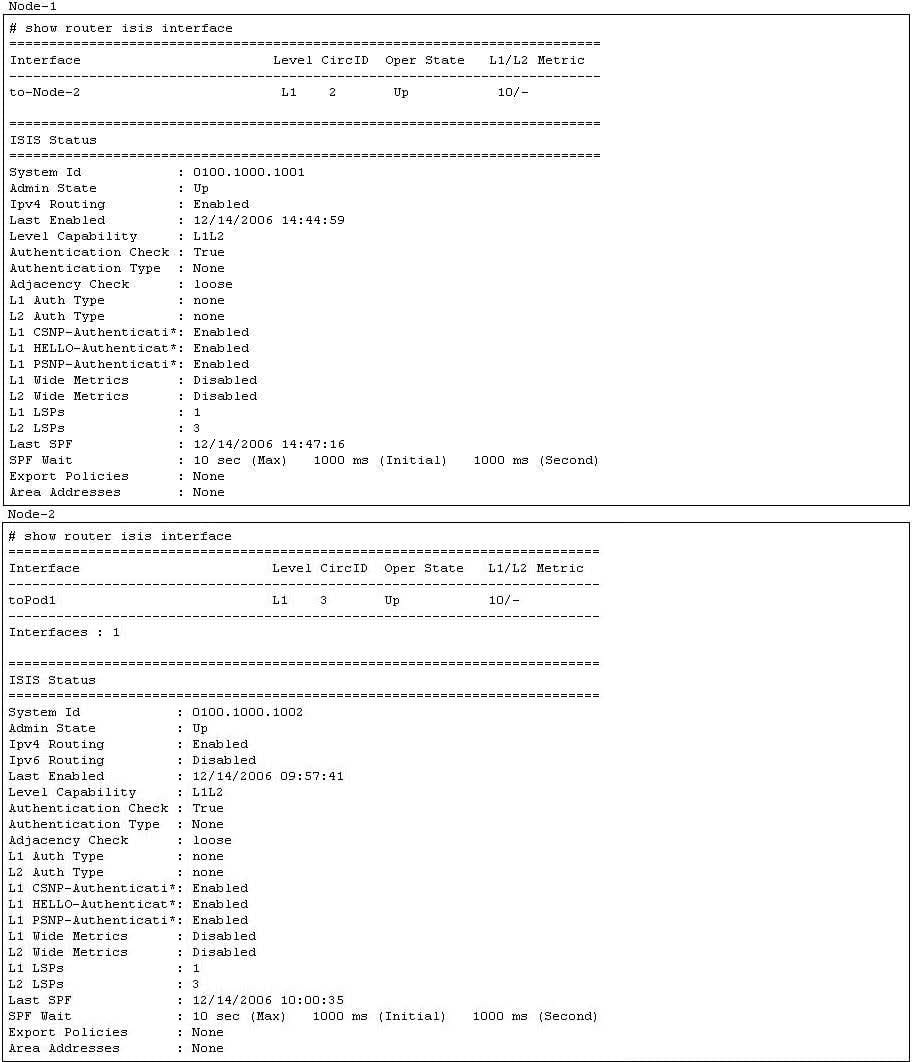
A. The ISIS interface level configured does not match the ISIS level capability supported on the routers
B. The ISIS authentication check is enabled but there is no authentication type and password configured
C. ISIS Area addresses are not configured on both routers
D. L1 wide Metrics are disabled on the routers
E. ISIS Circuit id does not match on Node-1 and Node-2
L1 ISIS adjacency is up between two routers (Node-1 and Node-2) with MD5 authentication configured. During a maintenance window, an operator was planning to change one of the ISIS hello authentication key from admin to admin123. After removing the hello authentication key from Node-1 (no change on Node-2 side), the ISIS adjacency stayed up. The operator decided to fall back to the original configuration and called Alcatel for support. Which of the following statement best describe the cause of the problem? Select one answer only.
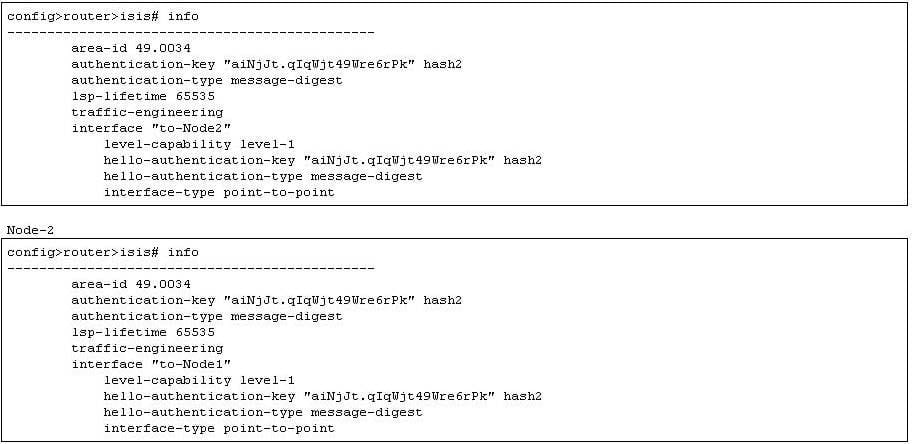
A. The ISIS hello authentication key was not configured properly in the first place, that's why removing the authentication key does not impact the adjacency
B. The ISIS authentication key is the same as the hello authentication key, therefore removing hello authentication key does not impact the adjacency
C. The system interface is missing from the ISIS configuration, therefore ISIS is not working properly even before the change
D. ISIS hello authentication key is only used for hello packet exchange. It does not affect ISIS adjacency
E. ISIS hello authentication key is not used to bring up ISIS adjacency when traffic-engineering is enabled on the routers
What are the typical RIP related issues found during troubleshooting?
A. Interface filters
B. Broadcast/Multicast mismatch
C. Area id not match with neighbor
D. Group name not match with neighbor
E. Hop count too high
Node A has an active BGP route 10.1.1.1 in its routing table, but the same route is not found in Node D routing table. Which of the following configurations are required to resolve this problem?
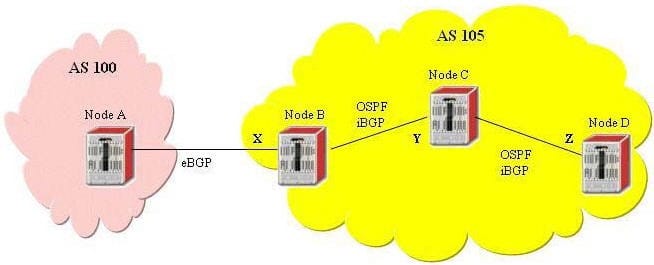
A. Add Interface X to OSPF on Node B as passive interface
B. Redistribute interface address Y and Z into BGP
C. ISIS Enable route-reflection on Node B
D. Enable next-hop-self on Node C
E. Enable route-reflection on Node C
The LDP session is not down between Node-1 and Node-2. Based on the following configurations, what is the cause of the problem?
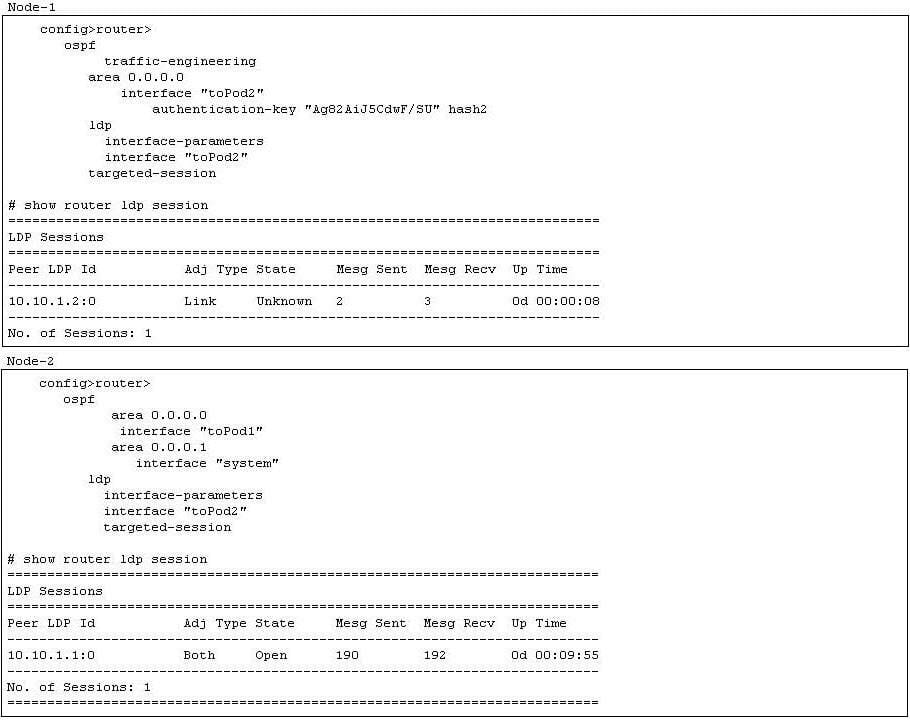
A. LDP targeted-session is enabled with no service configured
B. OSPF adjacency is not up between Node-1 and Node-2
C. Router id is not advertised by OSPF
D. LDP is disabled on Node-1
E. Traffic-engineering is not enabled on Node-2
A SDP is created on Node-2 with the far end address set to Node-3. The SDP stays down on Node-2. Based on the following CLI output from Node 2, what is the caused of the problem?
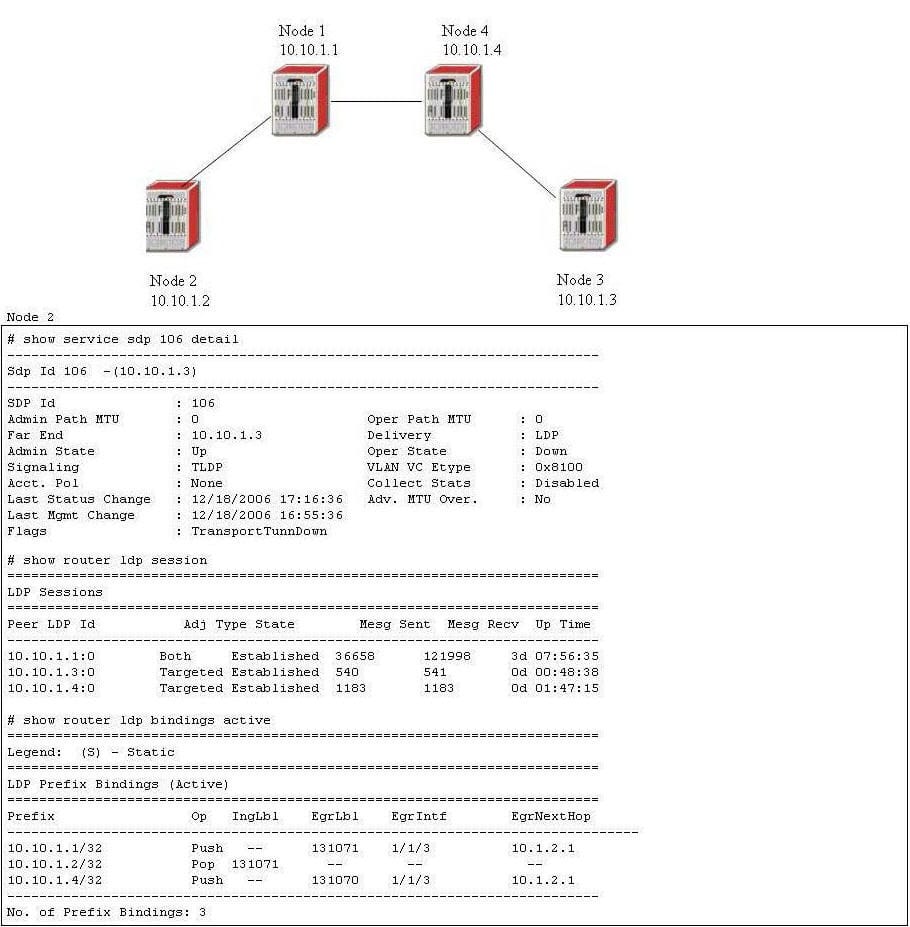
A. No LDP link session between Node 2 and Node 4
B. No LDP link session between Node 4 and Node 3
C. No LDP link session between Node 1 and Node 4
D. No LDP link session between Node 3 and Node 2
E. None of the above
A LSP is configured with one primary path and one secondary path as below. What configuration is required to make the LSP non-revertive. Choose the best answer.

A. Turn off CSPF and remove all the bandwidth reservations
B. Remove the primary path and configure both paths as secondary
C. Under asp toRouter3? configure on-revertive
D. It is not possible to configure the LSP as non-revertive
E. MPLS fast re-route has to be enabled to make it non-revertive
Node 1 and Node 2 are directly connected running LDP. The system ip address of Node 2 is 10.10.10.1.2. Based on the following display, why is the sdp down?
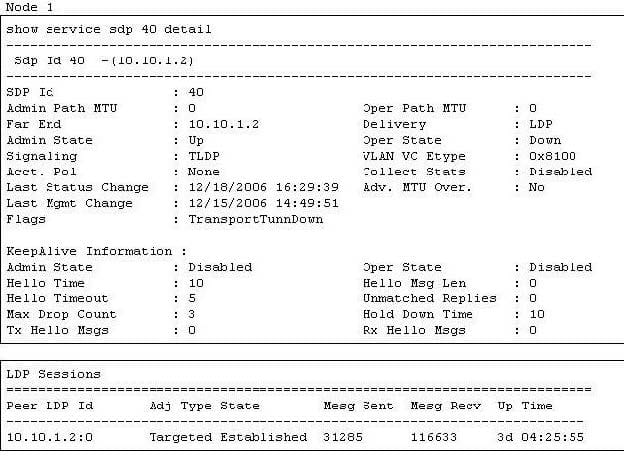
A. Local SDP id does not match with the remote sdp id.
B. Far End IP address is not reachable.
C. Keepalive has to be enable on the SDP.
D. LDP is not enable on the remote node's interface.
E. Targeted LDP session is disabled on the remote node.
The mesh-sdp binding for a VPLS configured on Node 1 is down with an error serviceMTUMismatch. One sap is configured in the VPLS and it is up with default mtu 1514. The LDP binding display on Node 1 shows that there is a mismatch on the MTU value. What are the required configurations on Node 1 to bring the VPLS up?
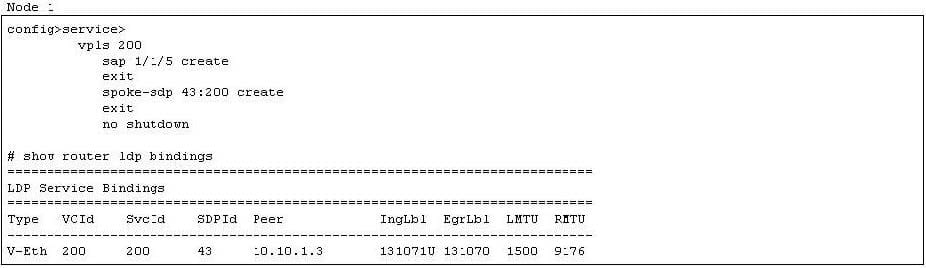
A. Set the sap port mtu to 9176
B. Set the service-mtu to 9176
C. Set the service-mtu to 9190
D. Set the sap port mtu to 9190
E. Set the service-mtu to 1514
VPRN 300 is configured on Node 3 and Node 4 with LDP and MP-BGP. No route can be found in the VPRN 300 routing table on both Nodes. What is the cause of the problem?
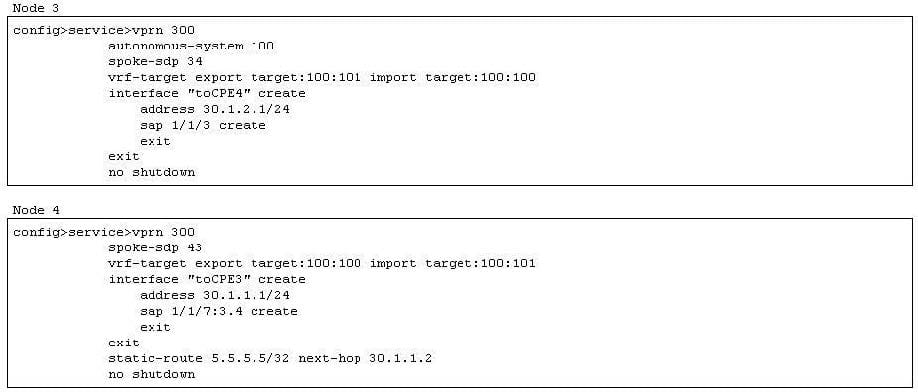
A. No static route configured on Node 4
B. No LDP defined in the VPRN configuration on both nodes
C. VRF-target does not match on Node 3 and Node 4
D. Route-distinguisher configuration is missing on Node 3 and Node 4
E. Encapsulation type on the SAP does not match on Node 3 and Node 4