
71300X Online Practice Questions and Answers
From a remote worker's SIP Endpoint connected via Mobile Workspace, which tool is used to trace the successful way through Avaya Session Border Controller for Enterprise (SBCE) of an Invite message?
A. traceRT
B. traceSM
C. traceMW
D. traceSBC
A field engineer runs the Installation Wizard to install the Avaya Session Border Controller for Enterprise
(SBCE).
Which statement about the Domain Name Service (DNS) configuration is true?
A. A DNS address always needs to be configured for both the Primary and Secondary DNS, even if only the DNS is available.
B. A DNS address does not need to be configured.
C. A DNS address needs to be configured, even if it is unused and/or unreachable.
D. A DNS address should not be configured here.
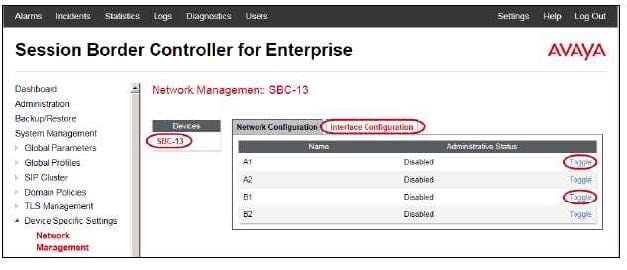
In Avaya Session Border Controller for Enterprise (SBCE), what is the default state of an Interface?
A. Deployed
B. Enabled
C. Disabled
D. Active
To route calls to Avaya Aura Messaging (AAM), which routing strategy is used by Avaya Aura Session Manager (SM)?
A. Automatic Route Selection (ARS)
B. Automatic Alternate Routing (AAR)
C. Network Routing Policies (NRP)
D. Registry Routing
To allow trust between Avaya Aura System Manager (SMGR) and Avaya Aura Messaging (AAM), there is
a password set when you add the Trusted Server on AAM. This password must match with the password
also configured in SMGR.
Which statement about the password in SMGR is true?
A. It needs to match the Enrollment Password.
B. It needs to match the admin password used to login to SMGR using a web browser.
C. It needs to match the Attributes of the Messaging Managed Element in the Inventory.
D. It needs to match the root password used to login to SMGR command line.
What are three ways of accessing Avaya Aura Application Enablement Services (AES) to perform administration? (Choose three.)
A. with an Open X.11 terminal window
B. with web access
C. with remote access using Rlogin
D. with local access using a system console
E. with remote access using SSH
Which statement describes Cross-Origin Resource Sharing (CORS)?
A. It allows for signaling-groups to be used by more than one trunk-group.
B. It is a W3C specification that allows cross-domain communication from the browser.
C. It is making DSP resources available regardless of the originating location of a call.
D. It is a network setup by which an Avaya Aura Media Server (AAMS) can be used by more than one Avaya Aura Communications Manager (CM).
The Avaya WebRTC solution uses the web intensively to make media calls from a standard web browser in the internet, into internal and secure communication premises in the enterprise. Which statement about security between the Enterprise-edge and those standard Web browsers in the internet is true?
A. A trust relationship based on certificates must be built to make WebRTC work.
B. No trust relationship exists between enterprise edge security and web browsers; therefore, the security strategy is based on an Authorization Token instead.
C. There must be a VPN connection between the Web Browser and the Enterprise-edge to build a WebRTC link.
D. WebRTC only works within the Enterprise network. External Web Browsers must connect through an Avaya Session Border Controller for Enterprise (SBCE) via a SIP trunk.
You are creating the identity certificates that must be installed in the Avaya Session Border Controller for
Enterprise (SBCE).
Which statement about installing the certificate files in the SBCE is true?
A. The cert file and the Key filenames generated by the Certificate Authority must match.
B. Both the PEM and Key files must be in a zip file.
C. The SBCE must be rebooted before the files installation.
D. The cert file and the Key filenames generated by the Certificate Authority must be different.
Avaya Aura Presence Services 7.x is implemented on Avaya BreezeTM (formerly Engagement
Development Platform (EDP)).
When looking at Elements > Breeze > Service Management > Services, which status would you expect for
a Presence Services snap-in that is ready to support Avaya Aura Presence Services?
A. Accepting
B. Loaded
C. Installed
D. Active