
A00-201 Online Practice Questions and Answers
The following SAS program is submitted:
data work.retail; cost = `20000'; total = .10*cost; run;
Which one of the following is the value of the variable TOTAL in the output data set?
A. 2000
B. `2000'
C. (missing numeric value)
D. ` `(missing character value)
The following SAS program is submitted:
data work.report; set work.sales_info; if qtr(sales_date) ge 3; run;
The SAS data set WORK.SALES_INFO has one observation for each month in the year 2000 and the variable SALES_DATE which contains a SAS date value for each of the twelve months.
How many of the original twelve observations in WORKSALES_INFO are written to the WORKREPORT data set?
A. 2
B. 3
C. 6
D. 9
The following SAS program is submitted:
data numrecords;
infile `file-specification';
input@1 patient $15.
relative$ 16-26@;
if relative = `children' then
input diagnosis $15. @;
else if relative = `parents' then
input @28 doctor $15.
clinic $ 44-53
@54diagnosis $15. @;
input age;
run;
How many raw data records are read during each iteration of the DATA step during execution?
A. 1
B. 2
C. 3
D. 4
The observations in the SAS data set WORK.TEST are ordered by the values of the variable SALARY.
The following SAS program is submitted:
proc sort data = work.test out = work.testsorted;
by name;
run;
Which one of the following is the result of the SAS program?
A. The data set WORKTEST is stored in ascending order by values of the NAME variable.
B. The data set WORKTEST is stored in descending order by values of the NAME variable.
C. The data set WORKTESTSORTED is stored in ascending order by values of the NAME variable.
D. The data set WORKTESTSORTED is stored in descending order by values of the NAME variable.
Which one or the following SAS system options displays the time on a report?
A. TIME
B. DATE
C. TODAY
D. DATETIME
The following SASS program is submitted:
data work.sales;
do year = 1 to 5;
do month = 1 to 12;
x+ 1;
end;
run;
Which one of the following represents how many observations are written to the WORK SALES data set?
A. 0
B. 1
C. 5
D. 60
The following SAS program is submitted:
proc report data = sasuser.houses nowd headline headskip; column style price;
where price < 100000;
title;
run;
Click the Exhibit button to view the output from the REPORT procedure.
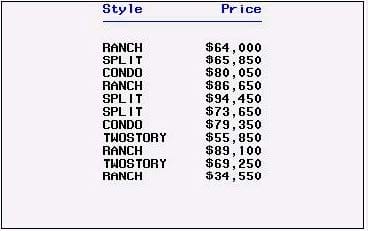
Assuming that the PRICE variable is numeric, which one of the following completes the program and produces the output displayed in the exhibit?
A. define style / group `Style'; define price / mean `Price' format = dollar9.;
B. define style / display `Style'; define price / across `Price' format = dollar9.;
C. define style / display `Style'; define price / sum `Price' format = dollar9.;
D. define style / order `Style'; define price / mean `Price' format = dollar9.;
A raw data file is listed below:
1901 2 1905 1 1910 6 1925 . 1941 1
The following SAS program is submitted and references the raw data file above:
data coins; infile `file-specification'; input year quantity;
Which one of the following completes the program and produces a non-missing value for the variable TOTQUANTITY in the last observation of the output data set?
A. totquantity + quantity;
B. totquantity = sum(totquantity + quantity);
C. totquantity 0; sum totquantity;
D. retain totquantity 0; totquantity = totquantity + quantity;
The following SAS program is submitted:
data work.clients;
calls = 6;
do while (calls le 6);
calls + 1;
end;
run;
Which one of the following is the value of the variable CALLS in the output data set?
A. 4
B. 5
C. 6
D. 7
The SAS data sets WORK.EMPLOYEE and WORKSALARY are listed below:
WORK.EMPLOYEE WORK. SALARY
name age name salary
Bruce 30 Bruce 25000
Dan 40 Bruce 35000
Dan 25000
The following SAS program is submitted:
data work.empdata;
merge work.employee
work.salary;
by fname;
totsal + salary;
run;
How many variables are output to the WORK.EMPDATA data set?
A. 3
B. 4
C. 5
D. No variables are output to the data set as the program fails to execute due to errors.