
Exam2pass
0 items Sign In or Register
  • Home
  • IT Exams
  • Guarantee
  • FAQs
  • Reviews
  • Contact Us
  • Demo
Exam2pass > Adobe > Adobe Certifications > AD0-E134 > AD0-E134 Online Practice Questions and Answers

AD0-E134 Online Practice Questions and Answers

Questions 4

An AEM server is overloaded with too many concurrently running workflows. The developer decides to reduce the number of concurrent workflows. What should be configured to reduce the number of concurrent workflows?

A. The number of threads in Scheduler

B. The number of threads in Apache Felix Jetty Http Service

C. Launchers for each workflow

D. Maximum Parallel Jobs in OSGI console

Buy Now

Correct Answer: D

Explanation: Maximum Parallel Jobs is a configuration property that controls how many workflows can run concurrently on an AEM instance. Reducing this value can help to avoid overloading the server with too many workflows. Reference: Workflow Engine Configuration section

Questions 5

A client is having issues with some query results:

Many of the client's industry terms have the same meaning, and users do not always search the exact wording Many users search by typing in short phrases instead of exact keywords, ex://";cats and dogs"

What index analyzers should the AEM developer recommend?

A. 1. Add a Mapping filter to the current indexes

2. Add a Stop filter to the current indexes

B. 1. Tokenize the current indexes with a Keyword tokenizer

2. Add a Mapping filter to the current indexes

C. 1. Add a Synonym filter to the current indexes

2. Add a Stop filter to the current indexes

D. 1. Add a Synonym filter to the current indexes

2. Add a LowerCase filter to the current indexes

Buy Now

Correct Answer: D

A Synonym filter can help to map different terms that have the same meaning, such as "cat" and "feline". A LowerCase filter can help to normalize the case of the terms, so that "cats and dogs" and "Cats and Dogs" are treated the same. Reference: 1 Lucene Analyzers section

Questions 6

Which configuration must be applied to enable re-fetching of cached items based on Cache Headers sent by AEM?

A. /autolnvalidate true

B. /autolnvalidate "1"

C. /enableTTLtrue

D. /enableTTL "1"

Buy Now

Correct Answer: D

Explanation: The /enableTTL "1" configuration must be applied to enable re-fetching of cached items based on Cache Headers sent by AEM. This configuration enables the Time To Live (TTL) feature of dispatcher, which allows dispatcher to check the Cache-Control and Expires headers of the cached files and re-fetch them from AEM if they are expired. References:https://experienceleague.adobe.com/docs/experience-manager- dispatcher/using/configuring/page-invalidation.html?lang=en#time-based-cache- invalidation

Questions 7

Which tool should a developer use to look up Adobe Identity Management System (IMS) users by email and return their IMS IDs?

A. Developer Console

B. User Mapping Tool

C. IMS Lookup Tool

D. Cloud Acceleration

Buy Now

Correct Answer: C

Explanation: The IMS Lookup Tool is a tool that allows looking up Adobe Identity Management System (IMS) users by email and returning their IMS IDs. The IMS Lookup Tool is available in the Cloud Manager UI under the Tools menu. The

IMS Lookup Tool can be used to find the IMS IDs of users who need to be added to Cloud Manager programs or environments.

References: https://experienceleague.adobe.com/docs/experience- manager-cloud-service/implementing/using-cloud-manager/ims-lookup- tool.html?lang=enhttps://experienceleague.adobe.com/docs/experience-manager-cloud- service/

implementing/using-cloud-manager/adding-users-to-programs-and- environments.html?lang=en

Questions 8

A snippet throws an exception at runtime:

@Model(adaptables = {Resource.class}) public class MyCustomModel {

(SSIingObject

private Resource resource;
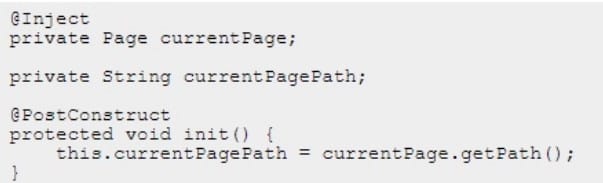
What should the developer add to fix it?

A. defaultlnjectionStrategy = DefaultlnjectionStrategy property to @Model Class annotation

B. (㎡ptional annotation to page field

C. throws Exception at the end of the init method declaration

D. SlingHttpServletRequest.class to adaptables property of ㎝odel Class annotation

Buy Now

Correct Answer: A

The developer should add the defaultInjectionStrategy = DefaultInjectionStrategy property to the @Model Class annotation to fix the snippet. The defaultInjectionStrategy property defines how the Sling Model handles missing or null values for the injected fields. By default, the Sling Model uses the REQUIRED injection strategy, which means that all fields must have a non-null value or else an exception is thrown. By setting the defaultInjectionStrategy property to OPTIONAL, the Sling Model allows null values for the injected fields and does not throw an exception. This way, if the page field is null because the resource is not a page, the Sling Model can still work without errors. References: https://sling.apache.org/documentation/bundles/models.htmlhttps://sling.apache.org/docum entation/bundles/models.html#optional-injection

Questions 9

A developer is on an AEM application that is being used to calculate an employee's salary. The calculation is done in an OSGi service called CalculationService. This service class has a dependency on one other service, called the EmployeeService.

How should the developer make sure that the critical code in the CalculationService has a high unit test coverage?

A. Use a mock framework in the unit test to inject the CalculationService

B. Instantiate the EmployeeService in the unit test and pass it to the constructor of the CalculationService

C. Use a mock framework in the unit test to inject the EmployeeService

D. Use the feature flag in the unit test to disable the calls to the EmployeeService

Buy Now

Correct Answer: C

Explanation: A mock framework is a tool that allows creating mock objects that simulate the behavior of real objects in a controlled way. A mock framework can be used in a unit test to inject the EmployeeService dependency into the CalculationService and verify its interactions. This way, the unit test can focus on testing the logic of the CalculationService without relying on the actual implementation of the EmployeeService. References: https://sling.apache.org/documentation/development/sling-testing- tools.htmlhttps://wcm.io/testing/aem-mock/usage.html

Questions 10

Which option should be used to synchronize user data across publish servers in a publish farm?

A. Sling Content Distribution

B. Vault plugin

C. CURL

D. Replication Agents

Buy Now

Correct Answer: A

Explanation: Sling Content Distribution is a feature that allows synchronizing user data across publish servers in a publish farm. Sling Content Distribution uses agents to distribute content from one instance to another using a publish-publish

topology. Sling Content Distribution can be configured to synchronize user data under /home/users and /home/groups paths, as well as their ACLs.

References: https://experienceleague.adobe.com/docs/experience-manager- 65/administering/security/sync.html?lang=enhttps://experienceleague.adobe.com/docs/exp erience-manager-learn/sites/deploying/sling-content-distribution.html?

lang=en

Questions 11

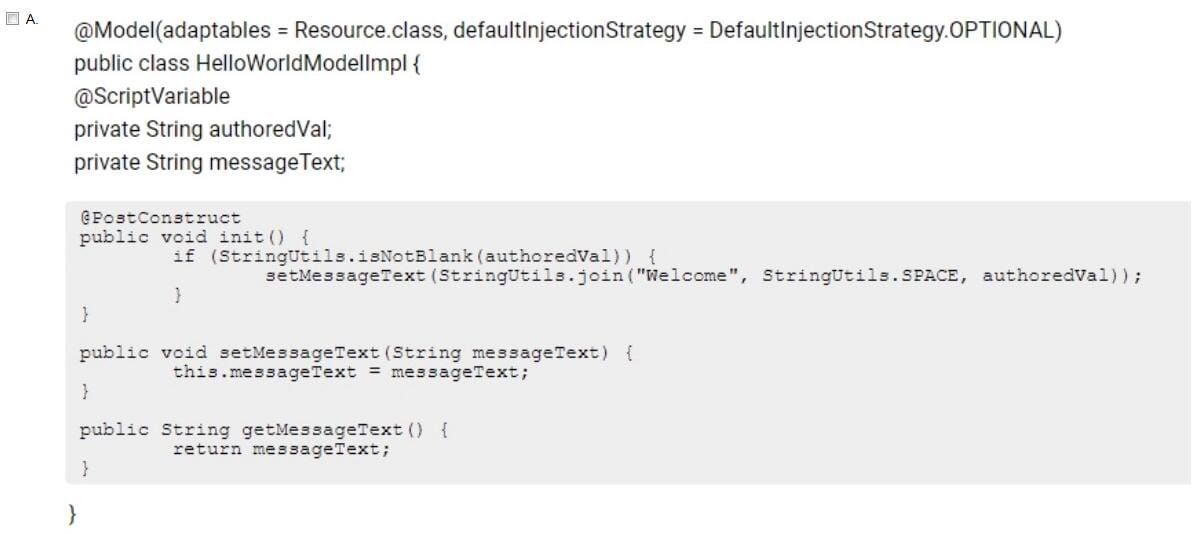
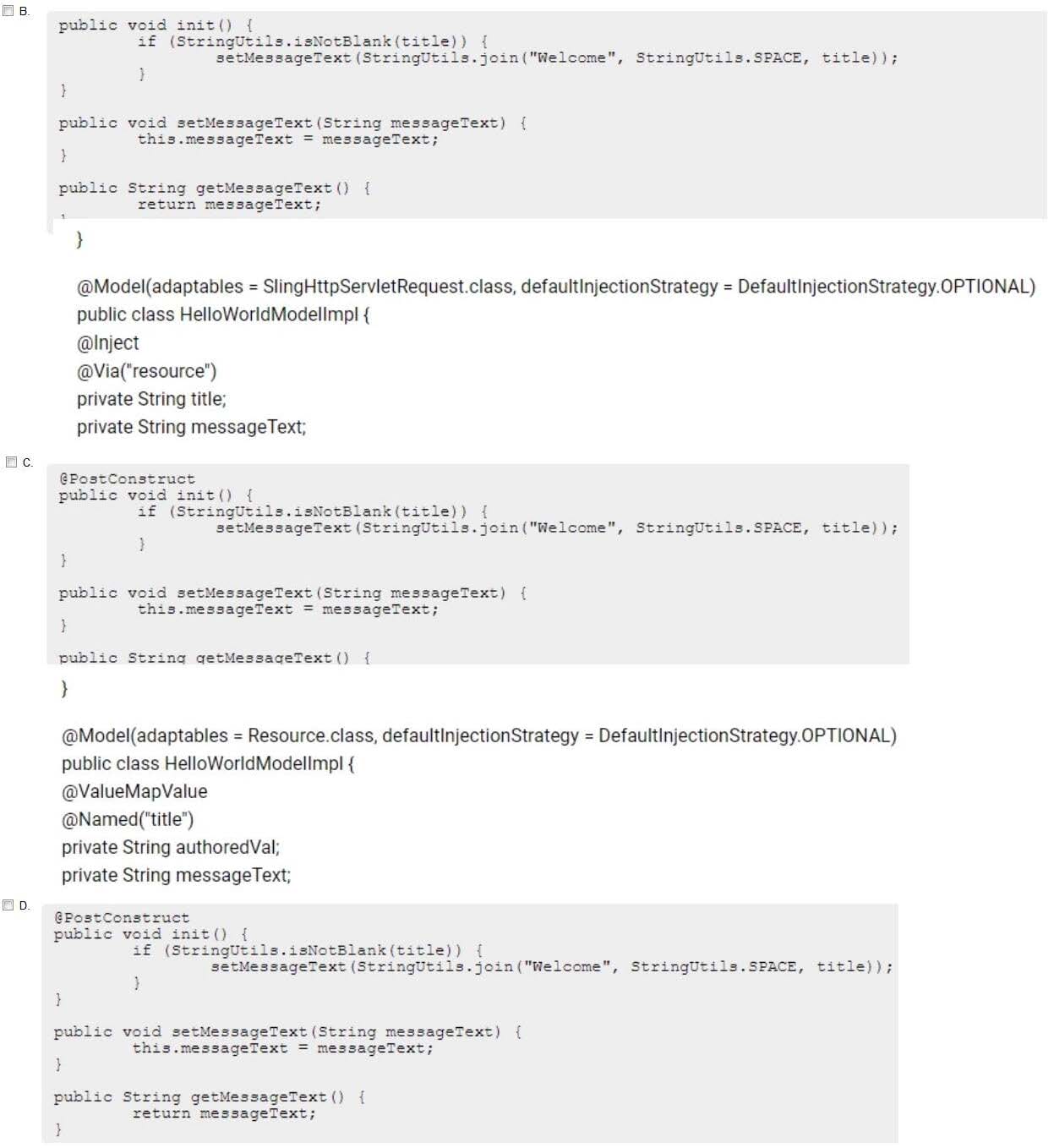
A custom component has one dialog field:

The developer needs to implement a Sling Model to perform a business logic on the authored value. The developer writes the following HTL snippet.

Which two implementations will support this HTL snippet? (Choose two.)
A. Option A

B. Option B

C. Option C

D. Option D

Buy Now

Correct Answer: BD

Explanation: Option B and Option D are two implementations that will support the HTL snippet. Option B uses the @Model annotation with the adaptables parameter set to Resource.class. This allows the Sling Model to adapt from a resource object and access its properties using the ValueMap interface. Option B also uses the @Inject annotation with the name parameter set to "./text" to inject the value of the text property into the text field. Option D uses the @Model annotation with the defaultInjectionStrategy parameter set to OPTIONAL. This allows the Sling Model to use optional injection for all fields and avoid null pointer exceptions if a property is missing. Option D also uses the @Inject annotation without any parameters to inject the value of the text property into the text field, using the field name as the default property name. References: https://sling.apache.org/documentation/bundles/models.htmlhttps://experienceleague.adob e.com/docs/experience-manager-htl/using-htl/htl-block-statements.html?lang=en#use

Questions 12

A developer needs to create a new Title component. The requirements are:

1.

The layout must be the same as the Title core component

2.

The text property must have the page title as prefix (e.g., Page Title - )

3.

The component must be reusable

Which approach is recommended?

A. 1. Create a Proxy Component of Title core component

2.

Create a Custom Sling Model that overrides the default behavior

3.

Customize the component template

B. 1. Create a custom component from scratch

2.

Create a Custom Sling Model for the component that follows the requirement

3.

Create a Model Exporter

C. 1. Create a Proxy Component from Title core component

2. Create a Custom Sling Model that overrides the default behavior

Buy Now

Correct Answer: A

Explanation: A proxy component is a site-specific component that inherits from a core component and allows customization of the component name, group, dialog, and behavior. A proxy component can refer to any version of the core component by changing the sling:resourceSuperType property. A custom sling model can be used to implement the logic for adding the page title as prefix to the text property. A component template can be used to define the layout of the component. Reference: 1 Using Core Components section 2 Create Proxy Component in AEM section 3 AEM- Create Proxy Component section 4 Proxy Components in AEM 6.4 section 5 AEM Proxy Component Pattern and Component Versioning section

Questions 13

An AEM application requires LDAP Service integration to synchronize users/groups. Which two OSGi configuration are required for LDAP integration in AEM? (Select Two.)

A. Apache Jackrabbit Oak AuthorizableActionProvider

B. Apache Jackrabbit Oak Solr server provider

C. Apache Jackrabbit Oak CUG Configuration

D. Apache Jackrabbit Oak External Login Module

E. Apache Jackrabbit Oak Default Sync Handler

Buy Now

Correct Answer: DE

Explanation: The Apache Jackrabbit Oak External Login Module and Apache Jackrabbit Oak Default Sync Handler are the two OSGi configurations that are required for LDAP integration in AEM. The External Login Module defines how AEM connects to the LDAP server and authenticates users against it. The Default Sync Handler defines how AEM synchronizes users and groups from the LDAP server to the repository. References:https://experienceleague.adobe.com/docs/experience-manager- 65/administering/security/ldap-config.html?lang=en#ldap-integration

Exam Code: AD0-E134
Exam Name: Adobe Experience Manager Developer Exam
Last Update: May 24, 2026
Questions: 72

PDF (Q&A)

$45.99
ADD TO CART

VCE

$49.99
ADD TO CART

PDF + VCE

$59.99
ADD TO CART

Exam2Pass----The Most Reliable Exam Preparation Assistance

There are tens of thousands of certification exam dumps provided on the internet. And how to choose the most reliable one among them is the first problem one certification candidate should face. Exam2Pass provide a shot cut to pass the exam and get the certification. If you need help on any questions or any Exam2Pass exam PDF and VCE simulators, customer support team is ready to help at any time when required.

Home | Guarantee & Policy |  Privacy & Policy |  Terms & Conditions |  How to buy |  FAQs |  About Us |  Contact Us |  Demo |  Reviews

2026 Copyright @ exam2pass.com All trademarks are the property of their respective vendors. We are not associated with any of them.