
AZ-801 Online Practice Questions and Answers
HOTSPOT
You have a failover cluster named Cluster1 that contains three Windows Server nodes named Node 1, Node2. and Node3.
You need to deploy a Storage Spaces Direct virtual disk to Cluster1.
You add the following disks to each node:
1.
Three 512-6B NVMe disks
2.
Three 3-TB diskS
3.
Three 1-TB SSD disks
On Cluster1. you enable Storage Spaces Direct and add the new disks.
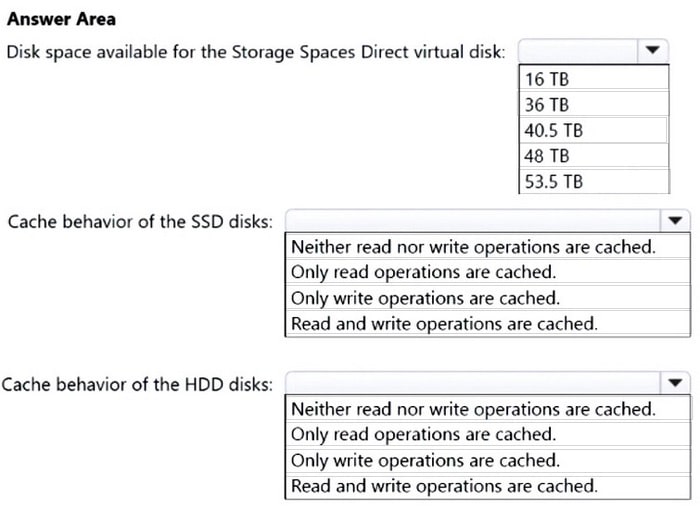
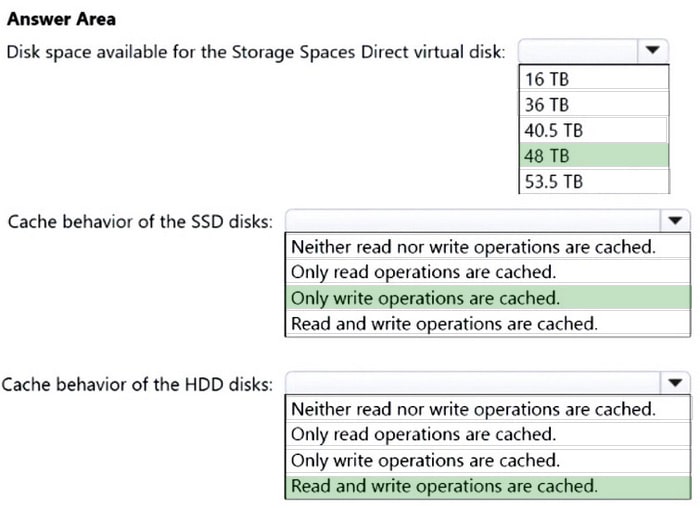
What is the total amount of disk space available for the Storage Spaces Direct virtual disk, and which operations are cached for the SSD and HDD disks? To answer, select the appropriate options in the answer area.
NOTE: Each correct selection is worth one point.
Hot Area:
HOTSPOT
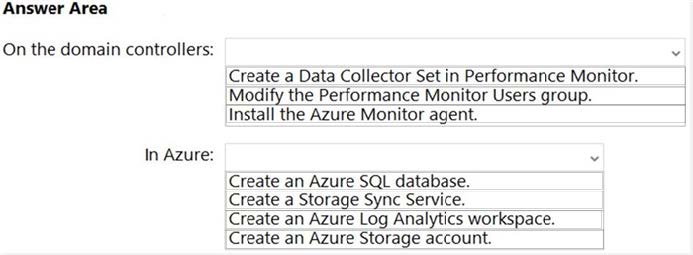
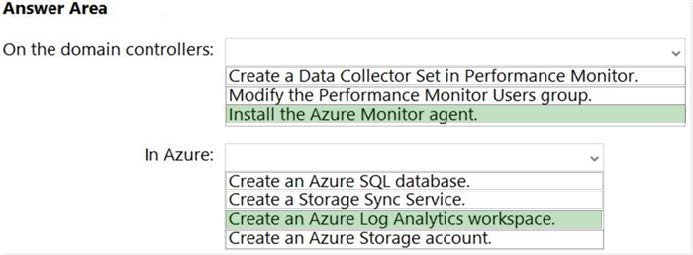
You need to implement alerts for the domain controllers. The solution must meet the technical requirements.
What should you do on the domain controllers, and what should you create on Azure? To answer, select the appropriate options in the answer area.
NOTE: Each correct selection is worth one point.
Hot Area:
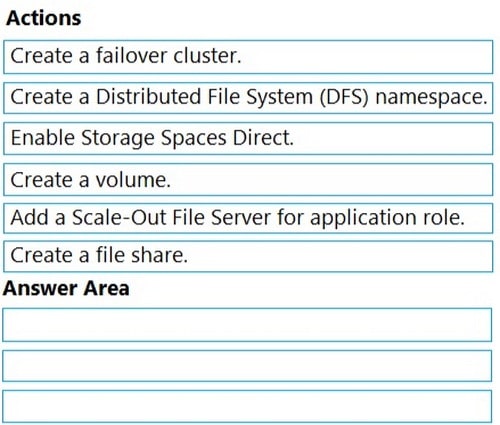
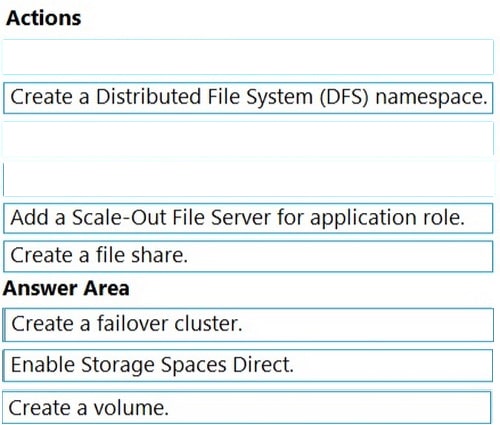
DRAG DROP You need to create a Hyper-V hyper-converged cluster that stores virtual machines by using Storage Spaces Owed Which three actions should you perform in sequence? To answer, move the appropriate anions from the list of actions to the answer area and arrange them in the correct order.
Select and Place:
You are planning the data share migration to support the on-premises migration plan. What should you use to perform the migration?
A. Storage Migration Service
B. Microsoft File Server Migration Toolkit
C. File Server Resource Manager (FSRM)
D. Windows Server Migration Tools
You need to meet technical requirements for Share1. What should you use?
A. Storage Migration Service
B. File Server Resource Manager (FSRM)
C. Server Manager
D. Storage Replica
You have an Azure virtual machine named VM1.
You enable Microsoft Defender SmartScreen on VM1.
You need to ensure that the SmartScreen messages displayed to users are logged.
What should you do?
A. From a command prompt, run WinRM quickconfig.
B. From the local Group Policy, modify the Advanced Audit Policy Configuration settings.
C. From Event Viewer, enable the Debug log.
D. From the Windows Security app. configure the Virus and threat protection settings.
You have an Azure subscription. The subscription contains a virtual machine named VM1 that runs Windows Server. The subscription contains the storage accounts shown in the following table.
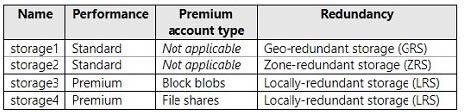
You plan to enable boot diagnostics for VM1.
You need to configure storage for the boot diagnostics logs and snapshots.
Which storage account should you use?
A. storage1
B. storage2
C. storage3
D. storage4
You have a Storage Spaces Direct configuration that has persistent memory and contains the data volumes shown in the following table.
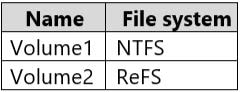
You plan to add data volumes to Storage Spaces Direct as shown in the following table.
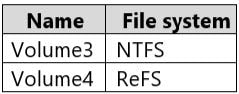
On which volumes can you use direct access (DAX)?
A. Volume3 only
B. Volume4 only
C. Volume1 and Volume3 only
D. Volume2 and Volume4 only
E. Volume3 and Volume4 only
Note: This question is part of a series of questions that present the same scenario. Each question in the series contains a unique solution that might meet the stated goals. Some question sets might have more than one correct solution, while
others might not have a correct solution.
After you answer a question in this section, you will NOT be able to return to it. As a result, these questions will not appear in the review screen.
You have an on-premises server named Server1 that runs Windows Server.
You have a Microsoft Sentinel instance.
You add the Windows Firewall data connector in Microsoft Sentinel.
You need to ensure that Microsoft Sentinel can collect Windows Firewall logs from Server1.
Solution: You install the Log Analytics agent on Server1
Does this meet the goal?
A. Yes
B. No
Note: This question is part of a series of questions that present the same scenario. Each question in the series contains a unique solution that might meet the stated goals. Some question sets might have more than one correct solution, while
others might not have a correct solution.
After you answer a question in this section, you will NOT be able to return to it. As a result, these questions will not appear in the review screen.
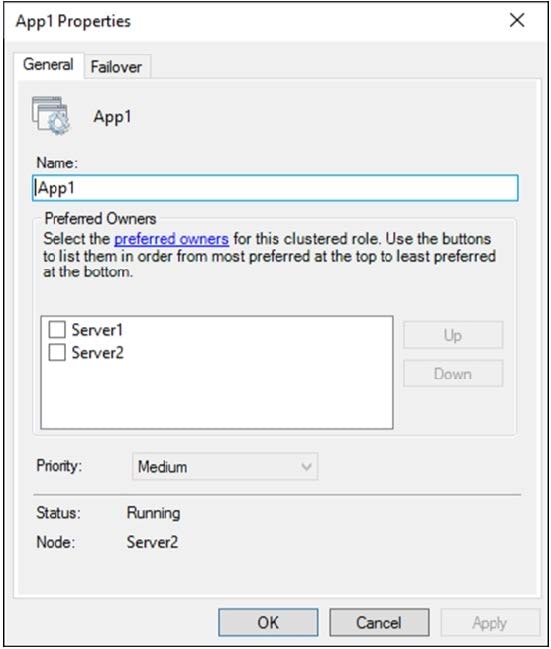
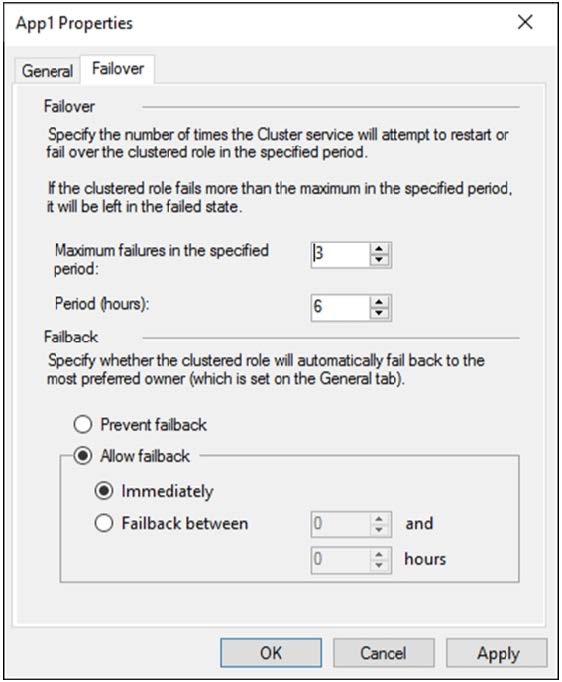
You have a failover cluster named Cluster1 that hosts an application named App1.
The General tab in App1 Properties is shown in the General exhibit. (Click the General tab.)
The Failover tab in App1 Properties is shown in the Failover exhibit. (Click the Failover tab.)
Server1 shuts down unexpectedly.
You need to ensure that when you start Server1, App1 continues to run on Server2.
Solution: You pause the Server1 node in Cluster1 and then start Server1.
Does this meet the goal?
A. Yes
B. No