
B2C-COMMERCE-ARCHITECT Online Practice Questions and Answers
An Architect is configuring a data replication schedule.
Which task(s) can be removed In order to reduce replication times?
A. Campaign
B. Static content
C. Storefront URLs
D. Search Indexes
The Client wants to offer custom made container products on its new B2C Commerce storefront. The Client provided two business requirements.
1.
Customer can specify container length, width, and height.
2.
Customer can specify the material that the container is made of.
The Client also provided the Architect a current data schema (shown below) forreference while preparing the technical documentation.
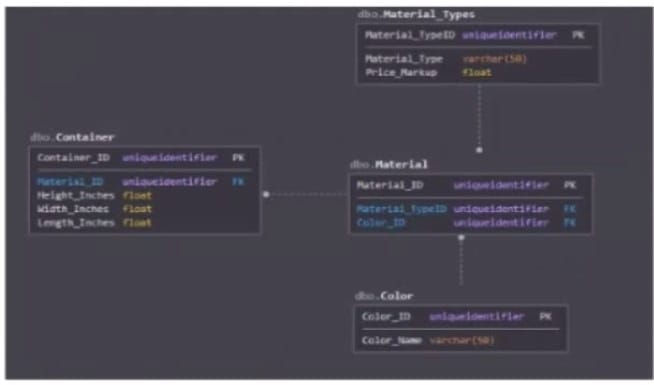
Which two gaps between the requirements and the data schema should the Architect discuss with the Client? Choose 2 answers
A. The data schema includes unique identifiers for material and colorfields, but neither are reflected in the business requirements.
B. The data schema includes an implied structure that the customer's choices should be captured as custom objects, but there isn't a business requirement to do so
C. The data schema includes amaterial Price_Markup field, but there Isn't a business requirement to factor the material cost Into the final price calculation.
D. The data schema includes a Color_ID field, but there isn't a business requirement to allow the customer to specify container color.
During a review of the most recent release notes, the Architect finds that Salesforce has deprecated an API that is used throughout the site. After reviewing the deprecated API usage in Business Manager, the Architect narrows down the usage of that API to a particular LINK integration cartridge. The cartridge was integrated when the site was first launched and is heavily customized for the Client.
What is the recommended way for the Architect to remove thedeprecated API so the LINK integration continues to work without interruptions, and lowest level of effort'
A. The Architect should update all the deprecated API cats in the already integrated LINK cartridge and test thoroughly.
B. The Architect does not need to do anything at this time, the API will continue to work with no issues for the foreseeable future.
C. The Architect should check to see If the LINK cartridge has been updated already, integrate It, apply the customisations, and teat thoroughly.
D. The Architect should contact the company that created the LINK cartridge to fix the issue and provide the client with updated code.
Given a website launched to production, the Architect can rely on several SFCC Business Manager tools that provide an automatic notification feature. Which three tools have such a feature and do not require to be monitored manually? Choose 3 answers
A. Job Schedules
B. Custom Log Settings
C. Analytics Conversion Reports
D. Pipeline Profiler
E. Quota Status
The following promotions are configured with no exclusivity (can be combined with any other promotion) in a -1month campaign:
1.
Free correct- in -store shipping
2.
20% accessories products discount, applies for all customers
3.
$5 off coupon based discount, sent to a selected group of customers
The combination of above promotions allows customers to get 16 socks for free in store. This was unintended, and the Client If considering disabling the coupon. The Client is concerned about a potential spike in the number of Call Center
calls from customers who had the coupon code added to their baskets before it was disabled. As basket lifetime is set to 30 days for all customers, this can continue for the full length of the campaign.
What solution should the Architect suggest to keep the Call Center calls to a minimum?
A. Disable the coupon code. Clear the production cache from the Business Manager to clear existing baskets.
B. Disable the coupon code. Email all the customers to not usethe coupon code in their baskets.
C. Disable the coupon code. Restart the production instance from control Center to dear existing baskets.
D. Disable the coupon code. Reduce the basket lifetime in Business Manager to expire some of the existing baskets
The client provided these business requirements:
1.
The B2C Commerce platform will integrate with the client's Order Management System (OMS).
2.
The OMS supports Integration us-no legacy RPC style SOAP services.
3.
The OMS is hosted on client s infrastructure.
What is the right cartridge folder to place the WSDL provided for the OMS service?
A. /cartridge/webreferences2
B. /cartridge/webreferences
C. /cartridge
D. /cartridge/services
An Architect has been asked by the Business to integrate a newpayment LINK cartridge. As part of the integration, the Architect has created four new services to access various endpoints in the integration. How can the Architect move the new services to Production when the integration is ready for launch?
A. The new services will be moved to Production with a Data Replication.
B. The new services will be moved to production with a Site Import.
C. The new services must be manually exported from staging and Imported into Production.
D. The new services will be moved toProduction with a Code Replication.
The client provided these business requirements:
1.
The B2C Commerce platform will integratewith the Client s Order Management System (OMS).
2.
The OMS supports Integration using REST services.
3.
The OMS is hosted on the Clients infrastructure. Whet configurations are needed for this integration with the OMS?
A. A service configuration, ahostname alias configuration, and a user credential configuration.
B. A service profile configuration, a WAF configuration, and a service credential configuration.
C. A service configuration, a service profile configuration, and a user credential configuration.
D. A service configuration, a service profile configuration, and a service credential configuration.
A developer is checking for Cross Site Scripting (XSS) and found that the quick search is not escaped (allows inclusion of Javascript) in the following script:
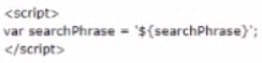
How would the developer resolve this issue?
A. Replace' with double Quote*
B. Use
D. Use
A client receives multiple feeds from third parties on the same SFTP location:
1.
Product prices (sftp: prod/prices)
2.
Stores information (sftp: prod/stores;
3.
Product information (sftp: prod/catalog)
4.
Categories information (sftp: prod/marketing)
5.
Content (sftp: prod/marketing)
Some of the feeds are placed on sftp multiple times a day, as the information is updated in the source system.
TheArchitect decides to have only two jobs:
1.
One that checks and downloads available feeds every hour
2.
One that imports the files from Webdav once a day before the data replication, using the standards steps available in the Job Framework
Which designis correct for the import Job, taking the steps scope in consideration?
A. 1. four sibling flows execute steps ki parallel: import products, stores, prices, content
2.
fifth flow executes: import categories
3.
last flow executes steps In sequence: reindex
B. 1. four sibling flows execute steps in parallel: import products, stores, prices, content
2. last flow executes steps in sequence import categories, reindex
C. 1. three siting flows Import steps In parallel: import products, stores, prices
2.
fourthflow executes: import categories
3.
last flow executes steps in sequece: reindex, Import content
D. 1. Four sibling flows execute steps in parallel: import products, stores, price, content
2. last flow executes steps in sequence: import:categories, reindex