
C2090-545 Online Practice Questions and Answers
Given the two SQL procedures shown below:
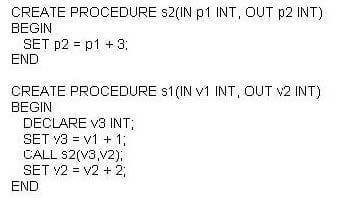
What is the expected output if procedure S1 is invoked with the value 1provided for parameter V1?
A. NULL
B. 2
C. 5
D. 7
Given the following script:
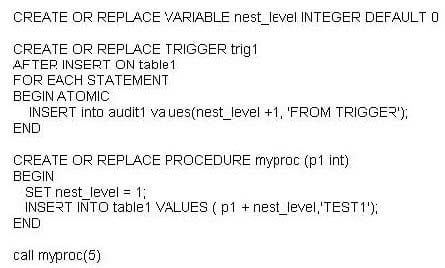
What would be result from the SELECT * FROM audi1?
A. NLEVEL MESSAGE 1 FROM TRIGGER
B. NLEVEL MESSAGE 2 FROM TRIGGER
C. NLEVEL MESSAGE 2 TEST1
D. NLEVEL MESSAGE 5 FROM TRIGGER
Which of the following statements is true?
A. A DATETIME value can be assigned to a DATE variable.
B. Values cannot beassigned to variables inside ERROR HANDLERS.
C. A TIMESTAMP value can be assigned to a TIME variable.
D. The result of a GET DIAGNOSTICS statement cannot be assigned to a variable.
Click the Exhibit button.
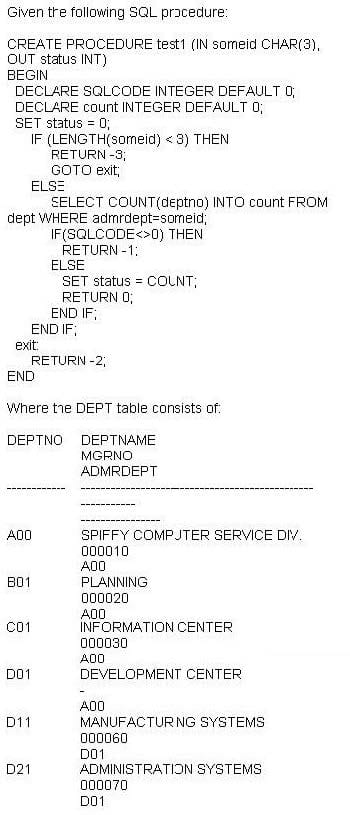
If the procedure TEST1 shown in the exhibit is called with the value 'A00'specified for the SOMEID parameter, what is the expected return code?
A. 0
B. -1
C. -2
D. -3
Click the Exhibit button.
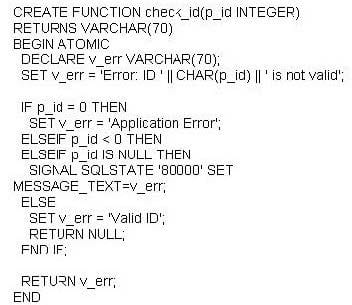
Given the user-defined function shown in the exhibit, what will the function return if invoked using the statement shown below? SELECT check_id(1) FROMSYSIBM.SYSDUMMY1
A. Error: ID 1 is not valid
B. Application Error
C. SQLSTATE 80000 will be returned, with the custom error message "Error: ID 1 is not valid"
D. NULL
Click the Exhibit button.
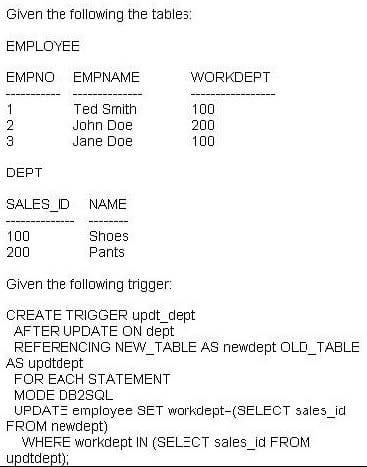
A trigger was created as shown in the exhibit.
The UPDATE statement shown below is executed. UPDATE dept SETsales_id = '300' WHERE sales_id = '200'
How many row(s) are updated in the EMPLOYEE table?
A. 0
B. 1
C. 2
D. 3
Which two types of storedprocedures can be developed in IBM Data Studio? (Choose two.)
A. SQL
B. PHP
C. PL/SQL
D. Perl
E. Ruby
Which statement is TRUE about associative arrays?
A. Associative array values can be stored in table columns.
B. The index values for an associative array must be a continuous set of integer values.
C. Associative array cannot be a type of a table column.
D. The index data type for an associated array must be an integer.
Given the following statement: How many values are inserted in to the array called quantity?
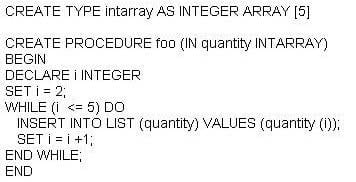
A. 1
B. 2
C. 3
D. 4
Which code fragment illustrates the proper way to capture and save SQL error handler values so they can be used to control procedure logic?
A. DECLARE CONTINUE HANDLER FOR SQLEXCEPTION, SQLWARNING, NOT FOUND SET retcode = SQLCODE;
B. DECLARE ERROR HANDLER FOR SQLEXCEPTION, SQLWARNING, NOT FOUND SET retcode = EXCEPTION;
C. DECLARE ERROR HANDLING SQLEXCEPTION, SQLWARNING, NOT FOUND SET retcode = SQLERRN;
D. DECLARE ERROR HANDLING FOR SQLEXCEPTION, SQLWARNING, NOT FOUND SET retcode = SQLMSG;