
C2180-279 Online Practice Questions and Answers
A company discovers a bug in one of the HTML pages of a Worklight hybrid mobile application that it has recently published to the Android Google Play store. It has fixed the bug and re-deployed the application to the production Worklight Server without changing its version number. Which additional administrative step, if any, must be performed for the update to take effect the next time a user accesses the application on a device?
A. No additional administrative steps are required.
B. Re-publish the application to the Android Google Play store.
C. Change the application status to Updated in the Worklight Console.
D. Change the application status to Updated in the Worklight Console and re-publish the application to the Android Google Play store.
The following changes are made to a Worklight mobile application: 1.Web resources of version 1 (v1) are updated and deployed to the Worklight Server. 2.A new version 2 (v2) is deployed with its updateSilently property set to true. What will be the direct update user experience on a device running v1 of the application when the user chooses to receive update?
A. v1 is uninstalled first followed by a silent installation of v2.
B. v1 web resources are updated first followed by a silent installation of v2.
C. v1 web resources are reloaded after the update and the application remains on v1.
D. The user is prompted to choose between updating v1 or installing v2 in the background.
When displaying native modal controls, the developer creates the following Worklight Common Control implementation:
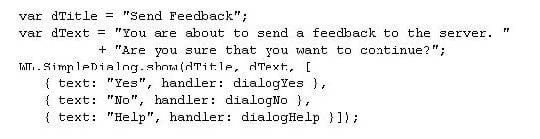
Assuming that the functions dialogYes, dialogNo and dialogHelp are properly defined, what is expected to happen when this snippet is executed on a real device?
A. The snippet will work as expected.
B. The snippet will fail because it is missing the mandatory options parameter.
C. The snippet will fail to execute because WL.SimpleDialog does not support 3 or more buttons.
D. The snippet will work on iOS and BlackBerry, but it will only show buttons Yes and No for Android and Windows Phone 7 (Mango).
A development team is preparing to install Worklight V5.0 Studio in a multi-platform environment including Mac OS, Linux, and Windows workstations. Which installation method can be used on all three platforms?
A. Eclipse Update Site
B. IBM Installation Manager
C. IBM Profile Management Tool
D. IBM Plug-In Installation Wizard
A developer is using a Worklight Studio installation that is configured with the Android 2.2 SDK and the corresponding Google USB driver. The developer has connected an Android device to the machine via a USB cable. The developer tries to run the application on the device but does not see the device listed as a target. What can be a cause for this issue?
A. Worklight does not support testing on Android 2.2 devices.
B. Installed Google USB driver is deprecated and must be explicitly enabled.
C. Installed Google USB driver does not support the device connected to the machine.
D. The worklight.properties file of the application is not configured to allow USB connection.
When working with a SQL adapter which of the following file should be manually added to project?
A. JDBC connector driver
B. Database schema
C. Properties file containing SQL server credentials and configuration
D. Startup script that will connect Worklight server to a specified SQL database
What are the steps of creating a native page?
A. Create a new Java class, extend Activity
B. Create a new Java class, extend Activity, add an activity declaration to AndroidManifest.xml
C. Create a new Java class, extend NativePage
D. Create a new Java class, extend NativePage, add a native page declaration to AndroidManifest.xml
How can the developer declare what to do when a response from Worklight adapter is received?
A. Developer does not have to declare it. Client side framework code will do everything automatically
B. By specifying the callback function names in adapter's XML file
C. By specifying the callback function names in onSuccess and onFailure properties of an options object
D. By adding the callback function names as an invocation parameters
Can application-related custom data be sent in a push notification?
A. No, push notification may only contain notification text that will be shown to user
B. Yes, application-related custom data can be sent in the push notification. but the application must be running in the foreground in order to receive it.
C. Yes, application-related custom data can be sent in the push notification but the application must be running in the background in order to receive it.
D. Yes, application-related custom data can be sent in the push notification. The application may receive it even if it was not running at the time of push notification arrival.
A developer creates two adapters. Each adapter is protected by its own authentication realm with different login modules. What would be the consequence of this approach?
A. Once the user authenticates in one realm he will be automatically authenticated in a second one
B. The user will not be able to use these adapters together in same application
C. The user will have to login in each realm separately
D. The user will have to logout from one realm prior to using adapter protected by another realm