
C5050-062 Online Practice Questions and Answers
Which three statements are true about creating new component versions? (Select three.)
A. New component versions can be created using the IBM UrbanCode Deploy client.
B. New component versions can be created when updating the application configuration.
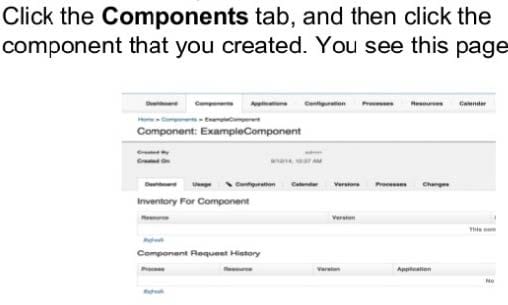
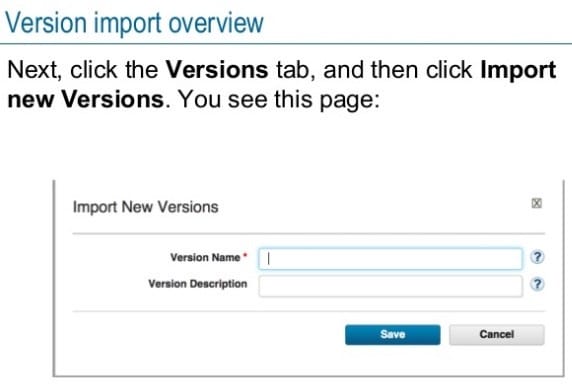
C. New component versions can be created from the versions tab of the component.
D. New component versions can be created using an IBM UrbanCode Deploy generic process.
When integrating .NET applications for deployment to an IIS server, IBM UrbanCode Deploy requires a property be set on the resource for the location of the appcmd.exe file. Where is the Windows default location for appcmd.exe?
A. C:\\Windows\System32\inetsrv
B. C:Program Files\Common Files
C. C:\\Program Files\MSBuild\Microsoft
D. C:\\Windows\Microsoft.NET\Framework
What is the correct order of steps for a typical deployment configuration?
A. Define Application Process; Create component Snapshot; Map Component to Environment; Identify Resource
B. Define Component and Component Process; Define Application; Configure Environment; Identify Resource
C. Define Component; Import Version to Component; Define Application Process; Configure Environment; Map Component to Resource
D. Define Application; Map Component to Recourse; Identify Agent and Environment; Configure Component Process
What is the best use of snapshots?
A. To identify dependences between agents for an application
B. To identify application resources that are related
C. To identify versions of application components that should be deployed together
D. To identify allowed property types and configurations
A customer shows interest in IBM UrbanCode Deploy (UCD) but seems hesitant about purchasing IBM's solution. What should you share as the main value propositions to help this customer adopt UCD?
A. With UCD, you will be able to accelerate your release pace to get to market faster, decrease expensive failures, and scale for growth.
B. UCD will ensure that your developers will produce bug-free code each time they check in.
C. UCD will map your enhancement requests, defect work items, and feature changes to requirements.
D. UCD will raise the social media presence for your company by at least 20% in the first year of use.
For which customer is IBM UrbanCode Deploy likely to be identified as the solution of choice?
A. A customer that has a large number of legacy mainframe applications that need to be migrated to modern tools to support online and mobile usage
B. A customer that is experiencing high testing costs due to poor functional test coverage and dependence on third-party applications to test developer changes.
C. A customer that is experiencing cost overruns coming from large-scale projects involving multiple teams, including some that are outsourced
D. A customer that is experiencing long lead times to deliver applications to production and difficulty coordinating across multiple applications with varying schedules
Where must the Hudson/Jenkins plugin for IBM UrbanCode Deploy (UCD) be installed?
A. The plugin must be installed into IBM UCD only.
B. The plugin must be installed into Hudson/Jenkins only.
C. The plugin must be installed into both Hudson/Jenkins and IBM UCD.
D. No installation is required because the plug in is built into IBM UCD.
What is the IBM definition of "DevOps"?
A. A methodology for software development that divides tasks into short phases or work and frequent reassessment and adaptation of plans with an emphasis on team collaboration
B. AN enterprise capability for continuous software delivery that enables organizations to seize market opportunities, respond more rapidly to customer feedback, and balance speed, cost, quality and risk
C. A system for increasing development efficiencies by transitioning core lean manufacturing principles over to software development practices in order to eliminate waste and amplify learning.
D. An approach for continuous improvement in software and systems delivery, which allows IBM customers to achieve greater value from their investment in software and systems technologies
Which two statements are true about how IBM UrbanCode Deploy (UCD) organize deployment artifacts? (Select two.)
A. Deployment artifacts are typically produced by an automated build and then imported into UCD as a version.
B. Deployment artifacts are stored in an external system (version control, CMDB, inventory, etc.) and UCD can only download the artifacts to the target server as part of a deployment process.
C. Deployment artifacts must be uploaded to Rational Asset Manager, so they can be used on a deployment process.
D. Each component contains at least one deployment package that contains all the deployment artifacts for that application.
E. A component contains in the artifact set (versions) and the automation to deploy it.
IBM UrbanCode Deploy (UCD) allows users to download artifacts from a Maven style repository. How does the incremental file transfer (sync/sync and clean) work from the repository to the target server?
A. IBM UCD downloads the files from the Maven repository, checks each files hash, and compares it to the target before copying files.
B. IBM UCD queries Nexus/Artifactory for the full list of hash values before transferring the files.
C. IBM UCD does not offer the ability to sync and clean with the Maven integration.
D. IDM UCD always performs a sync, regardless of the repository.