
C_HANAIMP_17 Online Practice Questions and Answers
You import a project that includes an SAP HANA database(HDB) module to your workspace. You need to create a calculation view that uses data from one table located in an external schema. Which of the following items must you build?
Note: There are 2 correct answers to this question.
A. Synonym
B. .hdinamespacefile
C. Authorization
D. Project
In a calculation view, what is the purpose of a variable?
A. To break up complex SQL into smaller steps
B. To pass values between procedures and calculation views
C. To provide a run-time attribute filter based on a user input
D. To provide a dynamic value in a calculated column
How do you embed a decision tree in to your calculation view using a table function? Note: There are 2 correct answers to this question.
A. Call the SAP-provided PAL decision tree procedure from the table function
B. Use dynamic SQL in the table function to generate the SQL code
C. Copy and adapt the SQL code generated by a flow graph into the table function
D. Build a flow graph and call it from the table function using input parameters
You have a calculation view which includes nodes as shown in the graphic. You decide to select the "Ignore Multiple Output for Filters" check box on Projection Node 3. What might the effects of this be?
Note: There are 2 correct answers to this question.
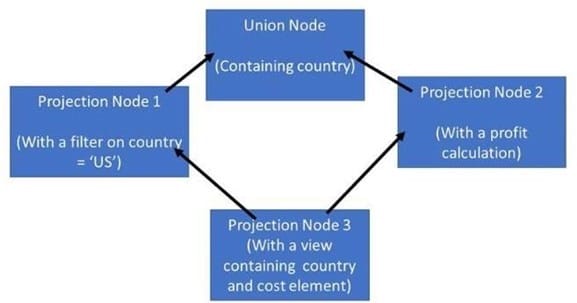
A. The view will return the profit calculation for only the US
B. A change to the data that is returned by the view
C. Increased performance
D. Decreased performance
You want to expose a hierarchy that is defined in a calculation view for access to SQL which of the following conditions must be met?
Note: There are 2 correct answers .
A. The hierarchy must be a local hierarchy.
B. The hierarchy must be exposed by a calculation view of type CUBE with star join.
C. The hierarchy must be defined in a calculation view of type SQL ACCESSONLY.
D. The hierarchy must be a shared hierarchy.
Referring to the diagram, which privileges would a user require to view United States data when querying the CUBE Calculation view?

A. Analytic Privileges and SELECT privileges on the CUBE Calculation view
B. A SELECT privilege and an Analytic Privilege (Country = United States) on the DIMENSION Calculation view
C. A SELECT privilege on the CUBE and an Analytic Privilege (Country = United States) on the DIMENSION Calculation view
D. SELECT or Privileges and Analytic Privileges on both views
Your calculation view consumes one data source which includes the following columns :
SALES_ORDER_ID, PRODUCT_ID, QUANTITY and PRICE.
In the output, you want to see summarized data by PRODUCT_ID and a calculated column, PRODUCT_TOTAL, with the formula QUANTITY ?PRICE.
In which type of node do you define the calculation to display the correct result?
A. Union
B. Join
C. Projection
D. Aggregation
You have imported a new calculation view in a folder that contains a .hdinamespace file. This calculation view consumes one data source which is a table. When trying to build the calculation view, there is a namespace-related issue and the build fails.
What could be the reason? Note: There are 2 correct answers.
A. The imported calculation view and its data source have different namespaces.
B. The name space used within the calculation view to reference the table is different from the actual namespace in the identifier of this table.
C. The .hdinamespace file specifies a different name space property than the one in the identifier of the calculation view.
D. The hdinamespace specifies "sub-folder": "append'', so calculation views can only be created in sub-folders.
Which type of join supports a temporal condition in a calculation view?
A. Left outer join
B. Text join
C. Referential join
D. Inner join
Why do you build a calculation view of type SQL Access only?
A. To enable SQL access to your hierarchies
B. To provide a high-performance model when only attributes are required
C. To provide a data source that can only be consumed by a function or procedure
D. To provide a data source that is only consumed by other calculation views