
Exam2pass
0 items Sign In or Register
  • Home
  • IT Exams
  • Guarantee
  • FAQs
  • Reviews
  • Contact Us
  • Demo
Exam2pass > AICPA > AICPA Certifications > CPA-TEST > CPA-TEST Online Practice Questions and Answers

CPA-TEST Online Practice Questions and Answers

Questions 4

In the first audit of a client, an auditor was not able to gather sufficient evidence about the consistent application of accounting principles between the current and prior year, as well as the amounts of assets or liabilities at the beginning of the current year. This was due to the client's record retention policies. If the amounts in question could materially affect current operating results, the auditor would:

A. Be unable to express an opinion on the current year's results of operations and cash flows.

B. Express a qualified opinion on the financial statements because of a client-imposed scope limitation.

C. Withdraw from the engagement and refuse to be associated with the financial statements.

D. Specifically state that the financial statements are not comparable to the prior year due to an uncertainty.

Buy Now

Correct Answer: A

Explanation: Choice "a" is correct. Since the auditor was unable to gather sufficient evidence on the beginning balances of the balance sheet accounts, the auditor would be unable to express an opinion on the current year's results of operations and cash flows. The auditor could express an opinion on the statement of financial position. Choice "b" is incorrect. Since the scope limitation could have a pervasive effect on the financial statements (affecting all assets and liabilities), a disclaimer of opinion (and not merely a qualified opinion) is required on the income statement and statement of cash flows. An opinion may be expressed on the year-end statement of financial position. Choice "c" is incorrect. The auditor does not need to withdraw from the engagement and refuse to be associated with the financial statements. Choice "d" is incorrect. An uncertainty does not exist. The auditor can express an opinion on one of the financial statements.

Questions 5

Which of the following is a conceptual difference between the attestation standards and generally accepted auditing standards?

A. The attestation standards provide a framework for the attest function beyond historical financial statements.

B. The requirement that the practitioner be independent in mental attitude is omitted from the attestation standards.

C. The attestation standards do not permit an attest engagement to be part of a business acquisition study or a feasibility study.

D. None of the standards of fieldwork in generally accepted auditing standards are included in the attestation standards.

Buy Now

Correct Answer: A

Explanation:

Choice "a" is correct. Attestation standards provide a framework for the attest function beyond historical

financial statements.

Choice "b" is incorrect. The independence standard is almost the same for both attest engagements and

audits.

Choice "c" is incorrect. An attest engagement may be part of a larger engagement (such as a business

acquisition study or a feasibility study).

Choice "d" is incorrect. Attestation standards include two of the three GAAS fieldwork standards: planning/

supervision and evidence. They do not include the internal control standard.

Questions 6

Which of the following tests of controls most likely would help assure an auditor that goods shipped are properly billed?

A. Scan the sales journal for sequential and unusual entries.

B. Examine shipping documents for matching sales invoices.

C. Compare the accounts receivable ledger to daily sales summaries.

D. Inspect unused sales invoices for consecutive prenumbering.

Buy Now

Correct Answer: B

Explanation: Choice "b" is correct. Tracing from a sample of shipping documents to matching sales invoices would provide support for the completeness assertion for billing. Choice "a" is incorrect. Scanning the sales journal for sequential and unusual entries tests the completeness and existence assertions for sales, but would not provide assurance that shipped goods

were properly billed.

Choice "c" is incorrect. Comparing the accounts receivable ledger to the daily sales summary helps ensure

that all sales were recorded as receivables and all receivables were recorded as sales, but it does not

provide assurance that shipped goods were properly billed.

Choice "d" is incorrect. Inspecting the consecutive numbering of unused sales invoices might identify

fictitious sales, but it would not ensure that goods that have been shipped were properly billed.

Questions 7

A client has a large and active investment portfolio that is kept in a bank safe deposit box. If the auditor is unable to count the securities at the balance sheet date, the auditor most likely will:

A. Request the bank to confirm to the auditor the contents of the safe deposit box at the balance sheet date.

B. Examine supporting evidence for transactions occurring during the year.

C. Count the securities at a subsequent date and confirm with the bank whether securities were added or removed since the balance sheet date.

D. Request the client to have the bank seal the safe deposit box until the auditor can count the securities at a subsequent date.

Buy Now

Correct Answer: D

Explanation: Choice "d" is correct. If the auditor is unable to count the securities at the balance sheet date the auditor should request the client to have the bank seal the safe deposit box until the auditor can count the securities. Choice "a" is incorrect. Bank employees are not present when items are put into or taken from the safety deposit box and do not keep records of safety deposit box contents. They would therefore be unable to provide any information to the auditors. Choice "b" is incorrect. Examining supporting evidence for the transactions occurring during the year is inefficient, as many of the securities purchased during the year may have been sold before the balance sheet date. Counting securities is preferable as it provides direct external evidence of the securities on hand at year-end. Choice "c" is incorrect. Bank employees are not present when items are put into or taken from the safety deposit box and do not keep records of safety deposit box contents. They would therefore be unable to provide any information to the auditors.

Questions 8

Which of the following statements is correct if there is an increase in the resources available within an economy?

A. More goods and services will be produced in the economy.

B. The economy will be capable of producing more goods and services.

C. The standard of living in the economy will rise.

D. The technological efficiency of the economy will improve.

Buy Now

Correct Answer: B

Explanation: Choice "b" is correct. If there is an increase in the resources available in an economy, the economy will be capable of producing more goods and services. This increase is really an increase in the long-run aggregate supply (potential GDP). On the aggregate supply and demand chart, the long-run aggregate supply line (LRAS) is the vertical line that represents the potential or equilibrium level of output. If that line shifts to the right, then the economy is capable of expanding, but it will not automatically expand just because the line shifts to the right. Choice "a" is incorrect. Just because there is an increase in the resources available in an economy, it does not mean that more goods and services will automatically be produced. There would have to be increased demand (a shift upward in the aggregate demand line) for more goods and services to actually be produced. Choice "c" is incorrect. If there is an increase in the resources available in an economy, the standard of living in the economy will not necessarily rise. It could rise, but it will not necessarily do that. Choice "d" is incorrect. If there is an increase in the resources available in an economy, the technological efficiency of the economy will not automatically improve. This statement is backwards. An increase in technological efficiency of an economy will normally increase the resources available in the economy by increasing productivity.

Questions 9

Under monopolistic competition, strategic plans focus on:

A. Profitability from production levels that maximize profits.

B. Maintaining the market share and being responsive to market conditions related to sales price.

C. Maintaining the market share and planning for enhanced product differentiation.

D. Maintaining the market share, ensuring product differentiation, and adapting to price changes or required changes in production volume.

Buy Now

Correct Answer: C

Explanation:

Choice "c" is correct. Under monopolistic competition, strategic plans include maintaining the market share

(as with pure competition), but they also likely include plans for enhanced product differentiation and

allocation of resources to advertising, product research, etc.

Choices "a", "b", and "d" are incorrect because they are characteristics of other types of market structures.

Questions 10

Strategic planning activities normally involve which of the following efforts:

I. Strategic Positioning.

II. Value Chain Analysis.

III.

Balance Scorecard Development.

A.

I.

B.

I and II.

C.

I and III.

D.

I, II, and III.

Buy Now

Correct Answer: D

Explanation:

Choice "d" is correct. Strategic planning activities are normally acknowledged to include each of three

operations including:

I. Strategic positioning. Strategic positioning includes the process of identifying mission, identifying overall strategy, identifying factors critical to succeeding given the assumed strategy and identifying internal and external factors that contribute or detract from achieving the strategy.

II. Value chain analysis. Value chain analysis includes the process of identifying the functional characteristics of an organization and the manner in which each one of those functions adds value to the firm's customers.

III. Balanced scorecard development. Development of a balanced scorecard identifies measurements of value that are both financial and non-financial to be used to monitor and evaluate performance.

Choice "a" is incorrect. All three activities are integral to strategic planning. Choice "b" is incorrect. All three activities are integral to strategic planning. Choice "c" is incorrect. All three activities are integral to strategic planning.

Questions 11

How should the effect of a change in accounting principle that is inseparable from the effect of a change in accounting estimate be reported?

A. As a component of income from continuing operations.

B. By restating the financial statements of all prior periods presented.

C. As a correction of an error.

D. By footnote disclosure only.

Buy Now

Correct Answer: A

Explanation: Choice "a" is correct. When the effect of a change in accounting principle is inseparable from the effect of a change in accounting estimate, the reporting treatment for the overall effect is as a change in estimate. Thus, the effect is reported prospectively as a component of income from continuing operations. Under SFAS No. 154, this type of change is now called a change in accounting estimate affected by a change in accounting principle. Choice "b" is incorrect. Restatement of all prior periods is the retroactive accounting treatment that is applied to the correction of an error and the retrospective accounting treatment given to changes in accounting principle. However, a change in accounting principle that is inseparable from the effect of a change in accounting estimate is now treated as a change in accounting estimate. Choice "c" is incorrect. Correction of an error is given retroactive treatment as a prior period adjustment to retained earnings with restatement of prior periods. This is not the treatment appropriate for the effect of a change in accounting principle that is inseparable from the effect of a change in accounting estimate. Choice "d" is incorrect. While footnote disclosure is always appropriate for an accounting change, such disclosure alone is never the appropriate accounting treatment.

Questions 12

In 19X4, Smith, a divorced person, provided over one half the support for his widowed mother, Ruth, and his son, Clay, both of whom are U.S. citizens. During 19X4, Ruth did not live with Smith. She received $9,000 in Social Security benefits. Clay, a 25 year-old full-time graduate student, and his wife lived with Smith. Clay had no income but filed a joint return for 19X4, owing an additional $500 in taxes on his wife's income. How many exemptions was Smith entitled to claim on his 19X4 tax return?

A. 4

B. 3

C. 2

D. 1

Buy Now

Correct Answer: C

Explanation: Choice "c" is correct. Smith is entitled to an exemption for himself. He is also entitled to an exemption for his mother Ruth (qualifying relative). Ruth has $9,000 in Social Security payments during 19X4, but since that is her only income, the Social Security is not taxable, and nontaxable income does not count in calculating whether an exemption can be taken for a dependent. Clay cannot be taken as a dependent because he filed a joint return with his wife. Since the joint return was filed for a purpose other than simply claiming a refund, the joint return prevents Smith from claiming an exemption for Clay. An exemption cannot be taken for Clay's wife because she filed a joint return with Clay. Smith is entitled to two exemptions. Choice "a" is incorrect. Clay cannot be taken as a dependent because he filed a joint return with his wife. Since the joint return was filed for a purpose other than simply claiming a refund, the joint return prevents Smith from claiming an exemption for Clay. An exemption cannot be taken for Clay's wife because she filed a joint return with Clay. Choice "b" is incorrect. Clay cannot be taken as a dependent because he filed a joint return with his wife. Since the joint return was filed for a purpose other than simply claiming a refund, the joint return prevents Smith from claiming an exemption for Clay. An exemption cannot be taken for Clay's wife because she filed a joint return with Clay. Choice "d" is incorrect. Smith is entitled to an exemption for his mother, Ruth. Ruth has $9,000 in Social Security payments during 19X4, but because that is her only income, the Social Security income is not taxable, and nontaxable income does not count in calculating whether an exemption can be taken for a dependent.

Questions 13

In the current year Jensen had the following items:
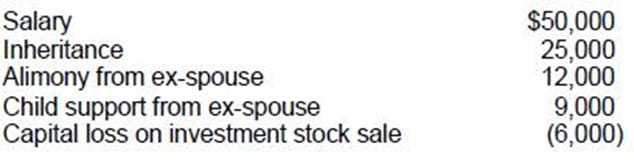
What is Jensen's AGI for the current year?

A. $44,000

B. $59,000

C. $62,000

D. $84,000
Buy Now

Correct Answer: B

Explanation:

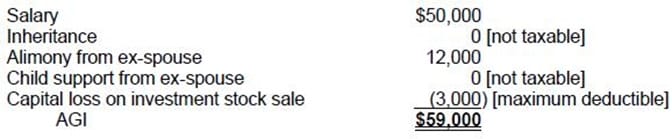
Choice "b" is correct. The question asks for AGI, but all of the items in the list are items of potential gross

income. There are no adjustments included in the list; therefore, in this case, AGI is the same as gross

income. The calculation is as follows:

Choices "a", "c", and "d" are incorrect, per the above calculation.

Exam Code: CPA-TEST
Exam Name: Certified Public Accountant Test: Auditing and Attestation, Business Environment and Concepts, Financial Accounting and Reporting, Regulation
Last Update: Jul 02, 2026
Questions: 1241

PDF (Q&A)

$45.99
ADD TO CART

VCE

$49.99
ADD TO CART

PDF + VCE

$59.99
ADD TO CART

Exam2Pass----The Most Reliable Exam Preparation Assistance

There are tens of thousands of certification exam dumps provided on the internet. And how to choose the most reliable one among them is the first problem one certification candidate should face. Exam2Pass provide a shot cut to pass the exam and get the certification. If you need help on any questions or any Exam2Pass exam PDF and VCE simulators, customer support team is ready to help at any time when required.

Home | Guarantee & Policy |  Privacy & Policy |  Terms & Conditions |  How to buy |  FAQs |  About Us |  Contact Us |  Demo |  Reviews

2026 Copyright @ exam2pass.com All trademarks are the property of their respective vendors. We are not associated with any of them.