
E20-370 Online Practice Questions and Answers
Which type of backups are supported by CBRM?
A. Incremental, Full, Automatic, Manual
B. Incremental, Full, Differential, Automatic
C. Incremental, Full, Differential, Continuous
D. Incremental, Full, Differential, Date Range
When creating an EMC Centera profile to use for CUA 4.0, which management role must be enabled?
A. Audit
B. Compliance
C. Monitor
D. Replication
Which types of applications are a good fit for CAS?
A. E-mail archiving
B. File Sharing
C. Server Backups
D. Transactional Databases
The storage-strategy is set to Performance Partial and CPP. All objects written to the EMC Centera are greater than 10 MB in size. The threshold is at the default setting. You notice that single instancing does
not work for these objects. What might be the reason?
A. "M" naming scheme is used by the application
B. Application uses embedded BLOBs
C. Collision avoidance flag is set on the application server
D. Size of the parity slices is smaller than the threshold
Which operating system does EMC Centera Console support?
A. AIx
B. HP-Ux
C. Linux
D. Windows
Your customer wants to maximize storage space on an EMC Centera. Which Protection Scheme and Storage Strategy combination should you choose?
A. CPM and Capacity
B. CPM and Performance
C. CPP and Capacity
D. CPP and Performance
Click the Exhibit button
You are asked to return to a recent implementation where you tested access to the EMC Centera with EMC Centera Verify and the customer's finance PEA file. The customer tells you that there are still objects on the two clusters even though you deleted all your test data.
It is clear that this is test data, but why did EMC Centera Verify fail to clean up?
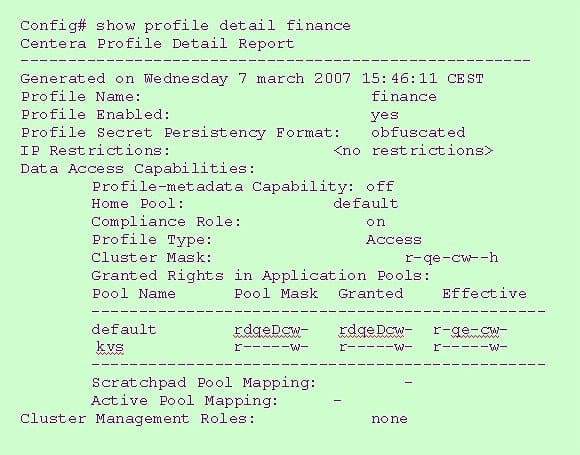
A. EMC Centera Verify cannot delete test data.
B. kvs pool does not allow deletes.
C. The cluster is in Governance Edition mode.
D. The cluster mask does not allow deletes.
Your customer wants to minimize access time to an EMC Centera. Which Protection Scheme and Storage Strategy combination should you choose?
A. CPM and Capacity
B. CPM and Performance
C. CPP and Capacity
D. CPP and Performance
A customer has an EMC Centera located on network A and an application server located on network B, with the two networks connected via the Internet. Which feature should be enabled to allow communication from the application server located outside of the local private network?
A. DHCP
B. FQDN
C. ICMP
D. NAT
What distinguishes a PEA file used for a replication profile from a PEA file used for an application profile in a replicated two-Centera environment?
A. PEA file for the replication profile will be encrypted
B. PEA file for the replication profile will contain only the cluster ID of the source EMC Centera
C. PEA file for the replication profile will contain only the cluster ID of the target EMC Centera
D. PEA file for the replication profile will contain the cluster ID of both the source and target EMC Centeras