
HP0-Y50 Online Practice Questions and Answers
HOTSPOT
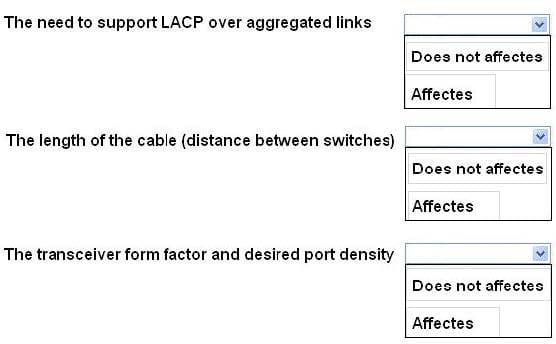
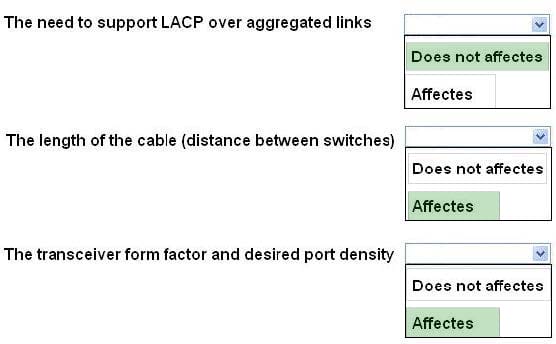
A network architect is choosing transceivers for switches-to-switches fiber links. Which factors affect the architect's choice?
Hot Area:
A customer is seeking an upgrade for their campus LAN network. Currently, the customer has access layer switches that support 18.10/100/1000 Mbps ports and one Gigabit uplink. The customer wants better performance in the upgrade but also wants to minimize costs.
The network architect has used the Network Traffic Analyzer (NTA) for Intelligent Management Center (IMC) to collect information about the access layer uplinks. These are the results:
For switches on Floor1, the peak utilization is 650 Mbps on a Gigabit uplink. On most days, the utilization peaks at about 400 Mbps. Peaks usually occur briefly. For switches on Floo2, the peak utilization is 800 Mbps on a Gigabit Uplink.
During active periods, the utilization often remain near 800.
What is most appropriate plan for oversubscription in the new access layer? (For this question, think only about oversubscription and not customer needs for redundancy)
A. 48 1 on floor 1 and 24 1 on floor 2
B. 24.1 on floor 1 and 4.1 on floor 2
C. 48 1 in all locations
D. 24 1 in all locations
A network architect is planning an intelligent Resilient Framework (IRF) group. What should the network architect implement to protect against a split IRF group?
A. Distributed Trunking (DT)
B. Virtual Router Redundancy Protocol (VRRP)
C. Multi-Active Detections (MAD)
D. Rapid Ring Protection Protocol (RRPP)
What are information technology Service Management (ITSM) framework, such as the infrastructure Technology Infrastructure Library (ITILv3) and The Open Group Architecture Framework (TOGAF)?
A. They are Internet Engineering Task Force (IETF) standards that provide evolving guidelines and best practices for IT design and management
B. They are high-level approaches that provide recommendations and best practices for IT design management
C. They are industry-wide standards that provide guidelines for enterprise design and management
D. They are Internet Engineering Task Force (IETF) standards that define proper network design
A network architect is choosing fabric module for an HP 10500 Series Switch. Which factors affect the choice?
A. The environment in which the switch will be installed and the direction of the airflow
B. The number of IPv4 and IPv6 routes that the switch must support in its routing table
C. The type of I/O modules and whether full bandwidth must be supported on all ports at the same time
D. The type of management modules and whether these modules operate in hot-standby mode
The customer plans to connect 40 Voice over IP (VoIP) phones and 8 security cameras to a switch:
The VoIP phones are Class 2 devices and require a maximum of 4.5W (draw 5w) The security cameras are Class 4 devices and require a maximum of 17W (draw 20W) The network architect is proposinga switch that supports PoE and PoE + and has a PoEPower budget of 370W.
The architect proposes the usage from of power allocation. What are the advantages and disadvantages of this proposal?
A. It allows the switch to run at a lower temperature, saving power and cooling costs, but it decreases the performance for the phones.
B. It allows the switch to connect to the PoE and PoE+ devices on cheaper copper cable, but it limits the distance between the devices.
C. It allows the switch to connect to the PoE and PoE + devices at the same time, but the customer must purchase a redundant power supply.
D. It allows the switch to support the PoE requirements without a redundant power supply, but power might be oversubscribed if conditions change.
A network architect is using the Network Traffic Analyzer (NTA) module for HP Intelligent Management Center (MC) to evaluate traffic patterns in a campus LAN environment. The network architect hopes to use this information to determine whether the current oversubscription is working well or whether the new plan to have less oversubscription.
What will provide the most useful information for this decision?
A. The peak utilization on uplinks
B. The sum of the average utilization on user edge ports
C. The peak utilization on randomly-selected user edge ports
D. The average utilization on uplinks
A customer plans to connect 40 Voice over IP (VoIP) phones and 8 security cameras to a switch:
The VoIP phones are Class 2 PoE devices and require a maximum of 45W (draw a maximum of 5w)
The security cameras are Class 4 PoE+ devices and require a maximum of 17W (draw a maximum of 20 W)
The network architect is proposing an HP 5500-48G-PoE switch, which supports PoE and PoE+ and has a PoE power budget of 370W
The customer and architect agree on the class form of power allocation
What else does the solution require?
A. A management module that is PoE+ capable
B. A redundant power supply for the switch that enhances the PoE/PoE+ budget
C. A power converter that enables the switch to provide PoE and PoE+ power at the same time
D. A 208-220V input power service
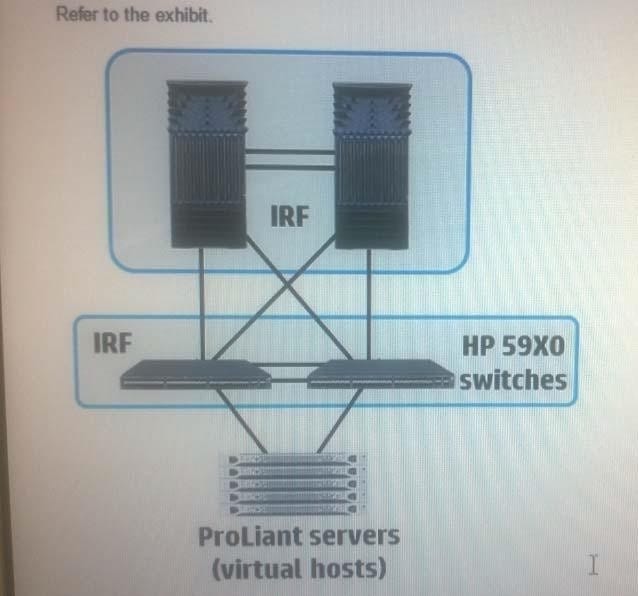
When does this design benefit a virtualized data center?
A. The access layer and core switches use several layers of redundancy protocols, including Multiple Spanning Tree Protocol (MSTP) at Layer 2, Virtual Router Redundancy Procotol (VRRP) at Layer 3, and Intelligent Resilient Framework (IRF) at Layer 4.
B. The access layer and core switches can connect on link aggregation groups. VLANs can extend across these aggregations, but they are more stable and highly-available than redundant Layer 2 links that use spanning tree.
C. The access layer switches can integrate their Intelligent Resilient Framework (IRF) capabilities with those on the core switches to create a single CLOS fabric.
D. The core switches can implement Virtual Ethernet Port Aggregator (VEPA) to extend tunnels for virtualized traffic across the data center backbone.
Refer to the exhibit.
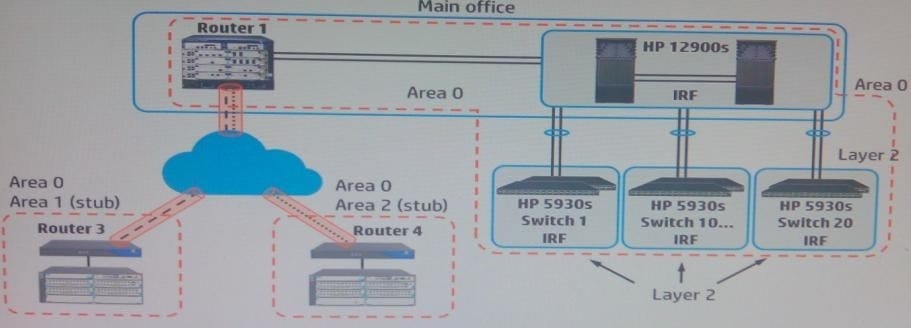
The exhibit is a plan for Open Shortest Path First (OSPF) areas. What should the network architect do to improve the OSPF network design?
A. Add a redundant link in area 0 between each branch router and the data center core Intelligent Resilient Framework (IRF)
B. Change area 1 and area 2 to not so stubby areas (NSSAs) or normal areas
C. Move the boundary between area 1 and area 0 to Router 1 make the same change to area 2
D. Implement routing on the 5930 switches. Make Switch 10 an area border router (ABR) between area 0 and a new area