
HPE2-K45 Online Practice Questions and Answers
What is the difference between crash consistent and application consistent cloning methods?
A. Application-consistent clones allow the pending 10 operations to finish before committing them to the database.
B. Both methods are the same; the only difference is speed of cloning.
C. Crash consistent method should be used only for the virtual machines with Fault Tolerance enabled.
D. Application consistent method is available only for Linux operating systems.
What are the requirements for stretched cluster implementation?
A. Arbiter located in the primary site
B. Round trip latency below 50ms
C. A direct-connected network configuration
D. The same subnet for the storage network for both locations
Refer to exhibit:
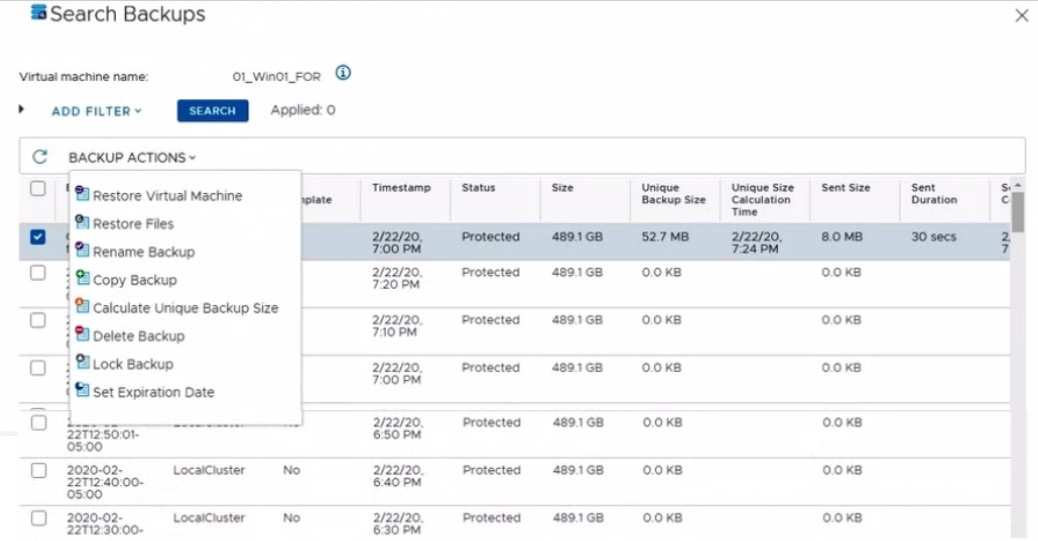
You are using Restore Virtual Machine for a given virtual machine. Which result is achieved by thrs operation?
A. Virtual machine boot partition mapped as IS image to another VM
B. New snapshot added to existing virtual machine
C. New linked-clone created
D. New virtual machine created out of this backup
A user deleted a file from Linux based virtual machine.
Which HPE SimpliVity data protection feature can be leveraged to recover the flie?
A. Restoring a virtual machine from the backup
B. Moving a virtual machine from DR site to the primary site
C. Reverting to the SimpliVity snapshot D. Using file level restore option
What is the difference between crash consistent and application consistent cloning methods?
A. Application-consistent clones allow the pending 10 operations to finish before committing them to the database.
B. Both methods are the same; the only difference is speed of cloning.
C. Crash consistent method should be used only for the virtual machines with Fault Tolerance enabled.
D. Application consistent method is available only for Linux operating systems.
Which functionality does HPE InfoSight for HPE SimpliVity provide?
A. balance workloads across HPE SimpllVity nodes based on utilization
B. recommendation for guest operating system settings optimization
C. automated firmware and software upgrades for registered customers
D. monitoring of virtual machine latency
A customer has some CPU intensive applications running that will be deployed in the virtual machines. The customer is concerned that these virtual machines may impact the performance of the other virtual machines.
What should you recommend to avoid this potential problem and still leverage HPE SimpliVity features for these virtual machines?
A. Present HPE SimpliVrty datastores to external ESXi system that will house these CPU intensive virtual machines.
B. Add an external ESXi cluster to HPE SimpliVity Federation, and enable Intelligent Workload ptimizer.
C. Add an external ESXi system to HPE SimpliVity cluster, and enable DRS functionality for CPU intensive virtual machines.
D. Deploy CPU intensive virtual machines on HPE SimpliVity, and configure for them CPU affinity parameter.
A customer wants to provide access to the HPE SimpliVity datastores for compute nodes running CPU-intensive virtual machines. What should you tell the customer?
A. It is supported to connect up to 5 compute nodes per SimpliVity node.
B. Additional license is required to connect ESXi nodes to SimpliVity datastores.
C. Connecting ESXi compute nodes is possible only when VMFS datastores are configured at SimpliVity Federation level
D. Compute nodes must reside in the same cluster as HPE SimpliVity nodes.
A customer has development virtual machines that do not require storage HA. How can the customer save storage capacity within an HPE SimpliVity cluster?
A. By disabling HA cluster functionality for HPE SimpliVity Federation
B. By placing them on HPE Storence instead of HPE SimpliVity
C. By disabling the HA feature for only these virtual machines at vCenter Server
D. By creating a single-replica datastore for these virtual machines
You are designing a new HPE SimpliVity solution. You want to confirm your configuration is compatible and supported with the customer requirements. Which items can you find in the HPE SimpliVity mniStack Interoperability Guide? (Select two.)
A. GPU Accelerators
B. ESXi version
C. Guest S version
D. vSphere License
E. Processor model