
HPE2-Z39 Online Practice Questions and Answers
What is one characteristic of a spanning tree edge port on an ArubaOS switch?
A. It ignores incoming BPDUs.
B. It stays in Designated role during topology changes.
C. It only forwards traffic in VLANs assigned to the instance 0 (1ST).
D. It connects to a switch that runs MSTP but in a different region.
What is one characteristic of a spanning tree edge port on an ArubaOS switch?
A. The port link state does not affect the RSTP topology.
B. The port connects to a switch that runs MSTP but in a different region.
C. The port only forwards traffic in VLANs assigned to the instance 0 (IST).
D. The port ignores incoming BPDUs
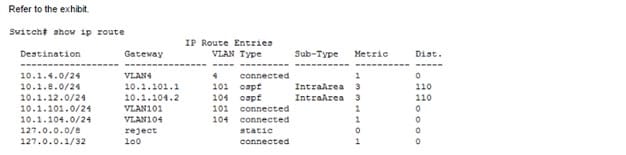
An ArubaOS switch has the routing table shown in the exhibit. A network administrator then enters this
command: Switch (config) # ip routs 10.0.0.0/8 10.1.104.2
After the administrator enters this command, packets arrive that are destined for 10.1.8.8 and 10.1.8.13.
What does the switch do with this traffic?
A. It load balances some of the traffic to 10.1.101.1 and some to 10.1.104.2.
B. It forwards at of the traffic to 10.1.104.2.
C. It drops the traffic.
D. It forwards all of the traffic to 10.1.101.1.
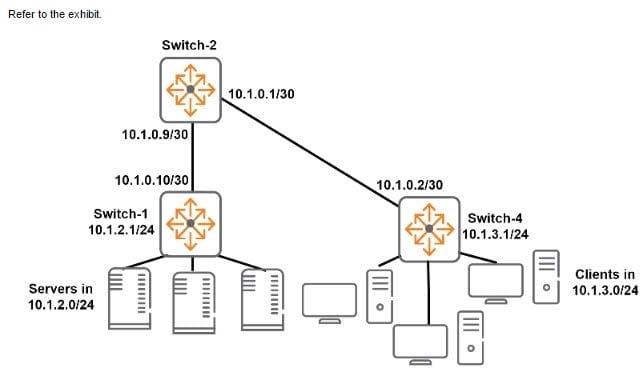
A network administrator creates a route to 10.1.2.0724 on Switch-4. What is the correct next hop for the route?
A. 10.1.0.2
B. 10.1.0.9
C. 10.1.0.1
D. 10.1.21
Two ArubaOS switches connect on a VLAN. and both enable OSPF on that VLAN. Which VLAN OSPF setting must match for the switches to become fully adjacent neighbors?
A. DR priority
B. area ID
C. cost
D. router ID
What is one reason to configure a dynamic LACP link aggregation instead of a static link aggregation?
A. so that the link aggregation automatically chooses its operational key
B. so that the link aggregation can detect the system ID and operational key on the other side of each link
C. so that the link aggregation can automatically change a passive LACP interface to active mode
D. so that the link aggregation can include more interfaces with some interfaces on standby
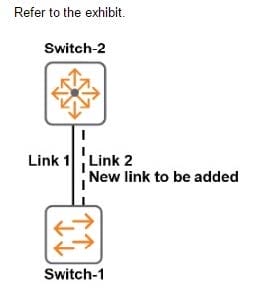
The switches in the exhibit use RSTP The network administrator needs to add Link 2. Why should the administrator configure Links 1 and 2 as a link aggregation?
A. to combine traffic statistics for the interfaces
B. to prevent a loop from occurring
C. to share traffic more evenly over both links
D. to automatically apply the settings already configured for Link 1 to Link 2
A network administrator connects several new Aruba Instant APs (at factor/ defaults) to a switch. After waiting several minutes for the cluster to form, the administrator is ready to provision the cluster. The VLAN on the ports connected to the APs has no DHCP services.
How can the administrator contact the Instant Ul and provision the APs with static IP addresses?
A. Access the cluster using Aruba Activate.
B. Connect to the Instant SSID and open a Web browser.
C. Access https://vc.arubanetworks.com from a device connected in the AP VLAN.
D. Access the default IP address. 192.168.1.1. from a device connected in the AP VLAN.
A network administrator wants to apply a critical PoE priority to any ArubaOS switch port that connects to an Aruba AR The priority should be applied dynamicaly based on LLDP messages received from the AP. Which step should the administrator take to meet this goal?
A. Configure the PoE usage setting on all ports as class and make sure that Aruba APs are defined as Class 4 devices.
B. Configure the PoE usage setting on all ports as tfdp.
C. Enable LLDP MED TLV extensions on the switch port.
D. Enable the default AP profile bound to the Aruba AP device type.
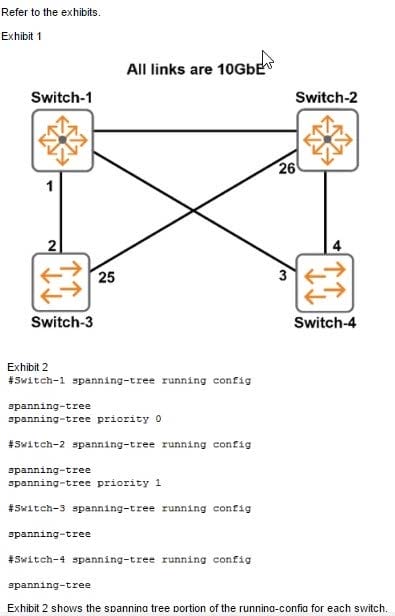
What are two ports with the alternate role?
A. 1 and 2
B. 2 and 4
C. 4 and 25
D. 25 and 26