
HPE6-A47 Online Practice Questions and Answers
Which guidelines should an architect use to determine how many AirWave servers to recommend?
A. One server should be deployed on every subnet with an infrastructure device.
B. One server is recommended for the base features and one server each for add-on features such as Clarity.
C. One server should be dedicated to the wired infrastructure and one server to the wireless infrastructure.
D. One server should monitor and manage up to about 4,000 infrastructure devices.
An architect plant to purpose an Aruba wireless solution with several Mobility Controllers (MCs) and a Mobility Master (MM) architecture. Wireless users run Skype for Business, a Unified Communications (UC) solution. The architect plans to use the Aruba SDN capabilities to integrate with the UC solution.
What helps to support high availability specifically for the SDN services?
A. a redundant master MC
B. backup controllers defines on the APs
C. a cluster deployment for MCs
D. a redundant MM
Refer to the exhibit.
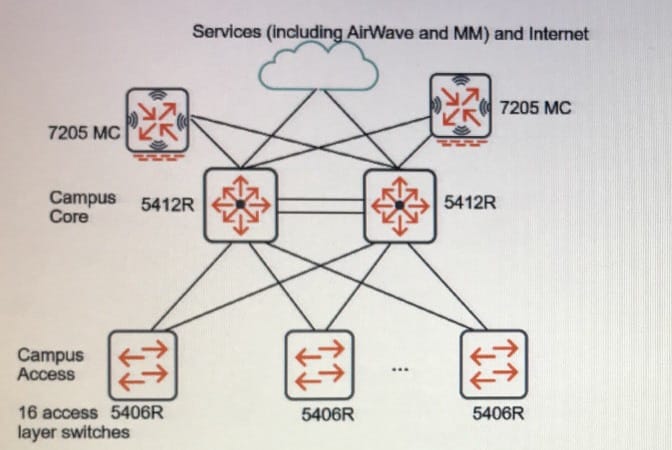
What is one reason for an architect to recommend the use of Virtual Switching Framework (VSF) in this network?
A. VSF enables software-defined network monitoring in conjunction with AirWare.
B. VSF transforms switches into virtual extensions of the MCs to simplify MST management.
C. VSF enables administrators to manage all 18 switches as a single switch.
D. VSF simplifies the topology and eliminates the need for spanning tree.
An architect needs to plan 802.11ac wireless deployment for an office environment with a mix of closed offices and cubicles. The coverage area is approximately 4,645 square meters (approximately 50,000 square feet) and has 350 users. The employees use the wireless network for typical office applications, such as email, Web, printing, and accessing shared files and datacenter services.
The architect plans to do a predictive site survey and use VisualRF to plan the coverage.
What is a general estimate for the AP count that the architect should have in mind?
A. 5-10
B. 10-15
C. 20-25
D. 40-45
An RF plan specifies wide sector directional antennas.
Refer to the antenna specifications.
H-plane refers to the Azimuth or Horizontal plane and E-plane refers to Elevation or Vertical plane.
Antenna 1: H-plane = 360; E-plane = 120
Antenna 2: H-plane = 360; E-plane = 60
Antenna 3: H-plane = 100; E-plane = 90
Antenna 4: H-plane = 60; E-plane = 60
Which antenna specifications indicate that the antenna is a good choice for the plan?
A. Antenna 1
B. Antenna 2
C. Antenna 3
D. Antenna 4
An architect needs to plan a very high density (VHD) wireless network at a large events venue, at which thousands of attendees are expected. The architect plans to deploy a cluster of Mobility Controllers (MCs) to control the APs. It is important to support seamless roaming for wireless devise across the venue.
What should the architect ensure for the network services?
A. DHCP servers can support a high number of scopes with a /24 size.
B. A third-party firewall integrates with ClearPass to filter the guest user traffic.
C. A domain CA is set up to deploy certificates to a high volume of guest devices.
D. DHCP and DNS servers are carrier-grade and support a low transaction time.
Refer to the exhibit. Exhibit 1.
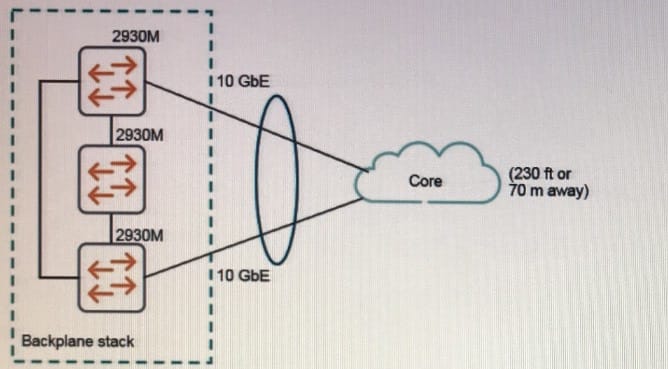
Exhibit 2.

Exhibit 1 shows the logical plan, and Exhibit 2 shows the BOM that the administrator has made in Iris. What is missing from the IRIS BOM?
A. stacking modules and cables
B. stacking licenses
C. 10 GbE direct attach cables
D. an uplink module for one of the switches
Refer to the exhibit.
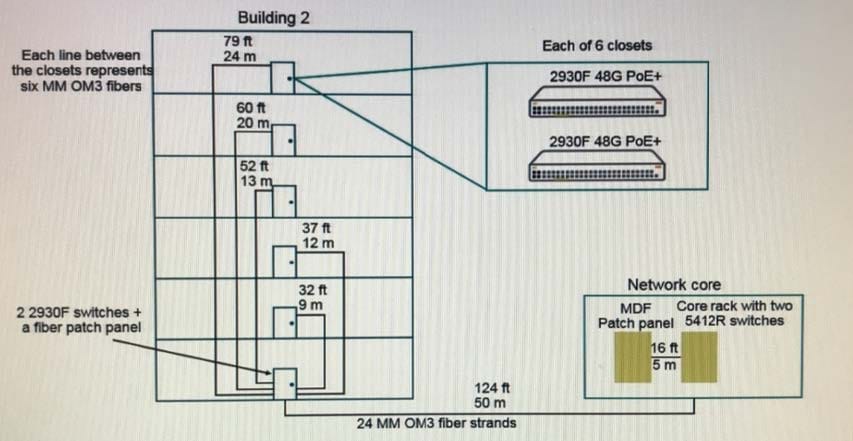
The exhibit shows the current plan for a wired network upgrade.
As much as possible, the customer wants to flatten the architecture and avoid recabling. However, each Building 2 switch must also maintain connectivity to the core if one link fails.
What should the architect propose to meet the customer requirements?
A. Use two additional 2930F switches to act as an aggregation layer for Building 2; connect them to the core on 40 GbE connections.
B. Connect each Building 2 switch directly to the core on a single fiber strand through the use of SFP+-SR transceivers.
C. Combine the switches in each Building 2 closet as a VSF fabric; establish two 10 GbE connections to the core per fabric.
D. Extend additional fiber between the buildings so that each Building 2 switch can have a direct 10 GbE connection to the core.
A customer needs a networking solution that supports their Microsoft Skype for Business Unified Communications (UC) solution. The architect discovers that user wireless devices are Wi-Fi Multimedia (WMM) capable. Windows policies assign voice traffic DSCP 46 and video traffic DSCP 34.
Which potential issue should the architect explain to the customer about the default QoS settings?
A. The DSCP values place both voice and video traffic in the video VMM queue, so voice does not receive the prioritization that is should.
B. The Aruba APs and controllers use different prioritization mechanism from WMM, so they will not accept high priority traffic from the wireless devices.
C. DSCP is incompatible with WMM. The Aruba APs and controllers instead use 802.1p to mark traffic to and from wireless devices.
D. The DSCP for wireless client traffic is concealed within the GRE packet on the path from the AP to the controller, and does not take effect.
What is a key criteria that an architect should use to choose between an Aruba 7000 Series or 7200 Series Mobility Controller (MC)?
A. the number of wireless devices that the MC needs to support
B. whether the MC needs to terminate VPN tunnels
C. the need to deploy controllers in a cluster
D. whether the MC needs to support advanced 8.x features