
HPE6-A49 Online Practice Questions and Answers
A customer has phones used as wireless Voice over IP (VoIP) devices. Which is one implication for the design?
A. Plan policies for the phone role on MCs to give the phones a high QoS priority.
B. Ensure a -75 GHz signal in both the 2.4GHz band and the 5GHz band across the entire site.
C. Ensure that APs connect on Smart Rate ports to support the high bandwidth demands of the phones.
D. Apply a bandwidth contract to the phone VLAN to limit broadcast and multicast traffic.
What is one reason to deploy an Aruba 8320 switch when compared to an Aruba 5400R switch?
A. to support cloud-based management and guest services through Aruba Central integration
B. to obtain a great number of options for types of ports, including PoE and non-PoE
C. to enhance network monitoring and analytics
D. to support Zero Touch Provisioning (ZTP)
A hospital needs a wireless solution which will provide guest access for patients and visitors, as well as for medical staff. In addition to laptops and tablets, staff have wireless voice communicator devices. Some medical equipment also connects wirelessly.
How can the network architect help to ensure that patient and visitor internet use does not interfere with more vital hospital applications?
A. Deploy IntroSpect to monitor patient and visitor traffic.
B. Plan a bandwidth contract for the guest role in the MC firewall.
C. Deploy dedicated Air Monitors (AMs) at about one-fourth the density of APs.
D. Ensure that the guest SSID has a password associated with it.
Refer to the exhibit.
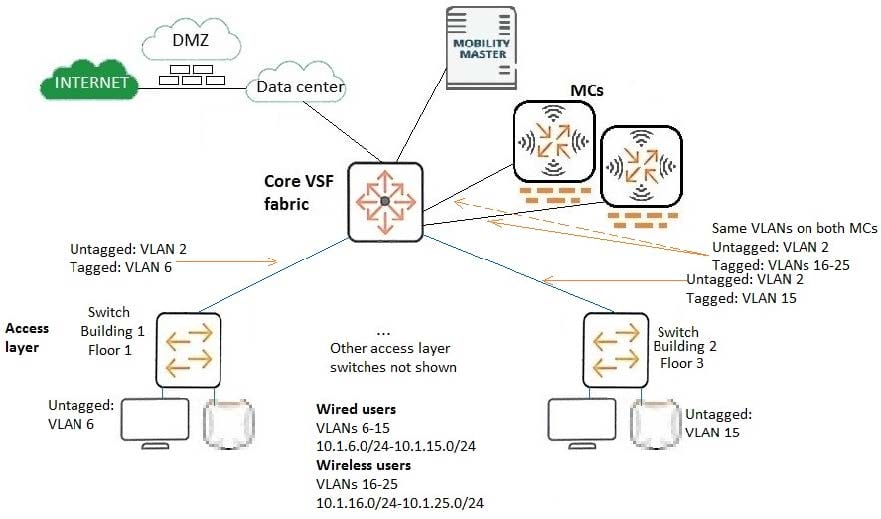
A customer needs a wireless network upgrade and has these requirements: Support any applications used on a wired connection Support up to 2500 wireless clients Support seamless roaming from floor to floor and building to building Continue to function seamlessly if one AP or controller fails
The architect has designed the local infrastructure for the network as shown in the exhibit.
Which change should the architect make to better meet customer requirements and best practices?
A. Combine the /24 subnets for wireless and wired users into a /16 subnet.
B. Place each controller in a different VLAN and subnet.
C. Change the /24 subnets for wireless users into a /25 subnet.
D. Combine the /24 subnets for wireless users into a /20 subnet.
A customer has Aruba network infrastructure devices that could be managed by either Aruba Central or
Aruba AirWave.
Which customer characteristic should point the architect toward an AirWave recommendation as opposed
to a Central recommendation?
A. desire to lease managed services on an ongoing basis
B. small IT staff and preference for cloud solutions
C. policies that network management occurs on premises
D. need to support Zero Touch Provisioning (ZTP)
A customer has an existing Aruba wireless solution to provide wireless access for employees. The solution includes APs, mobility controllers (MCs) at the network core, and a Mobility Master (MM). A customer would like to set up a separately managed guest network and have the traffic go directly to the DMZ.
What should the architect suggest as the simplest solution that meets the requirements?
A. Add APs in a dedicated AP group to support only the guest network SSID.
B. Have a dedicated mobility controller in the DMZ managed by the same MM.
C. Double the number of APs and controllers
D. Use MultiZone, and put a mobility controller in the DMZ.
A retailer wants to provide wireless services for guests across a section of store floor, which consists of 82 foot (25m) long aisles of cans and dry food goods. The shelves are six feet (1.8 m) high, and the ceiling height is 13 feet (4 m) high. The architect recommends overhead APs deployed at 40-50 foot (12 to 15 m) intervals every few aisles rather than in every aisle.
What is one factor that justifies this recommendation?
A. the low transmit power of most guest devices
B. the low shelf height relative to ceiling height
C. the aisle length
D. the low ceiling height
A customer has an Aruba wireless network, which includes two MC 7205s and an MM at the network core. The company now wants to accommodate 50 mobile trainers. These trainers travel around the world and run training events. The trainers often need to access materials in the company data center, but cannot reach materials when they are on the road.
The company wants to give the mobile workforce a secure way to reach the materials they need no matter where they are, including in public spaces like the hotels where they often teach. The customer also requires that the solution be as cost effective as possible while meeting the requirements.
Which plan meets the needs of the mobile trainers?
A. Add 50 VIA licenses to the MM, and deploy two 7005 MCs in the DMZ.
B. Add 50 RAPs; add 50 Enterprise licenses and 50 VIA licenses to the MM.
C. Add 50 RAPs; add 50 Enterprise licenses to the MM, and add two 7005 MCs in the DMZ.
D. Add 50 PEFV licenses to the MM, and add additional 7205 MC to the core.
Case study
A customer needs a wireless network upgrade for 802.11ac and possibly an upgrade to the wired network.
The customer requires dual-radio 802.11ac APs, each radio of which can support 4x4 MIMO at full feature
set.
The customer has given architects this information about their wireless devices:
2700 IoT devices which will have only wireless connections; they support WPA2 with 802.1X
300 on each floor in 3 buildings with 3 floors each
5,400 users, who use devices such as laptops and smartphones
600 users on each floor in 3 buildings with 3 floors each
24 security cameras which will have only wireless connections; they support WPA2 with 802.1X and have
a local power source
4 on floor 1 of each of the 3 buildings
2 on the other 6 floors
The architect also has collected information about the existing wired network.
The existing access layer switches support these features:
10/100/1000 edge ports
PoE (802.3af)
1GbE fiber uplinks
The existing aggregation switches support these features:
1/10GbE fiber ports
ARP tables up to 64,000
The customer has provided this figure that shows the existing cabling between floors and between
buildings:
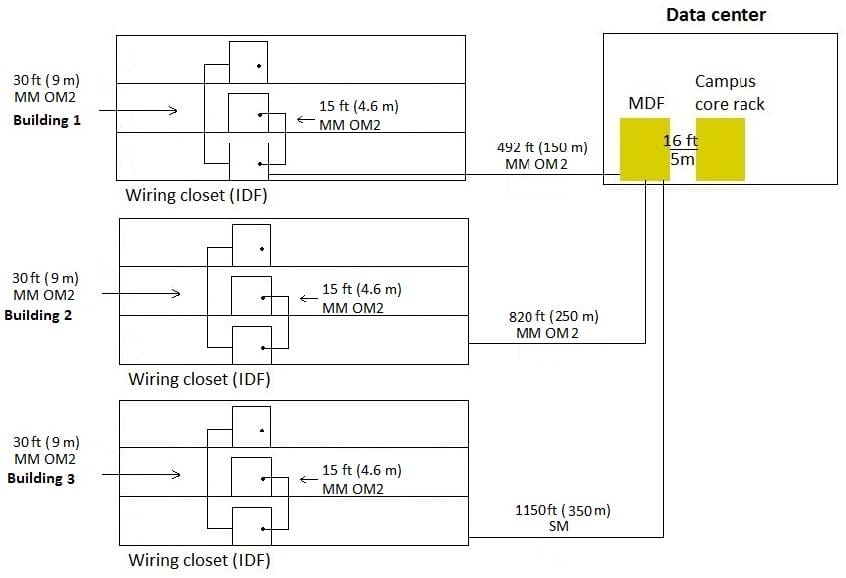
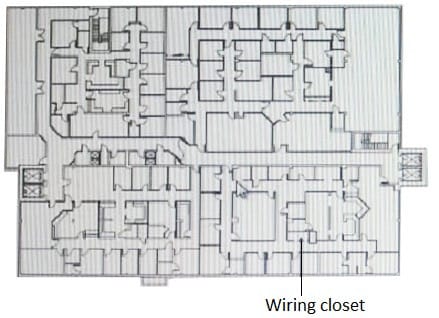
Each floor is about 100 feet (30 m) by 140 feet (43 m) with a 10 foot (3 m) ceiling. Interior walls are drywall. The layout for each floor is similar to that shown below. CAT5e cable is extended to all areas.
The customer wants to have a wired upgrade as well. The customer has indicated some additional requirements for the wired network, including redundancy for all switch-to-switch links. The customer also wants to explore whether the aggregation layer in buildings can be eliminated.
What is one missing piece of information the architect should obtain from the customer before they design the solution and select new switches and their accessories?
A. the power requirements on the wireless security cameras
B. the number of fiber strands for fiber runs
C. the percentage of time that employees use their wired connection
D. the power rating on the fiber deployed between buildings
Refer to the exhibit.
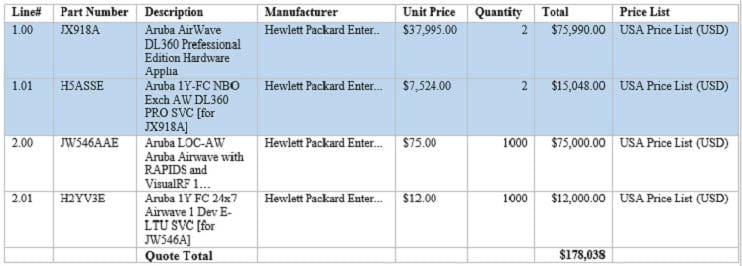
A customer needs an AirWave solution that can manage 1000 devices. The customer wants a hardware
solution and active/standby redundancy for the solution.
The exhibit shows the BOM that the architect has created.
Which corrections should the architect make?
A. Change the active appliance to an Enterprise appliance.
B. Add 1000 additional AirWave managed device licenses.
C. Change both of the appliances to Enterprise appliance.
D. Add a failover license for 1000 managed devices.