
HPE6-A77 Online Practice Questions and Answers
Refer to the exhibit:
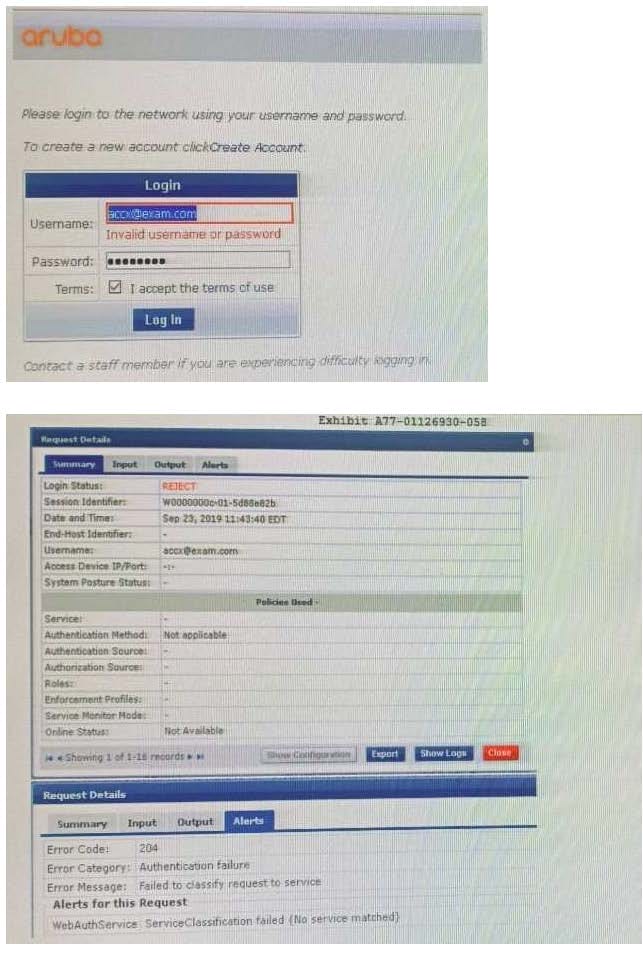
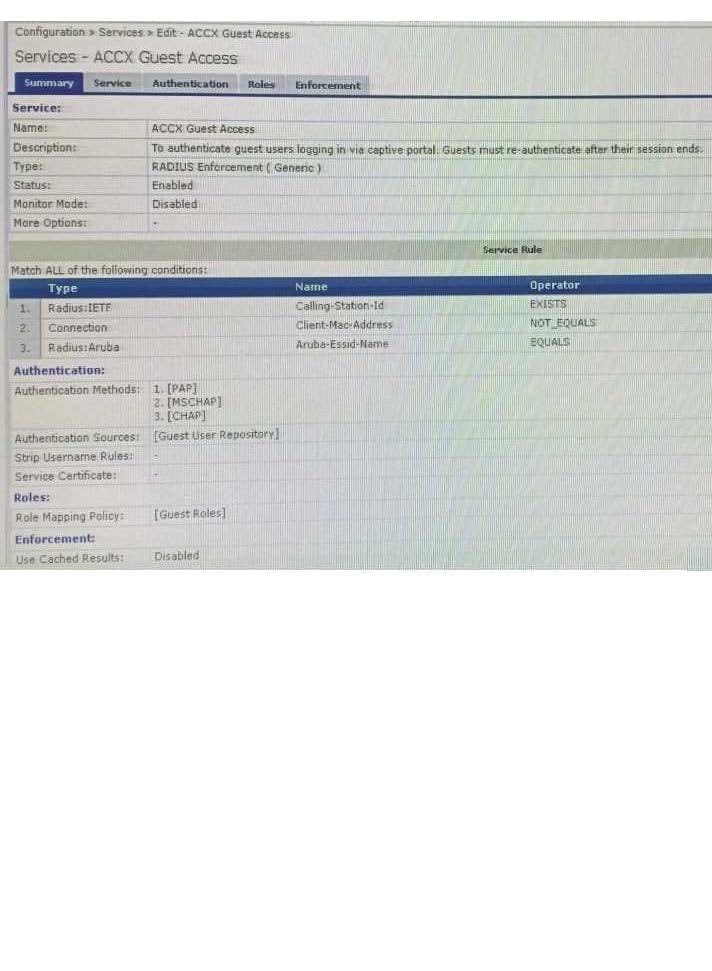
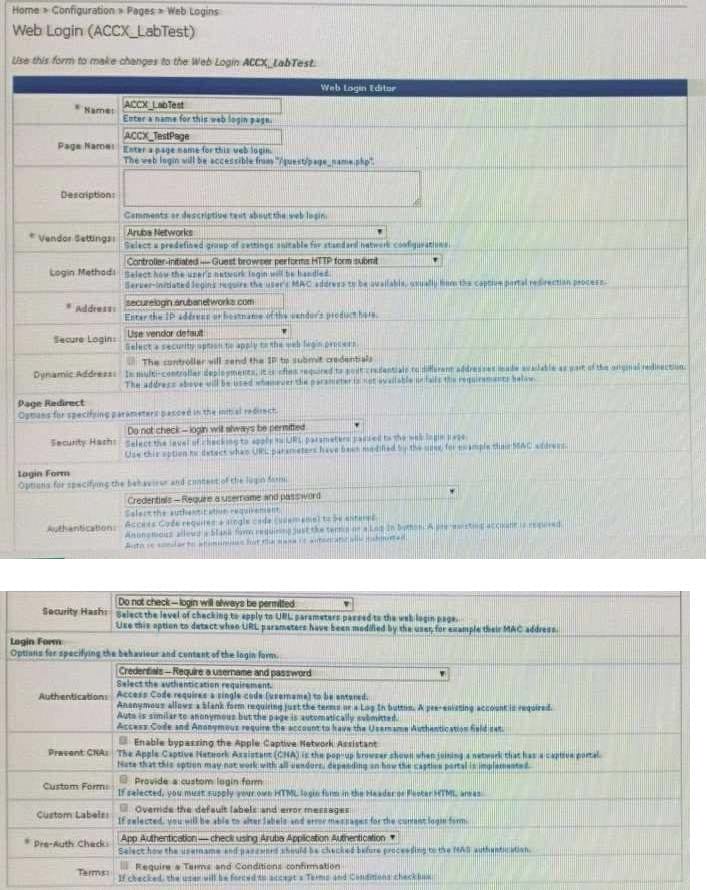
A year ago, your customer deployed an Aruba ClearPass Policy Manager Server for a Guest SSIC hosted in an IAP Cluster. The customer just created a new Web Login Page for the Guest SSID. Even though the previous Web Login page worked test with the new Web Login Page are falling and the customer has
forwarded you the above screenshots.
What recommendation would you give the customer to tix the issue?
A. The service type configured is not correct. The Guest authentication should De an Application authentication type of service.
B. The customer should reset the password tor the username accx@exam com using Guest Manage Accounts
C. The Address filed under the WebLogin Vendor settings is not configured correctly, it should be set to instant arubanetworks.com
D. The WebLogin Pre-Auth Check is set to Aruba Application Authentication which requires a separate application service on the policy manager
A customer has completed all the required configurations in the Windows server in order for Active Directory Certificate Services (ADCS) to sign Onboard device TLS certificates. The Onboard portal and the Onboard services are also configured. Testing shows that the Client certificates ate still signed by the Onboard Certificate Authority and not ADCS. How can you help the customer with the situation?
A. Educate the customer that, when integrating with Active Directory Certificate Services (ADCS) the Onboard CA will the same authority used for signing me final TLS certificate of the device.
B. Configure the identity certificate signer as Active Directory Certificate Services and enter the ADCS URL http://ADCSVVeoEnrollmentServemostname/certsrv in the OnBoard Provisioning settings.
C. Enable access to EST servers from the Certificate Authority to make ClearPass Onboard to use of the Active Directory Certificate Services (ADCS) web enrollment to sign the device TLS certificates.
D. Enable access to SCEP servers from the Certificate Authority to make ClearPass Onboard to use of the Active Directory Certificate Services (ADCS) web enrollment to sign the device TLS certificates.
A customer has created a Guest Sett-Registration page that they would like to use it as `template' for all the new pages that are going to be created from now on. Their goal is to ensure that the header and footer on every page are the same, and any edits made to them are automatically reflected on every Self-Registration Page. What should be configured in order to accomplish this request?
A. Save the "template" page as Master Self-Registration page
B. Create child pages when creating new Self-Registration pages and select the "template" as Parent
C. Save this "template" page as a new Skin to be used on other Self-Registration pages
D. Copy the "template" page and edit it each time a new Self-Registration Page is needed
A corporate ClearPass Cluster with two servers located at a single site, has both Management and Data port IP addresses configured. The Management port IPs are in the DataCenter networks subnet, while the Data port IPs are in the DMZ. What is the difference between using one Virtual IP for the AAA traffic versus sending AAA requests to the physical IPs for each server? (Select two.)
A. The failover can be accomplished only by using Virtual IP.
B. The Individual IPs can provide failover and load balancing.
C. One Virtual IP can be used together with the individual server IPs for load balancing.
D. By using the Virtual IP, the failover convergence is faster than using individual server IPs.
E. Using the one Virtual IP can provide failover and load balancing.
Refer to the exhibit:
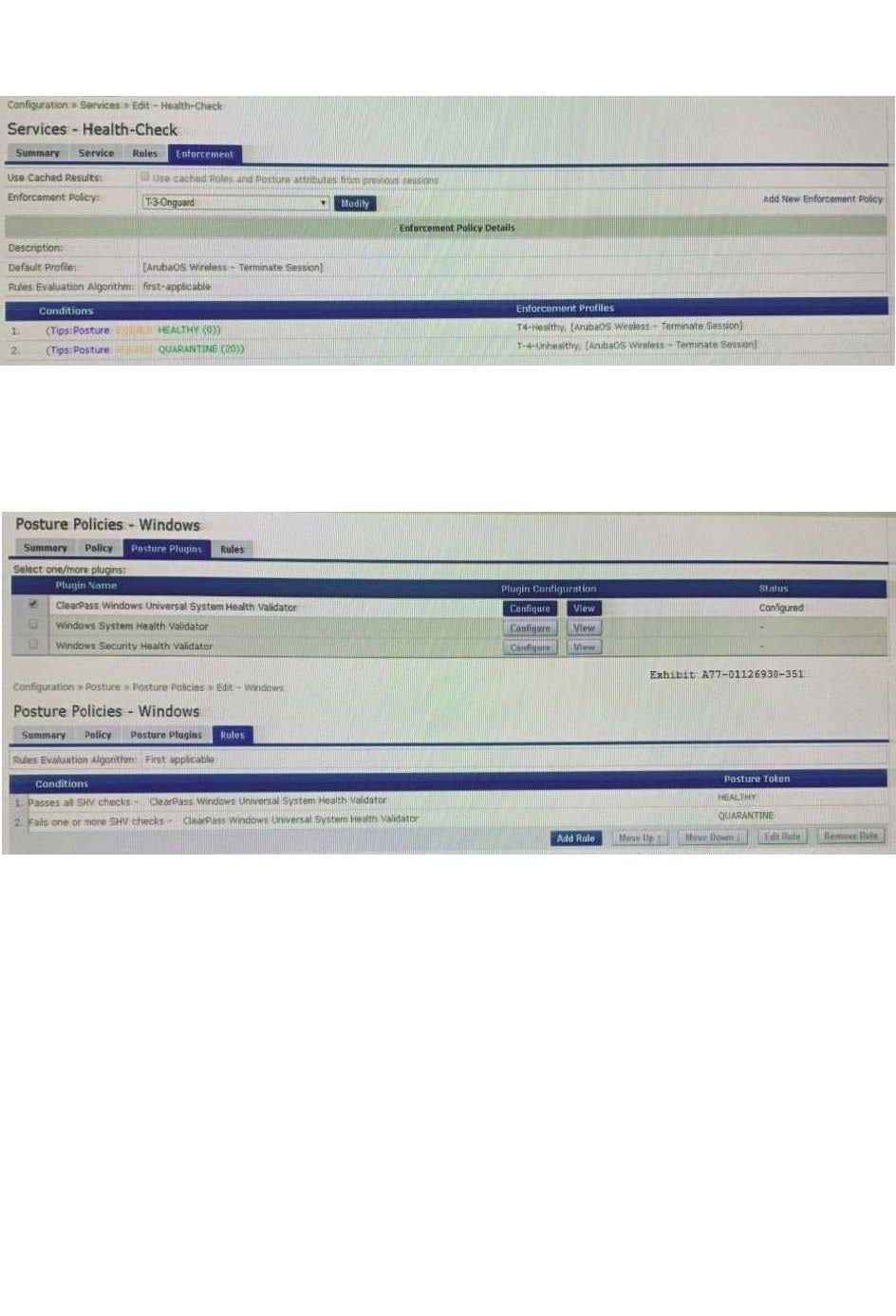
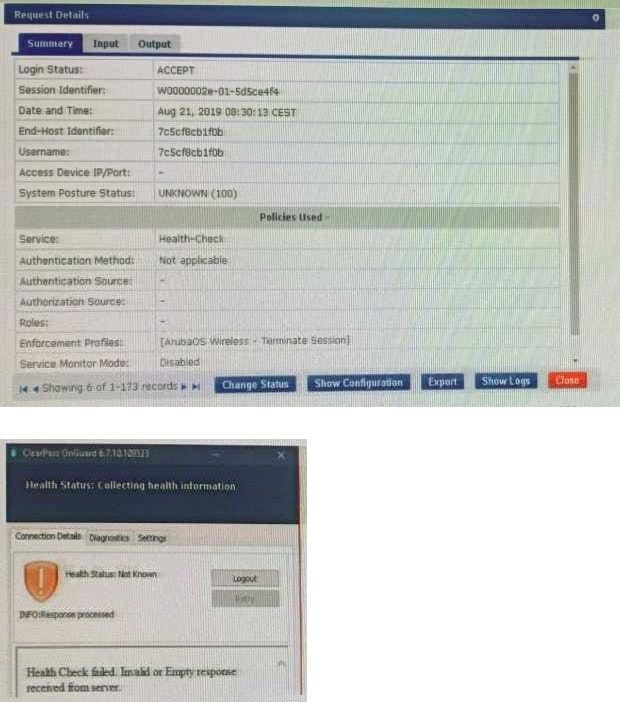
What could be causing the error message received on the OnGuard client?
A. The Service Selection Rules for the service are not configured correctly
B. The Web-Based Health Check service needs to be configured to use the Posture Policy
C. There is a firewall policy not allowing the OnGuard Agent to connect to ClearPass
D. The client's OnGuard Agent has not been configured with the correct Policy Manager Zone
Refer to the exhibit: You configuring an 802 1x service endpoint profiling. When the client connects to the network, ClearPass successfully profiles the client and sends Radius Change of Authorization (RCoA) but Radius Change of Authorization {RCoA) fails for the client You manually clicked on the Change Status button in the access tracker to force an RCoA but that failed too. What must you check to ensure that the RCoA will work? (Select two.)
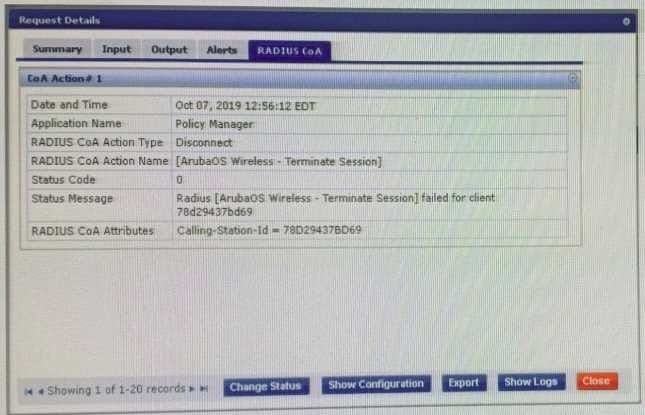
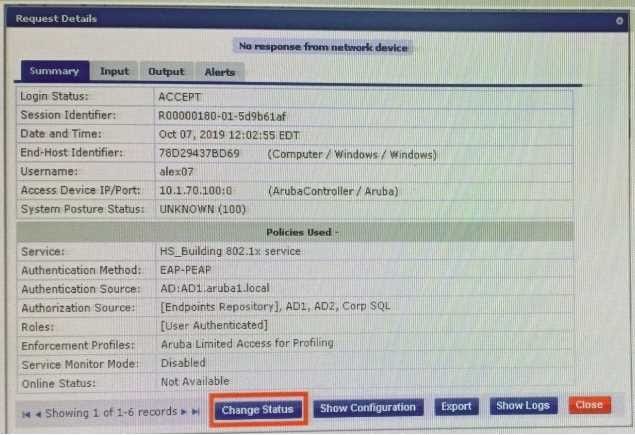
A. RFC 3576 option is enabled for Aruba Controller under Network device in ClearPass.
B. RFC 3576 server should be mapped in the server group on the Aruba Controller
C. The RFC 3576 shared secret on ClearPass should match the Authentication Server shared secret
D. RFC 3576 server IPs and the Authentication server IPs should be same in the AAA profile
Refer to the exhibit:
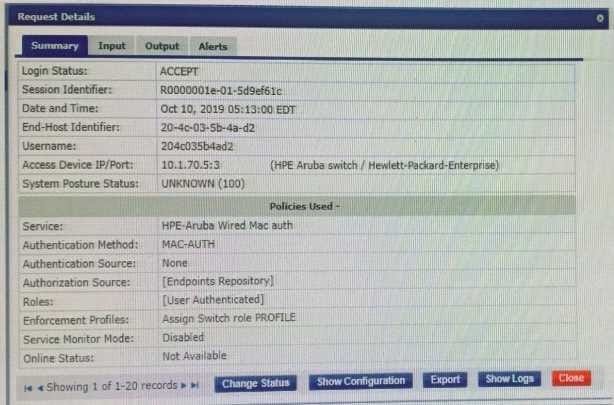
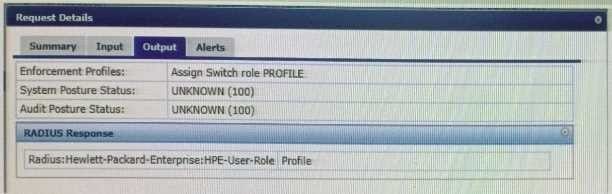
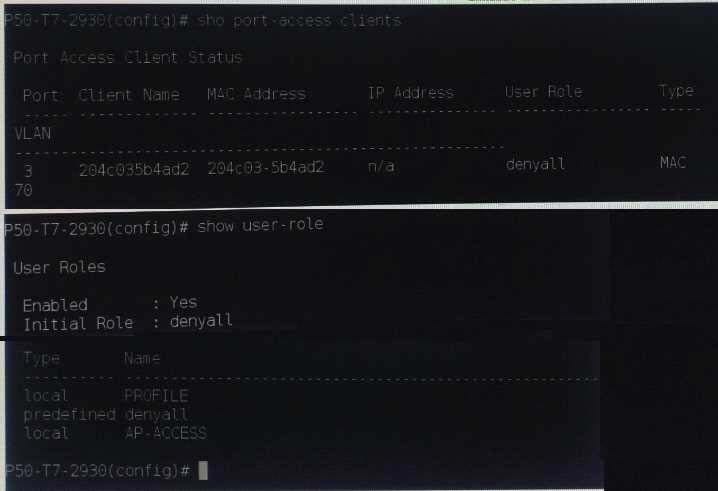
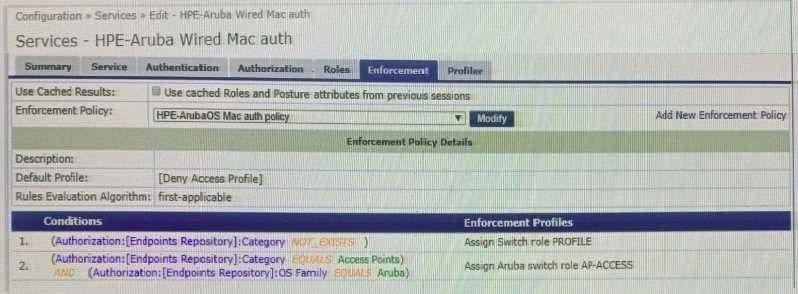
You have been asked to help a Customer troubleshoot an issue. They have configured an Aruba OS
switch (Aruba 2930 with 16.09) to do MAC authentication with profiling using ClearPass as the
authentication source. They cannot get it working.
Using the screenshots as a reference, how will you fix the issue?
A. Delete the initial role in the Aruba OS switch to force the device to get the server derived user roles
B. Use a CoA to bounce the switch port to force the port to change to the correct Aruba user role
C. Change the Vendor settings for the Aruba OS switch to "Aruba" so that the enforcement will use the correct VSAs
D. Modify the enforcement profile conditions with Aruba Vendor specific attributes and Aruba-user- roles
E. User-roles are case sensitive, update the correct role with correct case in the enforcement profile
Where is the following information stored in ClearPass?
1.
Roles and Posture for Connected Clients
2.
System Health for OnGuard
3.
Machine authentication State
4.
CoA session info
5.
Mapping of connected clients to NAS/NAD
A. Multi-Master cache
B. Endpoint database
C. insight database
D. ClearPass system cache
Refer to the exhibit:


Your company has a postgres SQL database with the MAC addresses of the company-owned tablets You
have configured a role mapping condition to tag the SQL devices. When one of the tablets connects to the
network, it does not get the correct role and receives a deny access profile.
How would you resolve the issue?
A. Remove SQL condition from role mapping policy and add it under the enforcement policy conditions.
B. Edit the SQL authentication source niter attributes and modify the SQL server filter query.
C. Add the SQL server as an authentication source and map .t under the authentication tab in the service.
D. Enable authorization tab in the service and add the SQL server as an authorization source.
A Customer has these requirements:
*
2.000 loT endpoints that use MAC authentication
*
6,000 endpoints using a mix of username/password and certificate (Corporate/BYOD) based authentication
*
1,000 guest endpoints at peak usage that use guest self-registration
*
1500 BYOD devices estimated as 3 devices per User (500 users)
*
2,500 endpoints that have OnGuard installed and connect on a daily basis
What licenses should be installed to meet customer requirements?
A. 11,500 Access, 500 Onboard, 2,500 Onguard
B. 13.000 Access, 1.500 Onboard, 2,500 Onguard
C. 11,500 Access, 1,500 Onboard, 2.500 Onguard
D. 9,000 Access, 500 Onboard. 2.500 Onguard