Exam2pass
0 items Sign In or Register
  • Home
  • IT Exams
  • Guarantee
  • FAQs
  • Reviews
  • Contact Us
  • Demo
Exam2pass > Juniper > Juniper Certifications > JN0-637 > JN0-637 Online Practice Questions and Answers

JN0-637 Online Practice Questions and Answers

Questions 4

You are deploying threat remediation to endpoints connected through third-party devices.

In this scenario, which three statements are correct? (Choose three.)

A. All third-party switches must support AAA/RADIUS and Dynamic Authorization Extensions to the RADIUS protocol.

B. The connector uses an API to gather endpoint MAC address information from the RADIUS server.

C. All third-party switches in the specified network are automatically mapped and registered with the RADIUS server.

D. The connector queries the RADIUS server for the infected host endpoint details and initiates a change of authorization (CoA) for the infected host.

E. The RADIUS server sends Status-Server messages to update infected host information to the connector.

Buy Now

Correct Answer: ABD

For threat remediation in a third-party network, the RADIUS protocol is necessary to communicate with the RADIUS server for details about infected hosts. CoA enables security measures to be enforced based on endpoint information

provided by the RADIUS server. Details on this setup can be found in Juniper RADIUS and AAA Documentation.

When deploying threat remediation to endpoints connected through third-party devices, such as switches, the following conditions must be met for proper integration and functioning:

of Answer A (Support for AAA/RADIUS and Dynamic Authorization Extensions):

Third-party switches must support AAA (Authentication, Authorization, and Accounting) and RADIUS with Dynamic Authorization Extensions . These extensions allow dynamic updates to be made to a session's authorization parameters,

which are essential for enforcing access control based on threat detection.

of Answer B (Connector Gathers MAC Information via API):

The connector uses an API to gather MAC address information from the RADIUS server . This MAC address data is necessary to identify and take action on infected hosts or endpoints.

of Answer D (Connector Initiates CoA):

The connector queries the RADIUS server for infected host details and triggers a Change of Authorization (CoA) for the infected host. The CoA allows the connector to dynamically alter the host's access permissions or isolate the infected

host based on its threat status.

Juniper Security Reference:

Threat Remediation via RADIUS: Dynamic remediation actions, such as CoA, can be taken based on information received from the RADIUS server regarding infected hosts. Reference: Juniper RADIUS and CoA Documentation.

Questions 5

You are asked to select a product offered by Juniper Networks that can collect and assimilate data from all probes and determine the optimal links for different applications to maximize the full potential of AppQoE.

Which product provides this capability?

A. Security Director

B. Network Director

C. Mist

D. Security Director Insights

Buy Now

Correct Answer: D

Juniper Networks' Security Director Insights is the product that provides advanced visibility and analytics by collecting and assimilating data from various probes and sources. Security DirectorInsights is an extension of Security Director but

focuses on delivering actionable insights into application quality of experience (AppQoE) and security posture. It can process large amounts of data from probes to optimize traffic routing for applications. Security Director Insightsanalyzes

traffic patterns and makes recommendations for optimal path selection to improve application performance. It integrates with other components like AppQoE to ensure that the best links are selected for each application, improving both

performance and security.

Juniper References:

Juniper Security Director Insights: Details the role of Security Director Insights in optimizing AppQoE by leveraging traffic analysis and probe data.

Questions 6

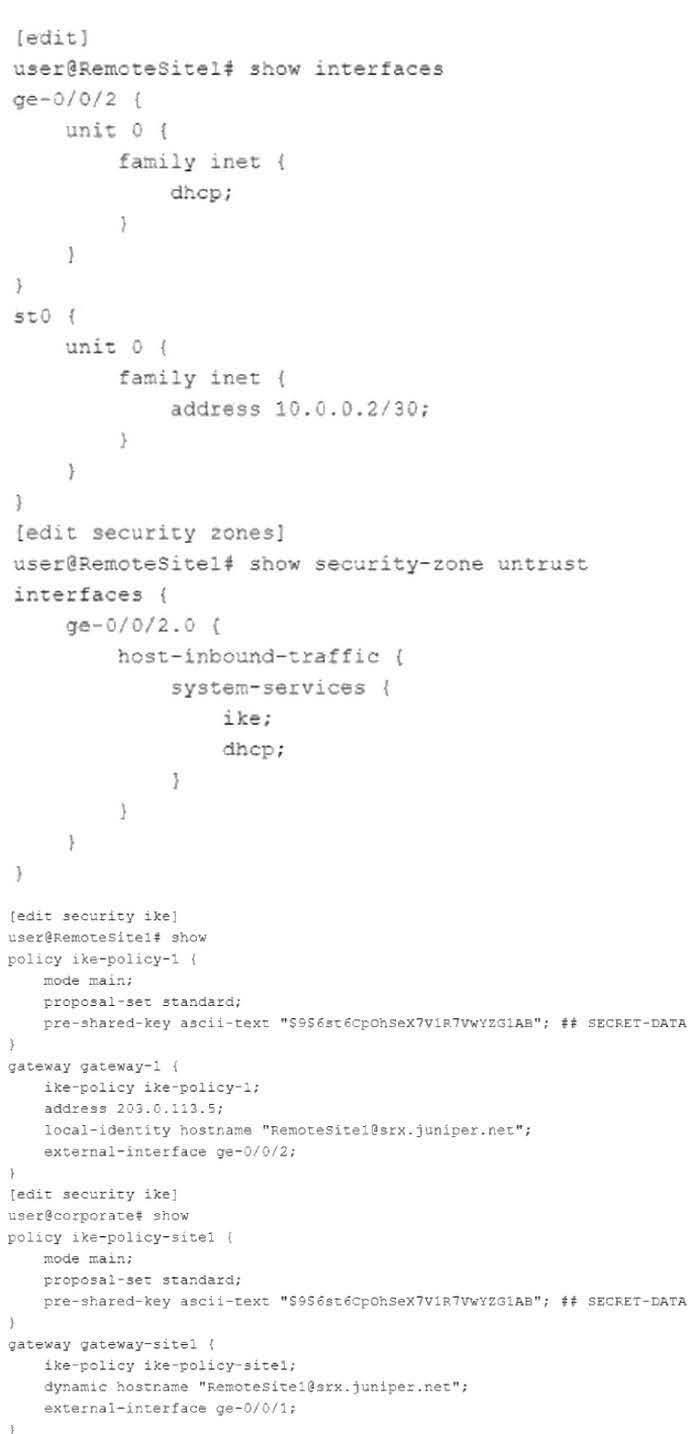
Referring to the exhibit.

You are troubleshooting a new IPsec VPN that is configured between your corporate office and the RemoteSite1 SRX Series device. The VPN is not currently establishing. The RemoteSite1 device is being assigned an IP address on its gateway interface using DHCP.

Which action will solve this problem?

A. On the RemoteSite1 device, change the IKE gateway external interface to st0.0.

B. On both devices, change the IKE version to use version 2 only.

C. On both devices, change the IKE policy proposal set to basic.

D. On both devices, change the IKE policy mode to aggressive.

Buy Now

Correct Answer: D

Aggressive mode is required when an IP address is dynamically assigned, such as through DHCP, as it allows for faster establishment with less identity verification. More details are available in Juniper IKE and IPsec Configuration Guide.

The configuration shown in the exhibit highlights that the RemoteSite1 SRX Series device is using DHCP to obtain an IP address for its external interface (ge-0/0/2). This introduces a challenge in IPsec VPN configurations when the public IP

address of the remote site is not static, as is the case here.

Aggressive modein IKE (Internet Key Exchange) is designed for situations where one or both peers have dynamically assigned IP addresses. In this scenario, aggressive mode allows the devices to exchange identifying information, such as

hostnames, rather than relying on static IP addresses, which is necessary when the remote peer (RemoteSite1) has a dynamic IP from DHCP. Correct Action (D): Changing the IKE policy mode to aggressive will resolve the issue by allowing

the two devices to establish the VPN even though one of them is using DHCP. In aggressive mode, the initiator can present its identity (hostname) during the initial handshake, enabling the VPN to be established successfully.

Incorrect Options:

Option A: Changing the external interface to st0.0 is incorrect because the st0 interface is used for the tunnel interface, not for the IKE negotiation.

Option B: Changing to IKE version 2 would not resolve the dynamic IP issue directly, and IKEv1 works in this scenario.

Option C: Changing the IKE proposal set to basic doesn't address the dynamic IP challenge in this scenario.

Juniper References:

Juniper IKE and VPN Documentation: Provides details on when to use aggressive mode, especially when a dynamic IP address is involved.

Questions 7

You have deployed an SRX Series device at your network edge to secure Internet-bound sessions for your local hosts using source NAT. You want to ensure that your users are able to interact with applications on the Internet that require more than one TCP session for the same application session.

Which two features would satisfy this requirement? (Choose two.)

A. address persistence

B. STUN

C. persistent NAT

D. double NAT

Buy Now

Correct Answer: AC

Address persistence ensures that the same NAT IP address is used for all sessions originating from a single source IP. Persistent NAT maintains connections for applications needing multiple sessions, like VoIP. Additional details are available in Juniper NAT Documentation.

For applications that require multiple TCP sessions for the same application session (such as VoIP or certain online games), the SRX device needs to handle NAT properly to maintain session continuity. Here's what helps: Address Persistence (Answer A): Address persistence ensures that multiple sessions initiated by the same internal host are mapped to the same external IP address. This is crucial for applications that use multiple TCP sessions to maintain a stateful connection with the external server. Command Example: bash Copy code set security nat source persistent-nat address-persistence Persistent NAT (Answer C): This feature allows the external server to initiate new connections to the internal client using the same NAT translation. It's essential for applications that require consistent NAT mappings across multiple sessions. Command Example: bash Copy code set security nat source persistent-nat permit target-host-port These features ensure that applications with multiple TCP sessions work seamlessly across NAT.

Questions 8

Which two statements are correct about mixed mode? (Choose two.)

A. Layer 2 and Layer 3 interfaces can use the same security zone.

B. IRB interfaces can be used to route traffic.

C. Layer 2 and Layer 3 interfaces can use separate security zones.

D. IRB interfaces cannot be used to route traffic.

Buy Now

Correct Answer: AB

In mixed mode, both Layer 2 and Layer 3 interfaces can be configured to operate within the same security zone, allowing for flexible network segmentation. Additionally, Integrated Routing and Bridging (IRB) interfaces facilitate routing for

Layer 2 bridged domains, allowing Layer 2 traffic to be forwarded at Layer 3. For more information on mixed mode and IRB functionality, refer to Juniper's Mixed Mode and IRB Documentation.

of Answer A (Layer 2 and Layer 3 in Same Zone):

In mixed mode configurations, it is possible to have both Layer 2 and Layer 3 interfaces within the same security zone. This allows for flexible design where different types of traffic can be handled by the same set of security policies.

of Answer B (IRB Interfaces Can Route Traffic):

IRB (Integrated Routing and Bridging)interfaces are used to route traffic between Layer 2 and Layer 3 domains. They can bridge traffic at Layer 2 and also provide Layer 3 routing capabilities within the same device. This allows for seamless

interaction between Layer 2 and Layer 3 traffic in mixed mode.

Step-by-Step Configuration:

Configuring Layer 2 and Layer 3 in the Same Security Zone:

Assign both Layer 2 and Layer 3 interfaces to the same security zone as follows:

bash

Copy code

set security zones security-zone interfaces

Configuring IRB Interface:

To route traffic using the IRB interface:

bash

Copy code

set interfaces irb unit 0 family inet address

set security zones security-zone interfaces irb.0

Juniper Security Reference:

IRB Interface Overview: IRB interfaces allow for both bridging and routing functionalities, making them essential in mixed-mode environments. Layer 2 and Layer 3 in the Same Zone: This feature provides flexibility in designingnetworks that

combine both Layer 2 switching and Layer 3 routing under the same security policies.

Questions 9

Your IPsec tunnel is configured with multiple security associations (SAs). Your SRX Series device supports the CoS-based IPsec VPNs with multiple IPsec SAs feature. You are asked to configure CoS for this tunnel. Which two statements are true in this scenario? (Choose two.)

A. The local and remote gateways do not need the forwarding classes to be defined in the same order.

B. A maximum of four forwarding classes can be configured for a VPN with the multi-sa forwarding- classes statement.

C. The local and remote gateways must have the forwarding classes defined in the same order.

D. A maximum of eight forwarding classes can be configured for a VPN with the multi-sa forwarding- classes statement.

Buy Now

Correct Answer: CD

When configuring CoS for an IPsec tunnel with multiple security associations (SAs):

Forwarding Classes Order (Answer C): Both the local and remote SRX devices must have the same forwarding classes defined in the same order to ensure proper traffic classification and SA mapping. If not aligned, traffic classification can

fail.

Command Example:

bash

Copy code

set security ipsec vpn vpn_name multi-sa forwarding-classes [class1 class2 ...]

Maximum Forwarding Classes (Answer D): The multi-sa forwarding-classes statement allows up to eight forwarding classes. This is the maximum number of traffic classes that can be differentiated within a single VPN tunnel.

Command Example:

bash

Copy code

set security ipsec vpn vpn_name multi-sa forwarding-classes [class1 class2 class3 class4 class5 class6 class7 class8]

Questions 10

You want to bypass IDP for traffic destined to social media sites using APBR, but it is not working and IDP is dropping the session.

What are two reasons for this problem? (Choose two.)

A. The session did not properly reclassify midstream to the correct APBR rule.

B. IDP disable is not configured on the APBR rule.

C. The application services bypass is not configured on the APBR rule.

D. The APBR rule does a match on the first packet.

Buy Now

Correct Answer: AC

of Answer A (Session Reclassification):

APBR (Advanced Policy-Based Routing) requires the session to be classified based on the specified rule, which can change midstream as additional packets are processed. If the session was already established before the APBR rule took

effect, the traffic may not be correctly reclassified to match the new APBR rule, leading to IDP (Intrusion Detection and Prevention) processing instead of being bypassed. This can occur especially when the session was already established

before the rule change.

of Answer C (Application Services Bypass):

For APBR to work and bypass the IDP service, the application services bypass must be explicitly configured. Without this configuration, the APBR rule may redirect the traffic, but the IDP service will still inspect and potentially drop the traffic.

This is especially important for traffic destined for specific sites like social media platforms where bypassing IDP is desired.

Example configuration for bypassing IDP services:

bash

Copy code

set security forwarding-options advanced-policy-based-routing profile application-services- bypass

Step-by-Step Resolution:

Reclassify the Session Midstream:

If the traffic was already being processed before the APBR rule was applied, ensure that the session is reclassified by terminating the current session or ensuring the APBR rule is applied from the start.

Command to clear the session:

bash

Copy code

clear security flow session destination-prefix

Configure Application Services Bypass:

Ensure that the APBR rule includes the application services bypass configuration to properly bypass IDP or any other security services for traffic that should not be inspected.

Example configuration:

bash

Copy code

set security forwarding-options advanced-policy-based-routing profile application-services- bypass

Juniper Security Reference:

Session Reclassification in APBR: APBR requires reclassification of sessions in real-time to ensure midstream packets are processed by the correct rule. This is crucial when policies change dynamically or new rules are added. Application

Services Bypass in APBR: This feature ensures that security services such as IDP are bypassed for traffic that matches specific APBR rules. This is essential for applications where performance is a priority and security inspection is not

necessary.

Questions 11

Which two statements are true regarding NAT64? (Choose two.)

A. An SRX Series device should be in packet-based forwarding mode for IPv4.

B. An SRX Series device should be in packet-based forwarding mode for IPv6.

C. An SRX Series device should be in flow-based forwarding mode for IPv4.

D. An SRX Series device should be in flow-based forwarding mode for IPv6.

Buy Now

Correct Answer: CD

NAT64 requires flow-based forwarding for both IPv4 and IPv6 to ensure proper stateful inspection and address translation. Packet-based forwarding does not support the necessary stateful inspection needed for NAT64. For more on NAT64,

refer to Juniper NAT64 Overview.

NAT64 allows communication between IPv6 and IPv4 devices by translating IPv6 addresses to IPv4 addresses and vice versa. On Juniper SRX devices, the device's forwarding mode is crucial in how the device processes traffic.

Flow-based forwarding mode:

Correct: Option C: For IPv4 traffic in NAT64 configurations, SRX devices should be in flow- based forwarding mode. Flow-based mode means that the device inspects traffic sessions and tracks state, which is essential for proper NAT64

operations. This mode enables the device to monitor and translate between IPv4 and IPv6 protocols dynamically while maintaining session states. Correct: Option D: Similarly, for IPv6 traffic, the SRX device should also be in flow-based

mode. Flow-based mode ensures the SRX tracks the IPv6-to-IPv4 translations properly by preserving the state of each connection, ensuring consistent NAT64 operations.

Packet-based forwarding mode:Packet-based mode is not used for NAT64 operations because it does not provide stateful inspection, which is required for NAT64 to function correctly. Hence, options A and B are incorrect.

Juniper References:

Juniper NAT64 Documentation: Discusses how NAT64 functions on SRX devices and specifies the requirement of flow-based mode for both IPv4 and IPv6 traffic when translating between these protocols.

Questions 12

What is the advantage of using separate st0 logical units for each spoke connection?

A. It is easy to configure even when managing many st0 units.

B. It facilitates scalability.

C. Junos devices can exchange NHTB data automatically using this method.

D. It enables assignments of different settings to each logical unit.

Buy Now

Correct Answer: B

Using separate st0 logical units for each spoke connection in a hub-and-spoke VPN topology is advantageous for scalability. Here's why:

Facilitates Scalability (Correct: Option B):By using separate st0 logical units for each spoke, you can easily scale the number of spokes without disrupting the overall configuration. Each spoke gets its own dedicated logical unit, making it

easier to manage individual VPN tunnels as the network grows. This approach provides clear separation of traffic, simplifying troubleshooting and configuration management, especially in large hub-and-spoke networks.

Incorrect Options:

Option A: While separate logical units make configuration management easier, scalability is the primary advantage.

Option C: NHTB (Next-Hop Tunnel Binding) data exchange does not inherently depend on the use of separate logical units.

Option D: While you can assign different settings to each logical unit, the main advantage remains scalability, especially when managing numerous VPN connections.

Juniper References:

Juniper IPsec VPN Documentation: Describes how using separate logical units facilitates scalability and is a best practice for large-scale hub-and-spoke VPN deployments.

Questions 13

How does an SRX Series device examine exception traffic?

A. The device examines the host-inbound traffic for the ingress interface and zone.

B. The device examines the host-outbound traffic for the ingress interface and zone.

C. The device examines the host-inbound traffic for the egress interface and zone.

D. The device examines the host-outbound traffic for the egress interface and zone.

Buy Now

Correct Answer: A

Exception traffic, including management and control plane traffic, is handled by examining host-inbound traffic configurations at the ingress interface and zone. It ensures traffic reaches necessary services like SSH and IKE securely. See

Juniper Host Inbound Traffic Documentation for more.

SRX Series devices handle exception traffic (such as management traffic like SSH, Telnet, DNS queries, etc.) differently than regular transit traffic. Exception traffic is examined based onhost-inbound traffic for the ingress interface and zone .

If traffic is destined for the device itself (e.g., management traffic or routing protocol messages), it must be allowed as host-inbound traffic on both the ingress interface and zone.

Example Command:

bash

Copy code

set security zones security-zone trust host-inbound-traffic system-services ssh

This ensures that traffic destined to the SRX device is inspected based on the ingress interface and zone.

Exam Code: JN0-637
Exam Name: Security, Professional (JNCIP-SEC)
Last Update: Jul 07, 2026
Questions: 125

PDF (Q&A)

$45.99
ADD TO CART

VCE

$49.99
ADD TO CART

PDF + VCE

$59.99
ADD TO CART

Exam2Pass----The Most Reliable Exam Preparation Assistance

There are tens of thousands of certification exam dumps provided on the internet. And how to choose the most reliable one among them is the first problem one certification candidate should face. Exam2Pass provide a shot cut to pass the exam and get the certification. If you need help on any questions or any Exam2Pass exam PDF and VCE simulators, customer support team is ready to help at any time when required.

Home | Guarantee & Policy |  Privacy & Policy |  Terms & Conditions |  How to buy |  FAQs |  About Us |  Contact Us |  Demo |  Reviews

2026 Copyright @ exam2pass.com All trademarks are the property of their respective vendors. We are not associated with any of them.