
JN0-682 Online Practice Questions and Answers
You are building an IP fabric underlay network for your new data center. You must ensure that you have predictable load-balancing behavior throughout your network. According to Juniper Networks, what are two best practices that should be followed in this scenario? (Choose two.)
A. All leaf devices must be identical to the spine device models including the same installed line cards.
B. All spine devices should be identical models including the same installed line cards.
C. Every leaf device should have an identical uplink to every other leaf device.
D. Every leaf device should have an identical uplink to every spine device.
Your manager asks you to secure ARP and DHCP traffic across your local Ethernet links In this scenario, which technology will accomplish this task?
A. SSL
B. MAC sec
C. IPsec
D. A firewall filter
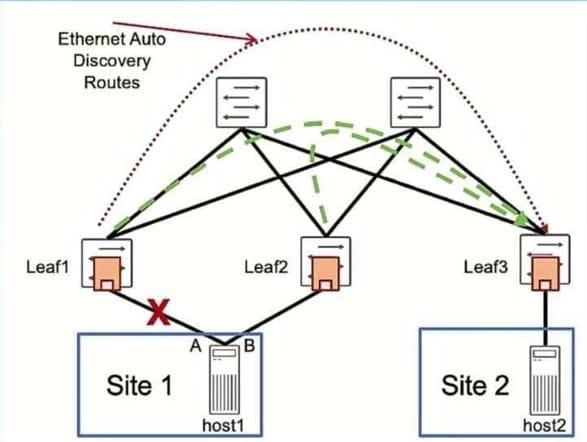
Site 1 contains 20+ VMs. The link between Site 1 and Leaf1 goes down. Referring to the exhibit, which statement is correct?
A. Type-1 routes for each VM will expire one at a time.
B. Type-1 routes for all VMs in the site will expire all at once.
C. Type-1 routes for all VMs in the site will be withdrawn all at once.
D. Type-1 routes for each VM will be withdrawn one at a time.
A company wants to expect their hosting business and is seeking solutions to supported multiple tenants. Each tenant should be able to configure their own logical interfaces. Also, based on customer needs, all routing features must be supported.
What will satisfy the customer's requirements?
A. Bridge domains
B. Tenant systems
C. Logical systems
D. Routing instances
Devices spine1 and spine have been configured as distributed Layer 3 gateways in the VXLAN topology, and devices leaf1 and leaf3 have been configured as layer 2 gateways. Device host must be able to communicate with device host?
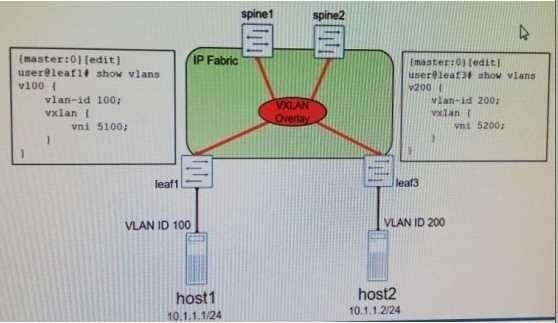
Which two statements are true? (Choose two.)
A. An IRB interface must be configured on device leaf1 and leaf2.
B. An IRB interface must be configured on devices spine1 and spine2.
C. Traffic from host1 to host2 will transmit the VXLAN tunnel from leaf1 to leaf3.
D. Traffic from host1 to host will transit a VXLAN tunnel to spine or spine2 then a VXLAN from spine1 or spine2 to leaf 3.
Which event triggers the generation of a EVPN type-4 route?
A. When unknown unicast traffic is received on an interface.
B. When known unicast traffic is received on an interface.
C. When a new VNI is configured.
D. When a new ESI is configured.
You are asked to scale the available bandwidth within your Clos data center network to support more east-west traffic. In this scenario, what are two ways to accomplish this task? (Choose two.)
A. Add leaf devices to increase available paths and bandwidth
B. Use aggregated interfaces in the fabric.
C. Add spines to increase available paths and bandwidth.
D. Interconnect all spines to increase available paths and bandwidth.
You are designing an EBGP IP fabric for a multi-side data center. In this scenario, which two statements are true? (Choose two.)
A. The same AS number should be used on all devices across all data centers.
B. Different AS numbers should be used on all devices.
C. Private AS numbers can be used.
D. Public AS numbers must be used
What are three advantages of using MPLS for data center interconnects? (Choose two.)
A. Dedicated MPLS backbones for Layer 1 and Layer 3 DCIs
B. Any to any connectivity
C. Dedicated connections between customer sites
D. Sub 50 ms failover times
E. Traffic engineering
Which two statements describes an IP fabric? (Choose two.)
A. Each leaf should have a connection to each spine.
B. Open standards allow for vendor interoperability.
C. Traffic should always follow a single path
D. xSTP protocols should be used to prevent loops