LSAT-TEST Online Practice Questions and Answers
If a petrochemical plant manufactures a range of hazardous chemical products and must therefore follow
strict guidelines concerning each of the chemicals may interact with one another on a daily basis. The
plant processes five different chemicals every week. Three of these chemicals can be processed on any
given day. Xenon may be processed any day except for every other Monday and every other Thursday.
Oxygen, however, can be processed only on Tuesdays and Wednesdays.
Liquid Hydrogen may be processed on Mondays, Wednesdays and Fridays.
Sulfur Dioxide can't be processed on Fridays.
Methane can't be processed on Wednesday.
Which weekday is most likely to be impossible for 3 chemicals to be processed in one day?
A. Monday
B. Tuesday
C. Wednesday
D. Thursday
E. Friday
The symptoms of hepatitis A appear no earlier than 60 days after a person has been infected. In a test of a hepatitis A vaccine, 50 people received the vaccine and 50 people received a harmless placebo. Although some people from each group eventually exhibited symptoms of hepatitis A, the vaccine as used in the test is completely effective in preventing infection with the hepatitis A virus. Which one of the following, if true, most helps resolve the apparent discrepancy in the information above?
A. The placebo did not produce any side effects that resembled any of the symptoms of hepatitis A.
B. More members of the group that had received the placebo recognized their symptoms as symptoms of hepatitis A than did members of the group that had received the vaccine.
C. The people who received the placebo were in better overall physical condition than were the people who received the vaccine.
D. The vaccinated people who exhibited symptoms of hepatitis A were infected with the hepatitis A virus before being vaccinated.
E. Of the people who developed symptoms of hepatitis A, those who received the vaccine recovered more quickly, on average, than those who did not.
Some planning committee members' those representing the construction industry -- have significant financial interests in the committee's decisions. No one who is on the planning committee lives in the suburbs, although many of them work there.
If the statements above are true, which one of the following must also be true?
A. No persons with significant financial interests in the planning committee's decisions are not in the construction industry.
B. No person who has a significant financial interest in the planning committee's decisions lives in the suburbs.
C. Some persons with significant financial interests in the planning committee's decisions work in the suburbs.
D. Some planning committee members who represent the construction industry do not work in the suburbs.
E. Some persons with significant financial interests in the planning committee's decisions do not Jive in the suburbs.
Exactly six piano classes are given sequentially on Monday: two with more than one student and four with
exactly one student. Exactly four females -- Gimena, Holly, Iyanna, and Kate -- and five males -- Leung,
Nate, Oscar, Pedro, and Saul -- attend these classes. Each student attends exactly one class. The
following must obtain:
Iyanna and Leung together constitute one class.
Pedro and exactly two others together constitute one class.
Kate is the first female, but not the first student, to attend a class.
Gimena's class is at some time after Iyanna's but at some time before Pedro's.
Oscar's class is at some time after Gimena's.
If Oscar and Pedro do not attend the same class as each other, then which one of the following could be
true?
A. Gimena attends the fifth class.
B. Holly attends the third class.
C. Iyanna attends the fourth class.
D. Nate attends the fifth class.
E. Saul attends the second class.
All actions are motivated by self-interest, since any action that is apparently altruistic can be described in terms of self-interest. For example, helping someone can be described in terms of self-interest: the motivation is hope for a reward or other personal benefit to be bestowed as a result of the helping action.
Which one of the following most accurately describes an error in the argument's reasoning?
A. The term "self-interest" is allowed to shift in meaning over the course of the argument.
B. The argument takes evidence showing merely that its conclusion could be true to constitute evidence showing that the conclusion is in fact true.
C. The argument does not explain what is meant by "reward" and "personal benefit."
D. The argument ignores the possibility that what is taken to be necessary for a certain interest to be a motivation actually suffices to show that that interest is a motivation.
E. The argument depends for its appeal only on the emotional content of the example cited
Joseph: My encyclopedia says that the mathematician Pierre de Fermat died in 1665 without leaving behind any written proof for a theorem that he claimed nonetheless to have proved. Probably this alleged theorem simply cannot be proved, since ?as the article points out ?no one else has been able to prove it. Therefore, it is likely that Fermat was either lying or else mistaken when he made his claim. Laura: Your encyclopedia is out of date. Recently someone has in fact proved Fermat's theorem. And since the theorem is provable, your claim ?that Fermat was lying or mistaken ?clearly is wrong.
Which one of the following most accurately describes a reasoning error in Laura's argument?
A. It purports to establish its conclusion by making a claim that, if true, would actually contradict that conclusion.
B. It mistakenly assumes that the quality of a person's character can legitimately be taken to guarantee the accuracy of the claims that person has made.
C. It mistakes something that is necessary for its conclusion to follow for something that ensures that the conclusion follows.
D. It uses the term "provable" without defining it.
E. It fails to distinguish between a true claim that has mistakenly been believed to be false and a false claim that has mistakenly been believed to be true.
Figorian Wildlife Commission: The development of wetlands in industrialized nations for residential and commercial uses has endangered many species. To protect wildlife, we must regulate such development in Figoria: future wetland development must be offset by the construction of replacement wetland habitats. Thus, development would cause no net reduction of wetlands and pose no threat to the species that inhabit them. Figorian Development Commission: Other nations have flagrantly developed wetlands at the expense of wildlife. We have conserved. Since Figorian wetland development might not affect wildlife and is necessary for growth, we should allow development. We have as much right to govern our own resources as countries that have already put their natural resources to commercial use.
Which one of the following is an assumption on which the argument advanced by the Figorian Wildlife Commission depends?
A. More species have been endangered by the development of wetlands than have been endangered by any other type of development.
B. The species indigenous to natural wetland habitats will survive in specially constructed replacement wetlands.
C. In nations that are primarily agricultural, wetland development does not need to be regulated.
D. Figorian regulation of development has in the past protected and preserved wildlife.
E. The species that inhabit Figorian wetlands are among the most severely threatened of the designated endangered species.
For some years before the outbreak of World War I, a number of painters in different European countries developed works of art that some have described as prophetic: paintings that by challenging viewers' habitual ways of perceiving the world of the present are thus said to anticipate a future world that would be very different. The artistic styles that they brought into being varied widely, but all these styles had in common a very important break with traditions of representational art that stretched back to the Renaissance.
So fundamental is this break with tradition that it is not surprising to discover that these artists ?among
them Picasso and Braque in France, Kandinsky in Germany, and Malevich in Russia ?are often credited with having anticipated not just subsequent developments in the arts, but also the political and social disruptions and upheavals of the modern world that came into being during and after the war. One art critic even goes so far as to claim that it is the very prophetic power of these artworks, and not their break with traditional artistic techniques, that constitutes their chief interest and value.
No one will deny that an artist may, just as much as a writer or a politician, speculate about the future and then try to express a vision of that future through making use of a particular style or choice of imagery; speculation about the possibility of war in Europe was certainly widespread during the early years of the twentieth century. But the forward-looking quality attributed to these artists should instead be credited to their exceptional aesthetic innovations rather than to any power to make clever guesses about political or social trends. For example, the clear impression we get of Picasso and Braque, the joint founders of cubism, from their contemporaries as well as from later statements made by the artists themselves, is that they were primarily concerned with problems of representation and form and with efforts to create a far more "real" reality than the one that was accessible only to the eye. The reformation of society was of no interest to them as artists.
It is also important to remember that not all decisive changes in art are quickly followed by dramatic events in the world outside art. The case of Delacroix, the nineteenth-century French painter, is revealing. His stylistic innovations startled his contemporaries ?and still retain that power over modern viewers ?but most art historians have decided that Delacroix adjusted himself to new social conditions that were already coming into being as a result of political upheavals that had occurred in 1830, as opposed to other artists who supposedly told of changes still to come.
Which one of the following most accurately states the main idea of the passage?
A. Although they flourished independently, the pre-World War I European painters who developed new ways of looking at the world shared a common desire to break with the traditions of representational art.
B. The work of the pre-World War I European painters who developed new ways of looking at the world cannot be said to have intentionally predicted social changes but only to have anticipated new directions in artistic perception and expression.
C. The work of the pre-World War I European painters who developed new ways of looking at the world was important for its ability to predict social changes and its anticipation of new directions in artistic expression.
D. Art critics who believe that the work of some pre-World War I European painters foretold imminent social changes are mistaken because art is incapable of expressing a vision of the future.
E. Art critics who believe that the work of some pre-World War I European painters foretold imminent social changes are mistaken because the social upheavals that followed World War I were impossible to predict.
While historians once propagated the myth that Africans who were brought to the New World as slaves contributed little of value but their labor, a recent study by Amelia Wallace Vernon helps to dispel this notion by showing that Africans introduced rice and the methods of cultivating it into what is now the United States in the early eighteenth century. She uncovered, for example, an 1876 document that details that in 1718 starving French settlers instructed the captain of a slave ship bound for Africa to trade for 400 Africans including some "who know how to cultivate rice." This discovery is especially compelling because the introduction of rice into what is now the United States had previously been attributed to French Acadians, who did not arrive until the 1760s.
Vernon interviewed elderly African Americans who helped her discover the locations where until about 1920 their forebears had cultivated rice. At the heart of Vernon's research is the question of why, in an economy dedicated to maximizing cotton production, African Americans grew rice. She proposes two intriguing answers, depending on whether the time is before or after the end of slavery. During the period of slavery, plantation owners also ate rice and therefore tolerated or demanded its "after-hours" cultivation on patches of land not suited to cotton. In addition, growing the rice gave the slaves some relief from a system of regimented labor under a field supervisor, in that they were left alone to work independently.
After the abolition of slavery, however, rice cultivation is more difficult to explain: African Americans had acquired a preference for eating corn, there was no market for the small amounts of rice they produced, and under the tenant system ?in which farmers surrendered a portion of their crops to the owners of the land they farmed ?owners wanted only cotton as payment. The labor required to transform unused land to productive ground would thus seem completely out of proportion to the reward ?except that, according to Vernon, the transforming of the land itself was the point.
Vernon suggests that these African Americans did not transform the land as a means to an end, but rather as an end in itself. In other words, they did not transform the land in order to grow rice ?for the resulting rice was scarcely worth the effort required to clear the land- ?but instead transformed the land because they viewed land as an extension of self and home and so wished to nurture it and make it their own. In addition to this cultural explanation, Vernon speculates that rice cultivation might also have been a political act, a next step after the emancipation of the slaves: the symbolic claiming of plantation land that the U.S. government had promised but failed to parcel off and deed to newly freed African Americans.
Which one of the following titles most completely and accurately summarizes the contents of the passage?
A. "The Introduction of Rice Cultivation into what is now the United States by Africans and Its Continued Practice in the Years During and After Slavery"
B. "The Origin of Rice Cultivation in what is now the United States and Its Impact on the Economy from 1760 to 1920"
C. "Widespread Rice Cultivation by African Americans under the Tenant System in the Years After the Abolition of Slavery"
D. "Cultural and Political Contributions of Africans who were Brought to what is now the United States in the Eighteenth Century"
E. "African American Tenant Farmers and their Cultivation of Rice in an Economy Committed to the Mass Production of Cotton"
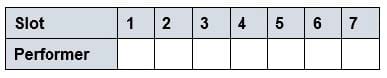
In a school function ceremony, seven students, Amy, Bob, Chad, Dom, Elisa, Fischer, and Grant have to deliver their performances in seven consecutive slots, not necessarily in the order of their given names. The following information is known about the order in which the students perform: Chad performs immediately before Dom Grant performs sometime after Chad There are exactly two performances made between the performances of Amy and Elisa
If it is known that Bob performs before Fischer, for which of the following positions of Amy can the exact order of all the performers be determined?
A. Second
B. Third
C. Fourth
D. Fifth
E. None of the seven positions