
NS0-513 Online Practice Questions and Answers
Synchronous replication is available for which two NetApp solutions? (Choose two.)
A. StorageGRID Webscale
B. ONTAP Select
C. MetroCluster
D. Cloud Backup
A company is evaluating different data protection solutions. The company requires a solution that provides both local failover and storage tiering.
Which two solutions meet these requirements? (Choose two.)
A. a FAS9000A system with SSD aggregates and FabricPool
B. a FAS8200A NetApp Private Storage (NPS) system and Cloud Backup
C. an AFF A300A with StorageGRID WebScale
D. a FAS2650A system with HDD aggregates and FabricPool
Click the Exhibit button.
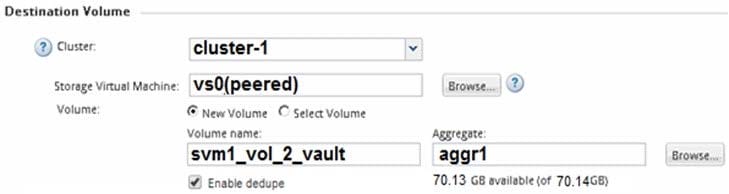
An employee's computer and mapped home folder has been encrypted with ransomware. You are asked to restore the data from a SnapVault repository.
Referring to the exhibit, what happens when the volume is restored?
A. All files in the volume are restored.
B. The restore is performed locally.
C. The original data is decrypted in place.
D. Only files that have changed in the volume are restored.
You have deployed a MetroCluster IP disaster recovery solution for cross-site protection and business continuity operations.
In this scenario, which two statements are correct? (Choose two.)
A. Replication of storage data is performed over the iSCSI connections between the two sites.
B. Replication of storage data is performed over high-bandwidth dedicated links in the IP fabric and NVRAM over a high-bandwidth dedicated FC fabric.
C. Replication of storage data is performed over a high-bandwidth dedicated FC fabric and NVRAM over high-bandwidth dedicated links in the IP fabric.
D. Replication of storage and NVRAM data is performed over high-bandwidth dedicated links in the IP fabric.
Which two statements are correct about MetroCluster IP requirements for intercluster LIFs? (Choose two.)
A. At least one interface per node is required.
B. Either an IPv6 address or IPv4 address is required.
C. A dedicated network port is required.
D. Jumbo frames are required.
You are planning on archiving 200 TB of data with SnapVault to an ONTAP Cloud Instance.
Which NetApp tool manages your Bring Your Own License (BYOL)?
A. OnCommand System Manager
B. OnCommand Unified Manager
C. OnCommand Cloud Manager
D. OnCommand Insight
When volumes are set to be thin-provisioned, what must be monitored for space usage?
A. Snapshot reserve
B. aggregate
C. volume clone space
D. LUN
Which technology uses synchronous replication?
A. SnapMirror XDP
B. FabricPool
C. MetroCluster mirrored aggregate
D. SVM DR
A user's home directory, mounted using NFS, has been encrypted by a ransomware attack. The user asks you to retrieve the data.
In this scenario, which process would allow you to accomplish this task?
A. Restore the data from a Snapshot copy.
B. Take a new Snapshot copy of the volume.
C. Apply the XDPDefault policy to the volume.
D. Apply the MirrorAllSnapshots policy to the volume.
You are asked to verify that data stored in your disaster recovery site can be restored and is viable. Currently, you have a NetApp SnapMirror relationship with a MirrorAllSnaps policy type that is enabled and is updating frequently.
What would be a nondisruptive method to carry out a detailed validation of your disaster-recovery strategy?
A. Use SyncMirror on the destination aggregate on the destination cluster, and validate the data.
B. Perform a SnapMirror reverse resynchronization to restore the data from the destination cluster to the source cluster, and validate the data.
C. Break the SnapMirror relationship and validate the data.
D. Create a FlexClone volume of the destination volume on the destination cluster, and validate the data.