
NS0-526 Online Practice Questions and Answers
Your customer needs to activate a destination SVM DR following a disaster. In this situation, which two actions should be performed? (Choose two.)
A. Shut down the source cluster.
B. From the destination cluster, break the SVM DR relationship.
C. From the source cluster, break the SVM DR relationship.
D. Start the destination SVM.
A client has a FlexVol volume that is 10 TB in size and is nearly full. The volume has a Snapshot reserve of 5%, that is currently utilized at 120%. They have chosen to enable ONTAP to automatically delete the oldest Snapshot copies with a volume threshold trigger in order to free space within the volume when it becomes necessary.
In this scenario, what amount of space would be made available to the client, without additional intervention?
A. 1000 GB
B. 500 GB
C. 50 GB
D. 100 GB
You have deployed the DP_Optimized (DPO) license on the destination cluster to support a high number of volumes and peer relationships for setting up data protection with multiple sourceclusters. You want to obtain a list of unprotected volumes on the source cluster and protect them.
Which two management tools would be used to accomplish this task? (Choose two.)
A. ONTAP CLI
B. OnCommand Insight
C. OnCommand System Manager
D. OneCollect
You have experienced a disaster at your source site and activated SVM DR. The source site is now up, but your source SVMs no longer exist. You must restore data to the original source and maintain the SVM DR configuration.
Which two steps must be taken to accomplish this task? (Choose two.)
A. Delete the cluster peer relationship.
B. Replicate the data from the disaster-recovery site to the new source with volume SnapMirror.
C. Create the new source SVM by creating an SVM disaster-recovery relationship from the original destination.
D. Delete the existing SVM peer relationship.
Which two NetApp tools would be used to set up protection relationships between a SolidFire cluster and an ONTAP cluster? (Choose two.)
A. SnapCenter
B. SolidFire Element Operating System UI
C. OnCommand Insight
D. ONTAP CLI
Click the Exhibit button.
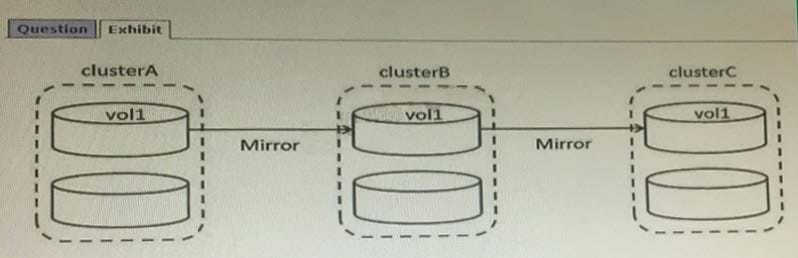
Refer to the Exhibit. clusterA, clusterB, and clusterC are in a mirror-mirror cascade relationship. clusterB is offline and not recoverable. You want to continue to protectcluster
A. In this scenario, which statement is correct? Response:
B. Resume the relationship between clusterA and clusterC, creating a new baseline.
C. clusterA will continue to be protected "as-is".
D. Synchronize the relationship between clusterA and clusterC, avoiding a new baseline.
E. Create a SnapVault relationship between clusterB and clusterC.
You are creating a SnapMirror relationship and custom SnapMirror policies are not defined. Which default policy will be applied in this scenario?
A. Mirror And Vault
B. Default C. SM Default
D. DP Default
A customer wants to maintain a single copy for both disaster recovery and backup on a secondary system. Which SnapMirror policy andrelationship type should be used?
Response:
A. Mirror And Vault/Relationship Type DP
B. Mirror And Vault/Relationship Type XDP
C. Mirror And Vault/Relationship Type TDP
D. Mirror And Vault/Relationship Type LS
You do not want to impact your ongoing SnapMirror relationship between your primary and secondary site. Which step must be taken prior to creating a FlexClone at the disaster recovery site?
A. Cascade the SnapMirror destination volumeto another SnapMirror destination.
B. Create a Snapshot copy of the SnapMirror destination volume.
C. Cascade the SnapMirror destination volume to another SnapVault destination.
D. Create a Snapshot copy of the SnapMirror source volume and wait for it totransfer.
You received an alert from OnCommand Unified Manager (OCUM) that a NetApp FlexVol is almost out of space. Which three actions are available to perform from the OCUM events detail Web page?
(Choose three.)
A. Acknowledge the event.
B. Mark the event as "resolved".
C. Create a job to move the FlexVol.
D. Increase the capacity of the FlexVol.
E. Add a note to the event.