
NSE5_FMG-6.4 Online Practice Questions and Answers
Which configuration setting for FortiGate is part of a device-level database on FortiManager?
A. VIP and IP Pools
B. Firewall policies
C. Security profiles
D. Routing
An administrator wants to delete an address object that is currently referenced in a firewall policy.
What can the administrator expect to happen?
A. FortiManager will not allow the administrator to delete a referenced address object
B. FortiManager will disable the status of the referenced firewall policy
C. FortiManager will replace the deleted address object with the none address object in the referenced firewall policy
D. FortiManager will replace the deleted address object with all address object in the referenced firewall policy
An administrator run the reload failure command: diagnose test deploymanager reload config
A. It downloads the latest configuration from the specified FortiGate and performs a reload operation on the device database.
B. It installs the latest configuration on the specified FortiGate and update the revision history database.
C. It compares and provides differences in configuration on FortiManager with the current running configuration of the specified FortiGate.
D. It installs the provisioning template configuration on the specified FortiGate.
View the following exhibit:
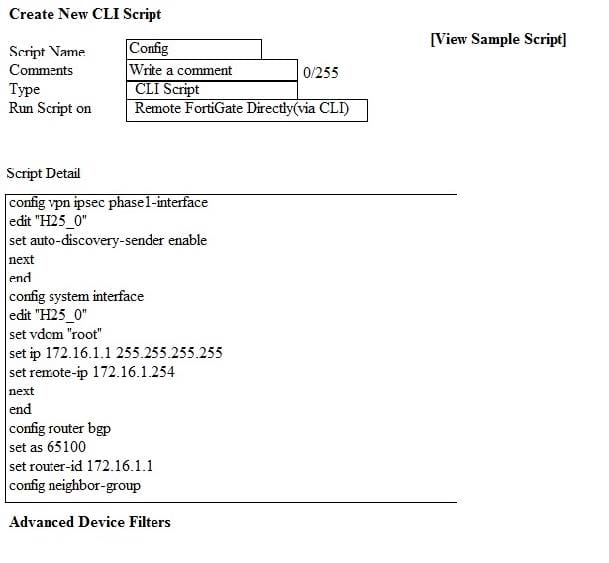
Which two statements are true if the script is executed using the Remote FortiGate Directly (via CLI) option? (Choose two.)
A. You must install these changes using Install Wizard
B. FortiGate will auto-update the FortiManager's device-level database.
C. FortiManager will create a new revision history.
D. FortiManager provides a preview of CLI commands before executing this script on a managed FortiGate.
View the following exhibit.
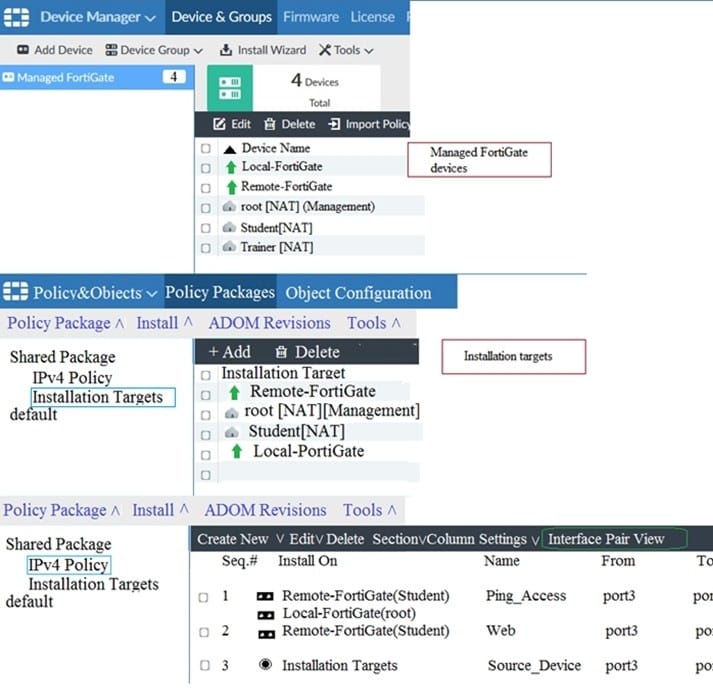
Given the configurations shown in the exhibit, what can you conclude from the installation targets in the Install On column?
A. The Install On column value represents successful installation on the managed devices
B. Policy seq#3 will be installed on all managed devices and VDOMs that are listed under Installation Targets
C. Policy seq#3 will be installed on the Trainer[NAT] VDOM only
D. Policy seq#3 will be not installed on any managed device
What will be the result of reverting to a previous revision version in the revision history?
A. It will install configuration changes to managed device automatically
B. It will tag the device settings status as Auto-Update
C. It will generate a new version ID and remove all other revision history versions
D. It will modify the device-level database
Which two items are included in the FortiManager backup? (Choose two.)
A. FortiGuard database
B. Global database
C. Logs
D. All devices
Refer to the exhibit.
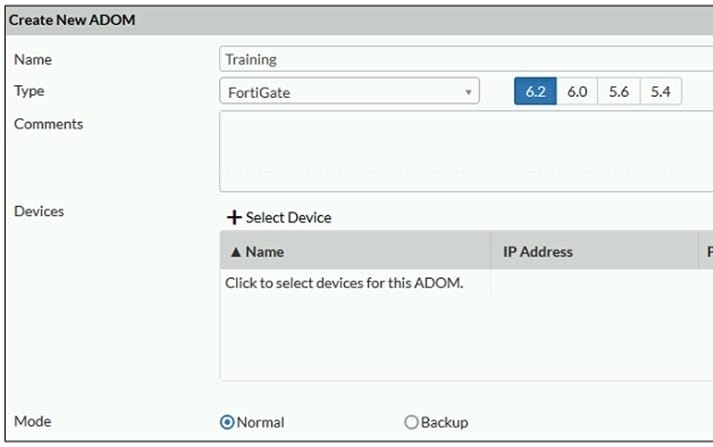
Which two statements about an ADOM set in Normal mode on FortiManager are true? (Choose two.)
A. It supports the FortiManager script feature
B. It allows making configuration changes for managed devices on FortiManager panes
C. FortiManager automatically installs the configuration difference in revisions on the managed FortiGate
D. You cannot assign the same ADOM to multiple administrators
An administrator would like to create an SD-WAN using central management. What steps does the administrator need to perform to create an SD-WAN using central management?
A. First create an SD-WAN firewall policy, add member interfaces to the SD-WAN template and create a static route
B. You must specify a gateway address when you create a default static route
C. Remove all the interface references such as routes or policies
D. Enable SD-WAN central management in the ADOM, add member interfaces, create a static route and SDWAN firewall policies.
An administrator would like to create an SD-WAN default static route for a newly created SD-WAN using the FortiManager GUI. Both port1 and port2 are part of the SD-WAN member interfaces.
Which interface must the administrator select in the static route device drop-down list?
A. port2
B. virtual-wan-link
C. port1
D. auto-discovery