
NSE5_FMG-7.2 Online Practice Questions and Answers
Which two settings must be configured for SD-WAN Central Management? (Choose two.)
A. SD-WAN must be enabled on per-ADOM basis
B. You can create multiple SD-WAN interfaces per VDOM
C. When you configure an SD-WAN, you must specify at least two member interfaces.
D. The first step in creating an SD-WAN using FortiManager is to create two SD-WAN firewall policies.
View the following exhibit:
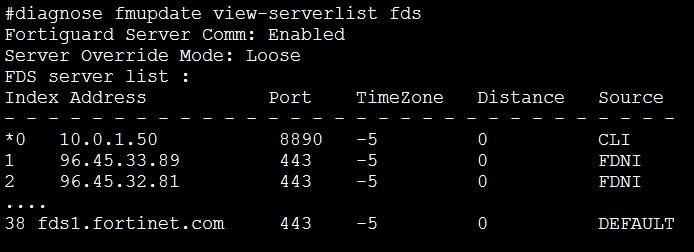
How will FortiManager try to get updates for antivirus and IPS?
A. From the list of configured override servers with ability to fall back to public FDN servers
B. From the configured override server list only
C. From the default serverfdsl.fortinet.com
D. From public FDNI server with highest index number only
An administrator wants to delete an address object that is currently referenced in a firewall policy. What can the administrator expect to happen?
A. FortiManager will not allow the administrator to delete a referenced address object
B. FortiManager will disable the status of the referenced firewall policy
C. FortiManager will replace the deleted address object with thenoneaddress object in the referenced firewall policy
D. FortiManager will replace the deleted address object withalladdress object in the referenced firewall policy
Refer to the exhibit.
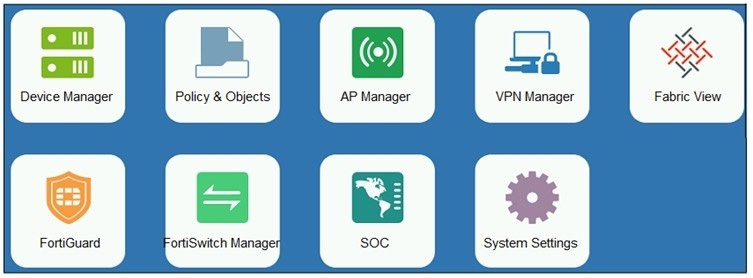
An administrator logs into the FortiManager GUI and sees the panes shown in the exhibit.
Which two reasons can explain why the FortiAnalyzer feature panesdo notappear? (Choose two.)
A. The administrator logged in using the unsecure protocol HTTP, so the view is restricted.
B. The administrator profile does not have full access privileges like theSuper_Userprofile.
C. The administrator IP address is not a part of the trusted hosts configured on FortiManager interfaces.
D. FortiAnalyzer features are not enabled on FortiManager.
Which two items are included in the FortiManager backup? (Choose two.)
A. FortiGuard database
B. Global database
C. Logs
D. All devices
Refer to the exhibit.
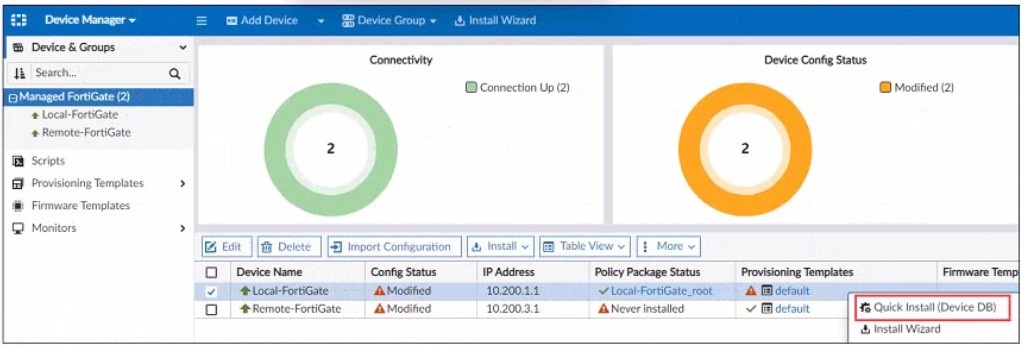
You ate using the Quick install option to install configuration changes on the managed FortiGate
Which two statements correctly describe the result? (Choose two)
A. It installs device-level changes on the FortiGate device without launching the Install Wizard
B. It installs all the changes in the device database first and the administrator must reinstall the changes on the FodiGate device
C. It provides the option to preview only the policy package changes before installing them
D. It install provisioning template changes on the FortiGate device
Which two settings are required for FortiManager Management Extension Applications (MEA)? (Choose two.)
A. When you configure MEA, you must open TCP or UDP port 540.
B. You must open the ports to the Fortinet registry
C. You must create a MEA special policy on FortiManager using the super user profile
D. The administrator must have the super user profile.
Refer to the exhibit.
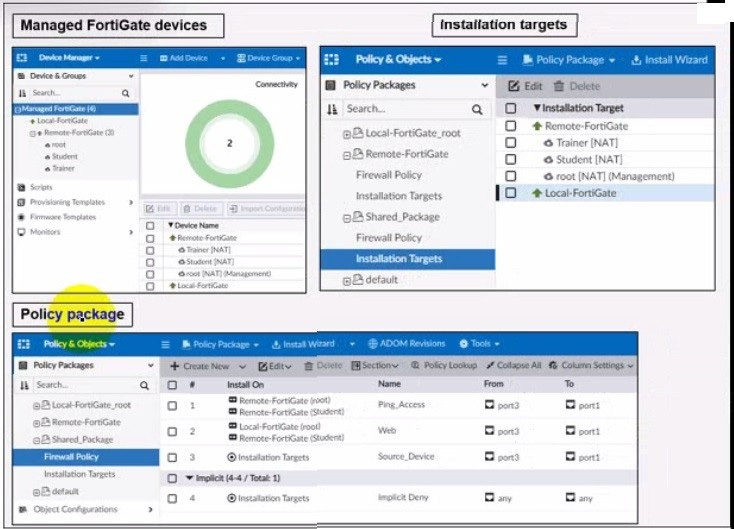
Given the configuration shown in the exhibit, what can you conclude from the installation targets m the Install On column? (Choose two)
A. Policy seq # 2 will not be installed on the Local-FortiGate root VDOM because there is no root VDOM in the Installation Target
B. Policy seq # 3 will be installed on all managed devices and VDOMs that are listed under Installation Targets
C. Policy seq # 1 will be installed on the Remoto-FortiGate root[NAT] and Student[NAT] VDOMs only
D. Policy 3 will be installed on all FortiGate devices and vdom belongs to the ADOM
E. Policy seq # 3 will be skipped because no installation targets are specified
What does thediagnose dvm check-integritycommand do? (Choose two.)
A. Internally upgrades existing ADOMs to the same ADON version in order to clean up and correct the ADOM syntax
B. Verifies and corrects unregistered, registered, and deleted device states
C. Verifies and corrects database schemas in all object tables
D. Verifies and corrects duplicate VDOM entries
Which configuration setting for FortiGate is part of an ADOM-level database on FortiManager?
A. NSX-T Service Template
B. Security profiles
C. SNMP
D. Routing