
NSE7_EFW-6.2 Online Practice Questions and Answers
An administrator has decreased all the TCP session timers to optimize the FortiGate memory usage. However, after the changes, one network application started to have problems. During the troubleshooting, the administrator noticed that the FortiGate deletes the sessions after the clients send the SYN packets, and before the arrival of the SYN/ACKs. When the SYN/ACK packets arrive to the FortiGate, the unit has already deleted the respective sessions. Which TCP session timer must be increased to fix this problem?
A. TCP half open.
B. TCP half close.
C. TCP time wait.
D. TCP session time to live.
An administrator has configured a FortiGate device with two VDOMs: root and internal. The administrator has also created and inter-VDOM link that connects both VDOMs. The objective is to have each VDOM advertise some routes to the other VDOM via OSPF through the inter-VDOM link. What OSPF configuration settings must match in both VDOMs to have the OSPF adjacency successfully forming? (Choose three.)
A. Router ID.
B. OSPF interface area.
C. OSPF interface cost.
D. OSPF interface MTU.
E. Interface subnet mask.
A FortiGate is rebooting unexpectedly without any apparent reason. What troubleshooting tools could an administrator use to get more information about the problem? (Choose two.)
A. Firewall monitor.
B. Policy monitor.
C. Logs.
D. Crashlogs.
Examine the output of the `diagnose ips anomaly list' command shown in the exhibit; then answer the question below.
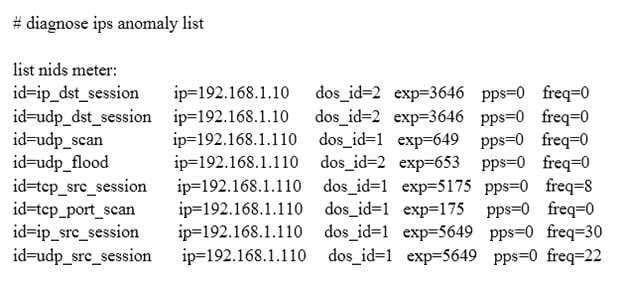
Which IP addresses are included in the output of this command?
A. Those whose traffic matches a DoS policy.
B. Those whose traffic matches an IPS sensor.
C. Those whose traffic exceeded a threshold of a matching DoS policy.
D. Those whose traffic was detected as an anomaly by an IPS sensor.
Which statements about bulk configuration changes using FortiManager CLI scripts are correct? (Choose two.)
A. When executed on the Policy Package, ADOM database, changes are applied directly to the managed FortiGate.
B. When executed on the Device Database, you must use the installation wizard to apply the changes to the managed FortiGate.
C. When executed on the All FortiGate in ADOM, changes are automatically installed without creating a new revision history.
D. When executed on the Remote FortiGate directly, administrators do not have the option to review the changes prior to installation.
How does FortiManager handle FortiGuard requests from FortiGate devices, when it is configured as a local FDS?
A. FortiManager can download and maintain local copies of FortiGuard databases.
B. FortiManager supports only FortiGuard push to managed devices.
C. FortiManager will respond to update requests only if they originate from a managed device.
D. FortiManager does not support rating requests.
View the exhibit, which contains the partial output of an IKE real time debug, and then answer the question below. The administrator does not have access to the remote gateway. Based on the debug output, what configuration changes can the administrator make to the local gateway to resolve the phase 1 negotiation error?
A. Change phase 1 encryption to AESCBC and authentication to SHA128.
B. Change phase 1 encryption to 3DES and authentication to CBC.
C. Change phase 1 encryption to AES128 and authentication to SHA512.
D. Change phase 1 encryption to 3DES and authentication to SHA256.
What configuration changes can reduce the memory utilization in a FortiGate? (Choose two.)
A. Reduce the session time to live.
B. Increase the TCP session timers.
C. Increase the FortiGuard cache time to live.
D. Reduce the maximum file size to inspect.
Examine the output from the 'diagnose debug authd fsso list' command; then answer the question below. # diagnose debug authd fsso list --FSSO logons-IP: 192.168.3.1 User: STUDENT Groups: TRAININGAD/USERS Workstation: INTERNAL2. TRAINING. LAB The IP address 192.168.3.1 is NOT the one used by the workstation INTERNAL2. TRAINING. LAB.
What should the administrator check?
A. The IP address recorded in the logon event for the user STUDENT.
B. The DNS name resolution for the workstation name INTERNAL2. TRAINING. LAB.
C. The source IP address of the traffic arriving to the FortiGate from the workstation INTERNAL2. TRAINING. LAB.
D. The reserve DNS lookup forthe IP address 192.168.3.1.
Examine the following routing table and BGP configuration; then answer the question below.
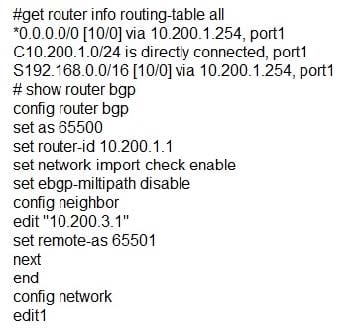
TheBGP connection is up, but the local peer is NOT advertising the prefix 192.168.1.0/24. Which configuration change will make the local peer advertise this prefix?
A. Enable the redistribution of connected routers into BGP.
B. Enable the redistribution of static routers into BGP.
C. Disable the setting network-import-check.
D. Enable the setting ebgp-multipath.