
NSE7_EFW-7.0 Online Practice Questions and Answers
An administrator has decreased all the TCP session timers to optimize the FortiGate memory usage. However, after the changes, one network application started to have problems. During the troubleshooting, the administrator noticed that the FortiGate deletes the sessions after the clients send the SYN packets, and before the arrival of the SYN/ACKs. When the SYN/ACK packets arrive to the FortiGate, the unit has already deleted the respective sessions. Which TCP session timer must be increased to fix this problem?
A. TCP half open.
B. TCP half close.
C. TCP time wait.
D. TCP session time to live.
View the exhibit, which contains the partial output of an IKE real-time debug, and then answer the question below.
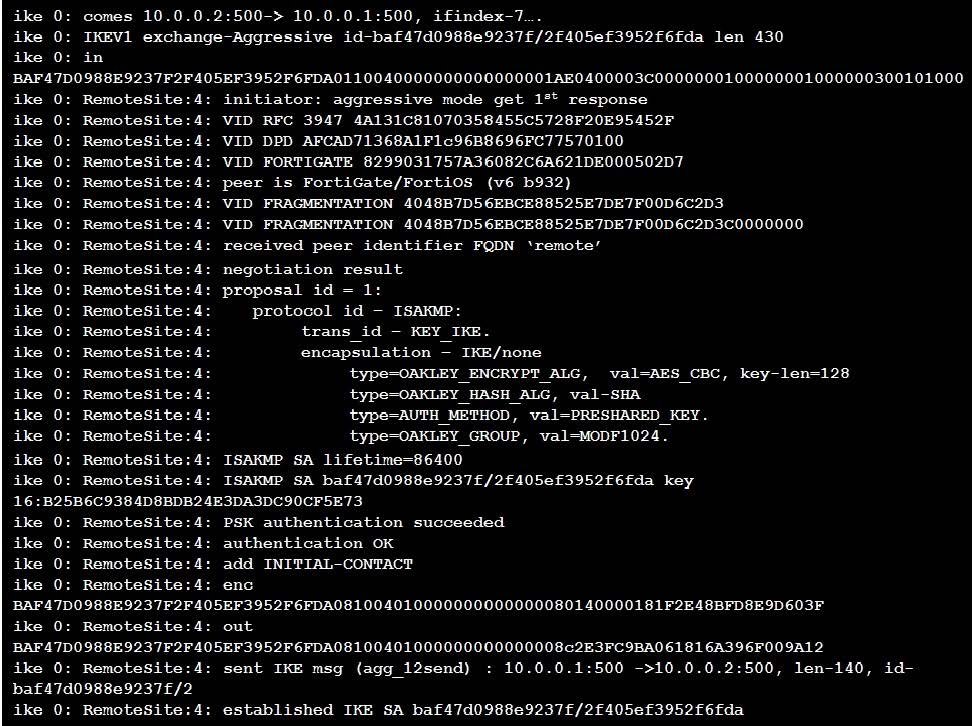
Which statements about this debug output are correct? (Choose two.)
A. The remote gateway IP address is 10.0.0.1.
B. It shows a phase 1 negotiation.
C. The negotiation is using AES128 encryption with CBC hash.
D. The initiator has provided remote as its IPsec peer ID.
Examine the following partial output from a sniffer command; then answer the question below.
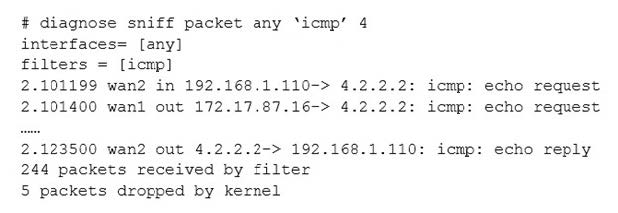
What is the meaning of the packets dropped counter at the end of the sniffer?
A. Number of packets that didn't match the sniffer filter.
B. Number of total packets dropped by the FortiGate.
C. Number of packets that matched the sniffer filter and were dropped by the FortiGate.
D. Number of packets that matched the sniffer filter but could not be captured by the sniffer.
An administrator has enabled HA session synchronization in a HA cluster with two members. Which flag is added to a primary unit's session to indicate that it has been synchronized to the secondary unit?
A. redir.
B. dirty.
C. synced
D. nds.
A FortiGate has two default routes:
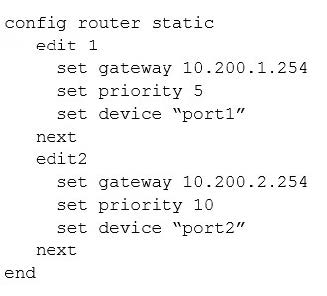
All Internet traffic is currently using port1. The exhibit shows partial information for one sample session of Internet traffic from an internal user:
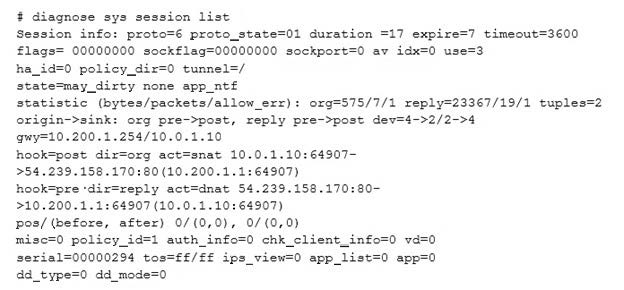
What would happen with the traffic matching the above session if the priority on the first default route (IDd1) were changed from 5 to 20?
A. The session would be deleted, and the client would need to start a new session.
B. The session would remain in the session table, and its traffic would start to egress from port2.
C. The session would remain in the session table, but its traffic would now egress from both port1 and port2.
D. The session would remain in the session table, and its traffic would still egress from port1.
Which of the following conditions must be met for a static route to be active in the routing table? (Choose three.)
A. The next-hop IP address is up.
B. There is no other route, to the same destination, with a higher distance.
C. The link health monitor (if configured) is up.
D. The next-hop IP address belongs to one of the outgoing interface subnets.
E. The outgoing interface is up.
Four FortiGate devices configured for OSPF connected to the same broadcast domain. The first unit is elected as the designated router The second unit is elected as the backup designated router Under normal operation, how many OSPF full adjacencies are formed to each of the other two units?
A. 1
B. 2
C. 3
D. 4
Examine the output of the `diagnose ips anomaly list' command shown in the exhibit; then answer the question below.
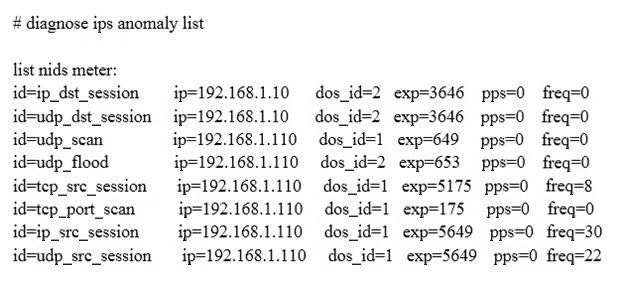
Which IP addresses are included in the output of this command?
A. Those whose traffic matches a DoS policy.
B. Those whose traffic matches an IPS sensor.
C. Those whose traffic exceeded a threshold of a matching DoS policy.
D. Those whose traffic was detected as an anomaly by an IPS sensor.
What does the dirty flag mean in a FortiGate session configured for NGFW policy mode?
A. The existing session table entry has been updated with the app_id and the firewall policy table needs to be checked for a match.
B. The application or URL category is unknown and needs to be rescanned by the IPS engine to try to identify the Layer 7 details.
C. The URL category for this session has been updated by FortiGuard and the session needs to be checked against the policy again to ensure proper web filtering is applied.
D. Traffic has been identified as coming from an application that is not allowed and the relevant replacement message needs to be displayed to the user, if configured.
View the exhibit, which contains the output of a diagnose command, and then answer the question below.
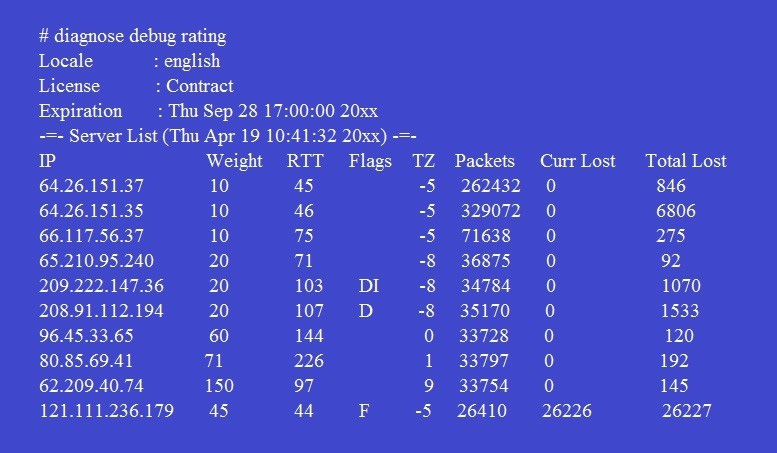
Which statements are true regarding the output in the exhibit? (Choose two.)
A. FortiGate will probe 121.111.236.179 every fifteen minutes for a response.
B. Servers with the D flag are considered to be down.
C. Servers with a negative TZ value are experiencing a service outage.
D. FortiGate used 209.222.147.3 as the initial server to validate its contract.