
PMI-RMP Online Practice Questions and Answers
You are the project manager for your organization. You are working with your key stakeholders in the qualitative risk analysis process. You understand that there is certain bias towards the risk events in the project that you need to address, manage, and ideally reduce. What solution does the PMBOK recommend to reduce the influence of bias during qualitative risk analysis?
A. Establish the definitions of the levels of probability and impact
B. Provide iterations of risk analysis for true reflection of a risk probability and impact
C. Isolate the stakeholders by project phases to determine their risk bias
D. Involve all stakeholders to vote on the probability and impact of the risk events
Holly is the project manager of the GHH Project. During risk identification and the subsequent risk analysis process she has identified a risk with a high probability and high impact for her project. She and the stakeholder agree that the project management plan should be changed to eliminate the risk threat entirely. What risk response has Holly used in this instance?
A. This is the risk mitigation response.
B. This is the avoidance risk response.
C. This is the transference risk response.
D. This is a scope change and not a risk response.
You work as a project manager for BlueWell Inc. You with your team are using a method or a (technical) process that conceives the risks even if all theoretically possible safety measures would be applied. One of your team member wants to know that what is a residual risk. What will you reply to your team member?
A. It is a risk that can not be addressed by a risk response.
B. It is a risk that will remain no matter what type of risk response is offered.
C. It is a risk that remains because no risk response is taken.
D. It is a risk that remains after planned risk responses are taken.
Who is the most appropriate person to conduct a risk identification brainstorming session?
A. Facilitator
B. Subject matter expert
C. Project manager
D. Project sponsor
Which analysis method uses stratified sampling without replacement?
A. Latin Hypercube
B. Monte Carlo simulation
C. Impact analysis
D. Linear regression analysis
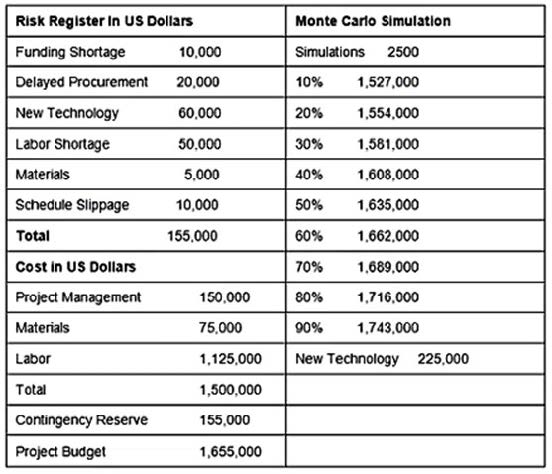
Given the output from the Monte Carlo simulation, what is the probability of a successful completion within the project budget?
A. 30% probability of meeting project budget
B. 46% probability of meeting project budget
C. 56% probability of meeting project budget
D. 60% probability of meeting project budget
During a company's audit, it is found that no risk management information exists within the lessons learned database. What could the company do to increase the amount of risk management organizational process assets?
A. Require the project manager to record significant risk management information, to provide concrete data in the lessons learned database for future projects.
B. Require the PMO to merge and distribute risk logs to all key stakeholders associated with risk management.
C. Require the project manager to update the project management office (PMO) policy and procedures on an iterative basis to ensure relevancy to current projects.
D. Require the PMO to perform quality audits on all active projects, to ensure alignment with communication industry standards.
The project team recorded a risk in the risk register indicating that weather-related delays may impact equipment delivery during project execution. When it is time to request the equipment shipment there is bad weather, but the client wants the equipment delivered anyway.
What should the project manager do?
A. Wait until the weather improves before sending the equipment.
B. Ask the project sponsor to approve shipping the equipment.
C. Proceed with the planned risk response to move the equipment.
D. Request the shipment of the equipment to satisfy the client.
A certain risk is identified for a major project, and the risk response is planned. However, the analysis reveals a high probability for a secondary risk which will be tolerated based on the organization's risk thresholds. The secondary risk is subsequently registered. During project execution, the primary risk occurs, the planned action is taken, and the secondary risk emerges
What two actions should the risk owner take? (Choose two.)
A. Implement the secondary risk response and update the project documents.
B. Conduct meeting with all stakeholder to agree on post impact solutions.
C. Set the corresponding trigger conditions to the secondary risk.
D. Engage the project manager to authorize the secondary risk's response.
E. Update and communicate assessments of the secondary risk's impact.
FILL BLANK
Fill in the blank with an appropriate phrase.
________is the study of how the variation (uncertainty) in the output of a mathematical model can be apportioned, qualitatively or quantitatively, to different sources of variation in the input of a model.