
PW0-105 Online Practice Questions and Answers
Why is it recommended for a wireless network administrator to disable 1 Mbps and 2 Mbps data rates on the WLAN infrastructure? (Choose two)
A. To improve capacity in the BSS
B. To reduce the size of the AP's effective service area
C. To prevent 802.11b devices from associating
D. To maximize the range of the highest data rates
E. To prevent VoWiFi multicast frames
F. To enable support for long preambles
Given:
You were previously on-site at ABC's facility to conduct a pre-deployment RF site survey. The WLAN has
been deployed according to your recommendations and you are on-site again to perform a network
validation.
When performing this type of post-deployment RF site survey for VoWiFi, what are two steps that must be
performed? (Choose two)
A. Coverage analysis to verify appropriate coverage and roaming boundaries
B. Spectrum analysis to locate and identify RF interference sources
C. Hidden node analysis to identify and relocate existing hidden nodes
D. Protocol analysis to discover channel use on neighboring APs
E. Application analysis with an active phone call on a VoWiFi handset
Given:
The center frequency of channel 1 in the 2.4 GHz ISM band is 2.412 GHz (2412 MHz).
What is the center frequency of channel 2?
A. 2.413 GHz
B. 2.417 GHz
C. 2.422 GHz
D. 2.432 GHz
E. 2.437 GHz
Given:
An 802.11 WLAN transmitter that emits a 50 mW signal is connected to a cable with 3 dB loss. The cable
is connected to an antenna with 16 dBi gain.
What is the EIRP power output?
A. 17 dBm
B. 20 dBm
C. 23 dBm
D. 27 dBm
E. 30 dBm
What distinguishes an independent basic service set (IBSS) from an infrastructure basic service set (BSS)?
A. An IBSS does not have a distribution system (DS), but a BSS does.
B. An IBSS does not require beacon frames, but a BSS does.
C. An IBSS does not support 802.11 authentication or association, but a BSS does.
D. An IBSS can only operate on a single channel, but a BSS can operate on multiple channels.
What statement about 802.11 WLAN performance is true?
A. Use of larger frame sizes results in greater throughput in low interference environments.
B. BSS support for 65 KB A-MPDUs will increase the maximum data rate available to client devices.
C. In 802.11n, changing the security mechanism from WPA2-Personal to WPA2-Enterprise will enable the HT MCS rates.
D. Compared to an Independent BSS, an Infrastructure BSS can provide almost twice the throughput between wireless nodes.
E. Use of short guard intervals improves reliability and throughput in high multipath environments
What is an advantage of using WPA2-Personal instead of WEP-128 as a security solution for 802.11 networks?
A. WPA2-Personal uses 802.1X/EAP for authentication, and WEP-128 uses preshared keys.
B. WPA2-Personal is based on IEEE 802.11 industry standards, but WEP is not.
C. WPA2-Personal uses CCMP for encryption, and WEP-128 uses TKIP for encryption.
D. WPA2-Personal uses dynamic encryption keys, and WEP-128 uses static keys.
E. WPA2-Personal requires complex 64-character hex keys, whereas WEP-128 requires weak 26character hex keys.
Given: As a station moves away from the access point to which it is associated, it changes its data rate from 54 Mbps to 48 Mbps and then to 36 Mbps.
What IEEE 802.11 term is used to describe this functionality?
A. Dynamic Rate Switching
B. Multirate Control
C. Modulation and Coding Selection
D. Rate Set Selectivity
E. Adaptive Rate Management
What is the general type and purpose of the application shown in the exhibit?
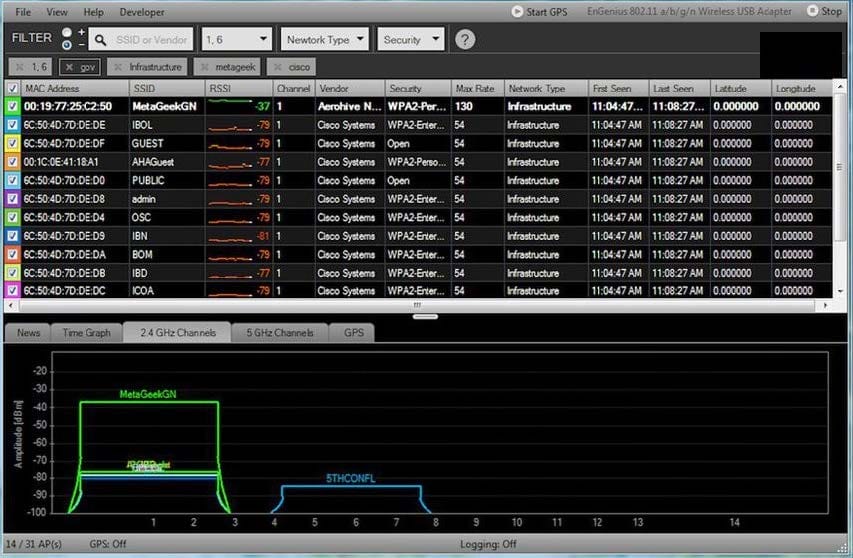
A. Laptop-based Site Survey Utility - Creating a list of necessary APs and plotting their locations on a floor plan
B. Wireless Network Management System - Managing multiple autonomous APs through the SNMP protocol
C. 802.11 Protocol Analyzer - Capturing and decoding 802.11 frames for the purpose of troubleshooting and optimization
D. Laptop-based Spectrum Analyzer - Monitoring the RF spectrum for interference sources and improper system operation
E. WLAN Discovery Tool - Locating and identifying secured and unsecured WLAN access points
F. Wireless Intrusion Protection System - Monitoring 802.11 frame exchanges for performance and security analysis and reporting
What is the approximate beamwidth of the antenna displayed in the exhibit?
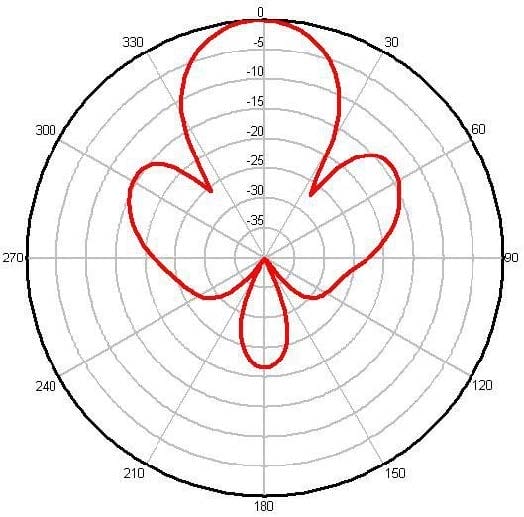
A. 15 degrees
B. 30 degrees
C. 50 degrees
D. 70 degrees
E. 120 degrees