
PW0-250 Online Practice Questions and Answers
After surveying for the ideal mounting locations for APs, you have been asked to compromise RF propagation optimization due to aesthetic concerns raised by your customer. In the end, you've decided to mount the APs in the ideal locations and paint the APs so they go unnoticed in the environment.
What is a valid recommendation or consideration when painting APs? (Choose 2)
A. Always use paints with metallic dye in them to prevent potential RF propagation impact.
B. Do not paint the notification LEDs on the AP, but configure them to be dim or turned off altogether until troubleshooting is required.
C. Painting APs may void the product manufacturer's warranty.
D. Most AP models for indoor environments come in a variety of form factors and colors. Painting is never recommended.
E. Painting APs always introduces a fire and gas emissions hazard and should be avoided for all indoor APs.
When deploying long-distance 802.11 bridge links (10 miles / 16 km), what parameter may be critical for improving data flow by reducing retries caused by the long distances?
A. The sequence control field value
B. The acknowledgement timeout threshold
C. The minimum transmit data rate value
D. The CTS-to-self threshold
E. The Beacon interval
F. The PHY parameter set field
Given: Assume that music on hold (MOH) features are unicast only.
What VoWiFi implementations require multicast packet delivery support by the WLAN infrastructure?
A. All VoWiFi implementations
B. Push-to-Talk VoWiFi phones
C. VoWiFi soft phones
D. FMC phones
E. Flat (non-VLAN) VoWiFi implementations
An associated STA detects a new BSS with the same SSID as the STA's current BSS. The new BSS uses a different IP subnet than the current BSS. If the STA is configured to use 802.1X/EAP preauthentication, what is likely to occur?
A. The STA will not attempt to preauthenticate because the new BSS uses a different IP subnet.
B. The STA will attempt to preauthenticate, but fail because the new BSS uses a different data-link broadcast domain.
C. The STA will attempt to preauthenticate and succeed if DHCP is supported on the new subnet.
D. The STA will attempt to preauthenticate and succeed if IP Mobility is enabled on the AP or WLAN controller.
E. The STA will attempt to preauthenticate and succeed if the current AP has shared its cached PMK.
Given: A WLAN controller is connected to ABC Company's core layer 3 Ethernet switch with an IEEE 802.1Q trunk connection. The WLAN controller's native VLAN is VLAN 6 and its IP address is 10.0.14.2 /24. Lightweight APs supporting centralized forwarding are connected to the network on VLANs 7, 8, and 9, and they each build a layer 3 tunnel back to the WLAN controller's IP address. The dynamically assigned IP addresses received by each AP from a DHCP server will be .
A. Associated with the VLAN on which they are connected.
B. Associated with the native VLAN of the WLAN controller.
C. Associated with VLAN 1, the default VLAN for new APs
D. Associated with a non-routable VLAN until the MAC address of the AP is removed from the controller's MAC filter
What is the purpose of Friis transmission equation [(LdB) = 20 log(d) + 20 log (f) - 27.55 ]?
A. Calculate earth bulge to determine minimum antenna height
B. Calculate receive sensitivity for an 802.11 radio/antenna pair
C. Calculate RF path loss in free space
D. Calculate the loss experienced between the intentional radiator and antenna
E. Calculate the minimum voltage requirements for lightning suppression systems
Given: You are evaluating the theoretical and real-world RF gain benefits of transmit and receive features introduced by 802.11n with MIMO. This exercise allows you to quantify the feature's value in a real-world environment.
What is the maximum theoretical signal gain of chip-based TxBF and MRC (as features) when compared to the same AP using only a single antenna for transmit and receive (effectively simulating a 1x1 chip)?
A. 2 Rx or Tx chains = 3 dBi gain 3 Rx or Tx chains = approx 5 dBi gain 4 Rx or Tx chains = 6 dBi gain
B. 2 Rx or Tx chains = 1 dBi gain 3 Rx or Tx chains = 2 dBi gain 4 Rx or Tx chains = 3 dBi gain
C. 2 Rx or Tx chains = 3 dBi gain 3 Rx or Tx chains = 6 dBi gain 4 Rx or Tx chains = 9 dBi gain
D. 2 Rx or Tx chains = approx 4-6.5 dBi gain 3 Rx or Tx chains = approx 7-10 dBi gain 4 Rx or Tx chains = approx 10-12 dBi gain
E. The theoretical gains offered by each additional radio are different for TxBF and MRC.
When performing an indoor predictive site survey to make the WLAN planning and design cycle more efficient, what is a best practice for configuration of the simulated APs in the predictive modeling software?
A. All simulated APs should be set to 20 MHz channels only.
B. Always use the default 2.2 dBi omnidirectional antenna patterns for simulated APs.
C. If dynamic RRM will be used, AP transmit power should be set to an estimated average level of the expected client devices, such as 25 mW.
D. Defining custom AP and antenna patterns will yield more accurate prediction data than the pre- configured vendor AP/antenna combinations.
What are some advantages of designing guest access as it is shown in the exhibit?
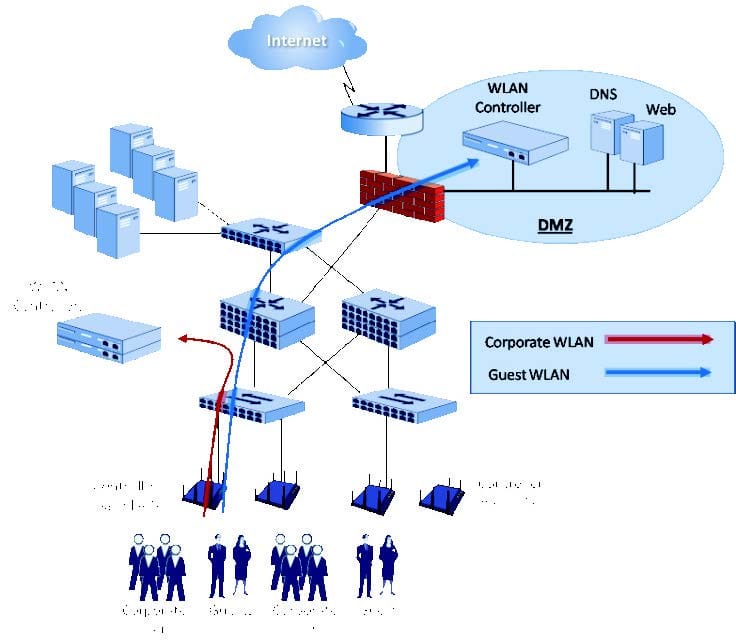
A. Allows a single SSID with different authentication/encryption models to be used for all WLAN services for corporate users and guests
B. Minimizes configuration requirements for segmentation and filtering of guest traffic across internal LAN
C. The border firewall configuration will not require any additional rules to pass guest traffic to the DMZ controller
D. Enhances performance of web proxy servers in the DMZ for guest Internet traffic
E. Allows simple and secure guest collaboration (file/print sharing) with corporate users
As you plan a WLAN upgrade, you have assessed the network requirements and data signatures of your applications. One of the popular applications used on your network requires high bandwidth and low to medium Wi-Fi loss, but can tolerate moderate latency and jitter.
What application matches this description?
A. FTP
B. Email
C. Skype chat
D. Voice
E. Video conferencing
F. Video-on-demand