
QSDA2019 Online Practice Questions and Answers
A data architect executes the following script:

What will Field_1 contain after this script is executed?
A. Abcd, abcd
B. abed
C. Abed. abed. ABCD, ABCDABCD
D. Abcd, abcd. ABCD
Multiple department fields in a dataset require a description. A data architect needs to add the department
descriptions or a default value when the department does NOT have a description.
Which strategy should the data architect use to meet these requirements?
A. ApplyMap with two parameters after the Mapping load
B. Left Join between tables and Description.xlsx in every Department table
C. Enter "Missing description" in the blank rows for Description.xlsx, then use Mapping Load
D. ApplyMap with three parameters after the Mapping load
Refer to the exhibit.
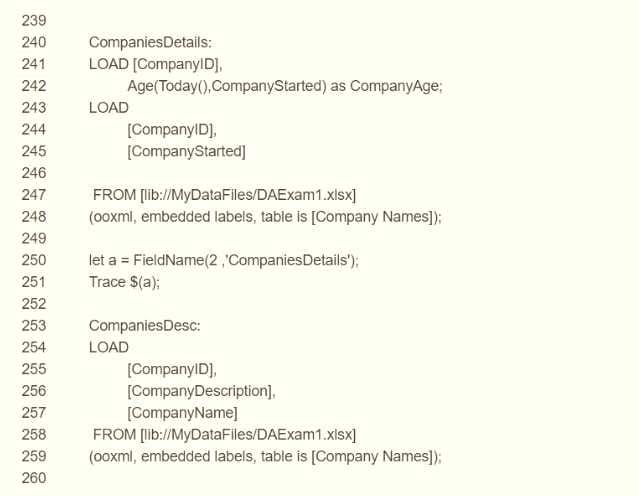
A business analyst reports that the 'CompanyAge' field does NOT display for users The data architect examines the LOAD script and wants to place the breakpoint in the script to check the field name. Which line number should the data architect use?
A. 242 because field name appears in the output Panel of the debugger
B. 251 because the field name appears in the Variable panel of the debugger
C. 251 because the field name appears in the Qlik Log files
D. 251 because the field name appears in the Output panel of the debugger
A data architect needs to load large amounts of data from a database which is continuously updated New records are added, and existing records get updated and deleted. Each record has a LastModified field All existing records are exported into a QVD file. The data architect wants to load the records into Qlik Sense efficiently. Which steps should the data architect take to meet these requirements?
A. 1. Use a partial load to load new and updated data from the database.
2.
Load the existing data from the QVD without the updated rows that have just been loaded from the database. Concatenate with the new and updated records.
3.
Use the Peek function to remove the deleted rows.
B. 1. Load the new and updated data from the database
2.
Load the existing data from the QVD without the updated rows that have just been loaded from the database. Concatenate with the new and updated records.
3.
Load all records from the key field from the database and use an Inner Join on the previous table.
C. 1. Load the existing data from the QVD.
2.
Load the new and updated data from the database without the rows that have just been loaded from the QVD. Concatenate with data from the QVD.
3.
Load all records from the key field from the database and use an Inner Join on the previous table.
D. 1. Load the existing data from the QVD.
2.
Load new and updated data from the database. Concatenate with the table loaded from the QVD.
3.
Create a separate table for the deleted rows and use a WHERE NOT EXISTS to remove these
records.
Refer to the exhibit.
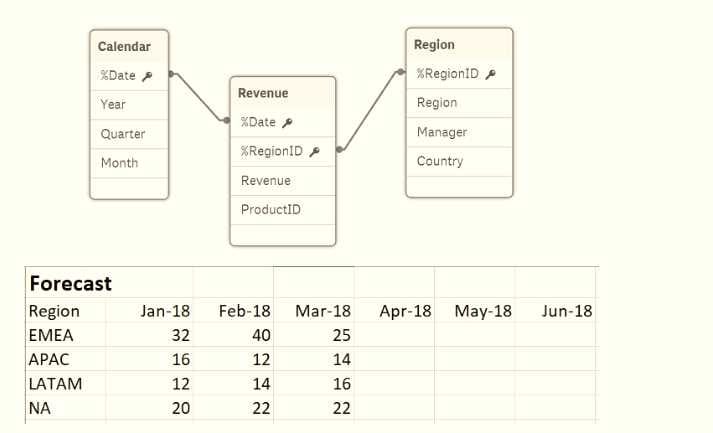
A business department is forecasting revenue within an Excel spreadsheet. A data architect needs to
include this forecast into the existing data model, and without losing any data.
Which two sets of steps will meet these requirements? (Select two.)
A. 1. Load the Excel spreadsheet using the data load editor
2.
Use the Unpivot function
3.
Use the Sum function to group the forecast by date
4.
Connect to the existing data model
B. 1. Load the Excel spreadsheet using the data load editor
2. Use the Crosstable function to unpivot the table
3 Create a composite key out of the date and region
4 Connect the new table to the data model
C. 1. Load the Excel spreadsheet using the data load editor
2.
Change the sort order by date
3.
Create a composite key out of the forecast and region
4.
Connect to the existing data model
D. 1. Load the Excel spreadsheet into the data manager
2.
Use the Unpivot function
3.
Create a composite key from the date and region
4.
Connect the new table to the data model
E. 1. Load the Excel spreadsheet using the data manager
2.
Rename the ForecastDate field to Date
3.
Disable the Region
4.
Connect to the existing data model
A customer has a dataset that contains latitude and longitude data for service points around the country. The data is retrieved using the following statement:

It must be clear to the end user that this is geographic data.
A. Define Location as a master item, and set the tag to Sgeodata
B. Add GeoProject{' Point' , LatandLong) AS Point to the preceding load
C. Add GeoKakePoint (Lat, Long} as Point to Location's preceding load
D. Add the following to the end of the script: TAG FIELD LocationName With 'Sgeodata1, 'Srelated'; TAG FIELD Point With 'Sgeodata', 'Srelated1;
E. Add the following to the end of the script: TAG FIELD LocationName With 'Sgeoname', @relates_Pt'; TAG FIELD Point With 'Sgeopoint*f 'Srelates Location', '$hidden';
Refer to the exhibit.

A data architect has a data model that includes historical order fulfillment centers. The order fulfillment
centers occasionally changed location. The history of order fulfillment must be tracked on a per center, per
location basis.
Which scripting function should the data architect use to meet this data modeling requirement?
A. IntervalMatch
B. Peek
C. ApplyMap
D. Inner Join
Refer to the exhibit.
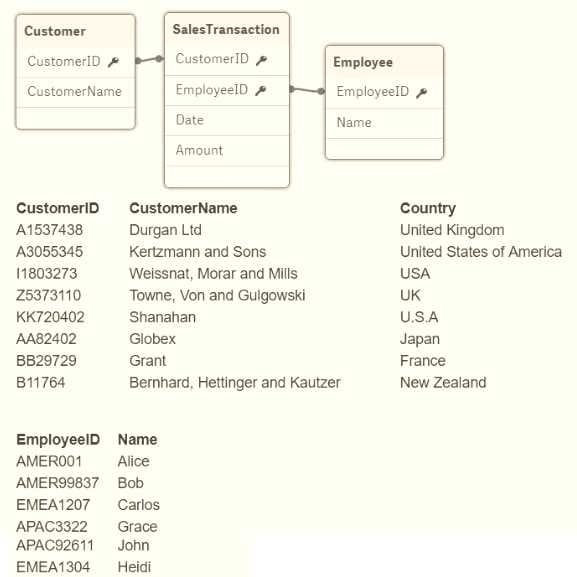
A global sales organization operates in three regions: AMERICAS, EMEA: and APAC. Each region stores its sales transactions in a separate database in which the employees update customer data through a third-party app. The data is extracted into three QVDs.
A data architect sets up a two-tier architecture for the data load. The data architect needs to add the region to the data model.
Which technique should the data architect use to create the Region field?
A. Create a Region field in the SalesTransaction table and populate using fixed region values while loading from each source
B. Create a Region field in the Employee table and populate using the LTrim function on the EmployeelD
C. Create a Region field in the Employee table and populate using the SubField function on the EmployeelD
D. Create a Region field in the SalesTransaction table and create a mapping table based on the Country field in the Customer table
A human resources (HR) team manager is due to go on leave. The manager needs to assign permissions to colleague to help the HR team publish apps.
Which action(s) should the manager assign to the colleague before going on leave?
A. Owner Publish
B. Publish
C. Owner Publish, Read
D. Publish, Read
A data architect plans to build an app that contains geographically diverse data that must be specific to
user run-time selections. The source contains transactional data. The app must have minimal impact on
already limited server resources.
Which approach should the data architect use?
A. Loop and Reduce
B. QVDs
C. In-memory
D. ODAG