
QV_DEVELOPER_01 Online Practice Questions and Answers
A designer needs to create a chart displaying the number of patients currently checked into a hospital by
age group.
What is the appropriate Dimension for the chart?
A. number of patients
B. checked-in status
C. hospital
D. age group
A customer has a set of date values in different formats.
Some dates are in Julian date format; Some dates are text strings.
How can a developer ensure the data is loaded in a consistent format?
A. change the default DateFormat variable assignment on the Main script tab
B. use the Date function to format the field during load
C. use the Alt function with different Date# functions
D. use the Lookup function with a format table
Refer to the exhibit below.
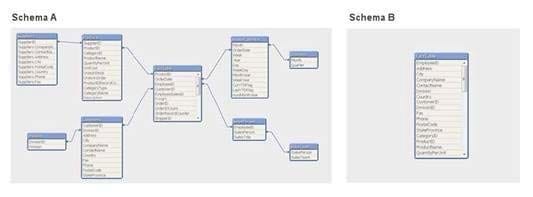
Schema A displayed in the exhibit has been transformed into schema B. How can the before and after schemas be described?
A. The snowfake schema has been transformed into a de-normalized schema.
B. The snowfake schema has been transformed into a normalized schema.
C. The star schema has been transformed into a de-normalized schema.
D. The star schema has been transformed into a normalized schema.
Refer to the exhibit to the right.
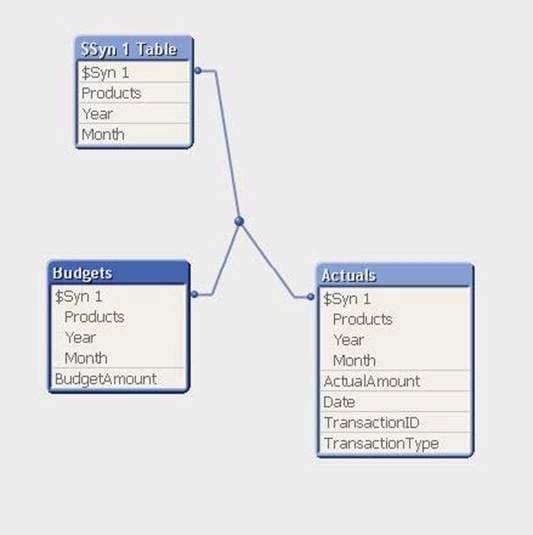
A customer has aggregated budgets for products by year and month. Actual data is stored at a more detailed transaction level and so a one-to-many relationship exists between the Budgets to Actuals table. Budgets have been assigned for all months of the current year, but there are only transactions up to the current month of October. There are transactions for products that were not assigned budgets. How can a developer remove the synthetic key automatically generated by QlikView and be able to analyze budgets andactualsbyproduct, month, andyear?
A. load the Actuals table, and when loading the Budgets table, use Outer Join to join the BudgetAmount field to the Actuals table
B. load the Actuals table, and when loading the Budgets table, rename fields Year and Month to BudgetYear and BudgetMonth
C. load the Actuals table, and when loading the Budgets table, use the Concatenate function to append the Budgets table to the Actuals table
D. create a concatenated key of Product-Year-Month in both the Budgets and Actuals table and comment out the individual fields in the Budgets table
Which QlikView script should a developer add to a Load script to output the resulting number of rows from a joining Load statement to the script Execution Progress window and the script log file?
A. LET vNumRows = NoOfRows('TableName'); ECHO 'Resulting Rows = $(vNumRows)';
B. SET vNumRows = NoOfRows('TableName'); ECHO 'Resulting Rows = $(vNumRows)';
C. LET vNumRows = NoOfRows('TableName'); PRlNT 'Resulting Rows = $(vNumRows)';
D. SET vNumRows = NoOfRows('TableName'); Response.Write 'Resulting Rows = $(vNumRows)';
E. LET vNumRows = NoOfRows('TableName'); TRACE 'Resulting Rows = $(vNumRows)';
A customer has data tables for financial results, staffing, sanitary conditions, and customer satisfaction.
Each table contains a date field and a location lD. Not all dates appear in all tables.
How can a developer create a master calendar that can be used with all the tables?
A. Designate one of the date fields as the reference Build a calendar spanning the minimum and maximum dates in that table Rename all other date fields to match the reference field Left join the location lD from each table into the calendar table on the date fields Drop the location and date fields from all other tables
B. Find the minimum and maximum dates spanned by all tables Create a calendar spanning those dates Rename all other date fields to match the reference field Left join the location lD from each table into the calendar table on the date fields Drop the location and date fields from all other tables
C. Designate one of the date fields as the reference Build a calendar spanning the minimum and maximum dates in that table Rename all other date fields to match the reference field Create a link table with a key of Location and date that contains all unique locations and dates Create a key of location and date in the other tables
D. Find the minimum and maximum dates spanned by all tables Create a calendar spanning those dates Create a link table with a key of location and date that contains all unique locations and dates Create a key of location and date in the other tables Drop the location and date fields from all other tables
A developer created two QVWs. The first QVW loads data from the data source and creates QVD files.
The second QVW loads the QVD files and provides the user interface for the analytics.
The customer does not have Publisher installed.
How should the reloads be configured on the server to ensure the first QVW reload completes before the
second QVW reload begins?
A. Only the first QVW reload can be automated. An alert will need to be sent to prompt an administrator to manually perform the second QVW reload.
B. Only one QVW reload can occur at a time on the QlikView server. The second QVW reload will always wait until the first QVW reload completes.
C. The second QVW reload can be scheduled to start upon the successful completion of the first QVW reload.
D. An action can be placed on the OnPostReload trigger within the first QVW to submit the reload of the second QVW.
A customer has 30 target values that are used to evaluate the quality of an organization's facilities. At least
half the target values are changed monthly by the business users.
What is the most efficient way for the developer to store, access, and maintain the target values?
A. save the target names and values in an external file, load them into a QlikView table, and use a FOR loop to assign the values to variables
B. manually create a variable for each value in Expression Overview and maintain them in Expression Overview
C. create a Variables tab in the load script and use 30 LET statements to assign the values to variables
D. embed the target values into each expression in which they are required
Refer to the exhibit to the right.
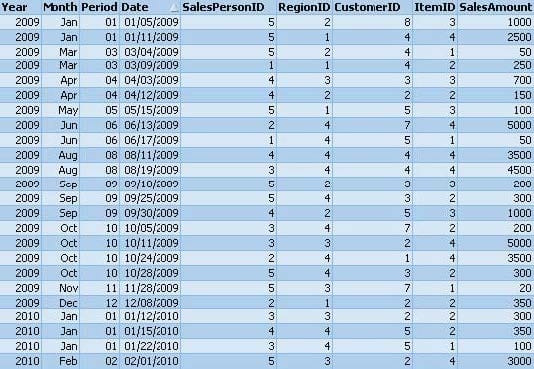
The sales table displayed in the exhibit represents the entire data set. Given the expression. =sum(Given the expression.=sum( {$< Month={'Oct'}, RegionlD={'4'} >} salesAmount)
What is the result with the selections for salesPersonlD=1 and RegionlD=3?
A. 0
B. 3500
C. 4500
D. 5000
A customer who operates a large national sales organization needs to divide a sales.qvw document into
region- specificdocumentsusingtheRegionfield(North, South, East, andWest).
Each region should have access to region-specific data.
Which instruction should a developer give to the server/Publisher administrator to meet the customer's
needs?
A. create a QlikView server task to reduce the sales.qvw document based on the Region field and distribute to region- specific folders with appropriate file permissions
B. create a QlikView Publisher task to reduce the sales.qvw document based on the Region field and distribute to region-specific folders with appropriate file permissions
C. create four QlikView server tasks to reload data from the sales.qvw document with data only for each region and distributetoregion-specificfolderswith appropriatefilepermissions
D. create a QlikView Publisher task to reduce data from the sales.qvw document to create four QVX files with data only for each region and distribute to region-specific folders with appropriate file permissions